

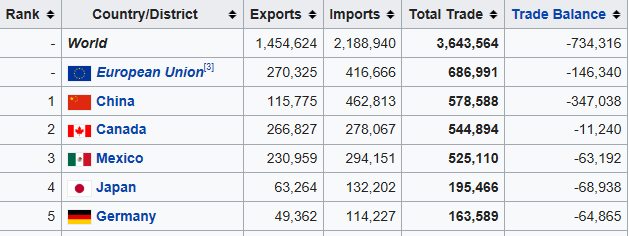
U.S. international economic policy entered into a new aggressive phase last week. Initially, the Treasury Secretary, Steven Mnuchin, called for a weaker U.S. dollar as a major tool to reduce the U.S. trade deficit. Then, the U.S. Administration introduced new tariffs on solar panels and washing machines. U.S. Secretary of Commerce, Wilbur Ross, raised the prospects of a trade war when he warned that “the U.S. troops are now coming to the ramparts”. Government officials have put U.S. trading partners on notice that this is just the start of protectionist policies aimed at the U.S. trade deficit. We can expect further unilateral actions by the United States, especially against Chinese imports. The United States runs a total trade deficit of $750b, the largest deficit being with China ($347b), followed by the EU ($146b), Japan ($68b), Mexico ($63b) and Canada ($11b).
Figure 1 US Trade Data 2016
Trump's international economic policy fails to understand how trade deficits and capital flows are part of a nation’s balance sheet. A first-year university student of international economics knows that a policy affecting one side of the accounting ledger (trade flows) will have an opposite effect on the other side of the accounting ledger (investment flows) in order to bring the overall balance to zero. Just as double entry booking principles apply to corporate balance sheets, so does it apply to a nation’s balance sheet.
To begin with, the United States runs trade deficits with nearly 100 countries because it consumes more than it produces. Its major trading partners, especially in the EU and Asia, consume much less than they produce, offering their surplus production to the U.S. consumers. The United States, in turn, pays for its net imports with U.S. dollars which its trading partners willingly use to purchase U.S. government securities. Nearly half of the U.S. government debt is owned by China and Japan. Trade deficits are financed with capital inflows such that the overall international balance remains at zero.
Global capital flows are enormous and are dictated by the decision of millions of investors in every corner of the world. So, interfering with trade flows, such as dollar devaluation or the introduction of tariffs, have an impact upon investment flows. Since U.S. capital markets are so extensive and so highly liquid, countries running a trade surplus are able to channel their excess savings into U.S. assets.
The United States has provided assets for most of the excess savings in Asia and Europe. Money continues to pour into the United States from sovereign nations and from American businesses operating overseas. This inflow forces the U.S. capital account to go into surplus. From a balance sheet perspective, the United States has no choice but to run trade deficits worldwide to absorb this excess savings.
Ironically, Trump’s statement at Davos that the United States is “open for business” is a call for more foreign investment which would only make the trade deficit greater. How is this so? A rise in capital inflows leads to greater business capital investment, greater growth and employment, and, most importantly in this context, a stronger dollar. The stronger dollar, in the final analysis, will dampen exports and encourage imports---- i.e. widen the trade deficit.
If the United States wants to reduce its trade deficit it must go about in a completely different fashion. First, it must promote an increase in domestic savings. U.S. national savings rate is near record lows at less than 3%, and this leaves the country without the ability to finance fully the Federal government deficit. Second, it must resist protectionist policies, since anything that harms the economies of its major trading partners will reduce the amount of savings that flow into the United States to finance its trade deficit. Finally, it must deal with its domestic government deficits to reduce its reliance on the “kindness of strangers” to finance the twin deficits.[1]
[1] The Fallacy Of “America First” Trade Policy


Comments
Log in or sign up to join the conversation.