

The March data in Hungary brought positive vibes, with both industry and retail delivering upside surprises, even if several one‑off factors were also at play. As a result, while we may not be the loudest cheerleaders for Team Hungary, the improvement is real and the mood has clearly turned brighter.
The Hungarian Central Statistical Office has released March data on retail sales and industrial production, following the publication of first-quarter GDP growth. Even against this backdrop, the latest figures still managed to raise eyebrows – this time in a clearly positive way. While we argued a month ago that Hungary’s positive economic momentum had faded, the March data suggests that February was more likely an outlier and that the economy has returned to a more favourable trajectory.
Broad-based recovery in Hungarian industry in March
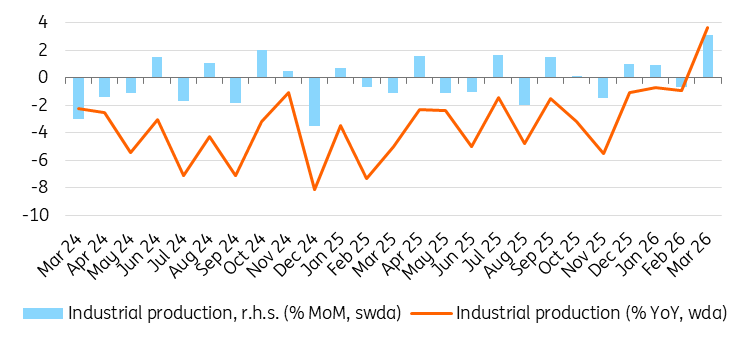
After a weak February, Hungarian industry found its footing again and managed to post meaningful growth in March. What's more, the latest data delivered one of the most positive surprises seen in recent years. The strong March performance had already been signalled by the first-quarter GDP release, in which the HCSO highlighted industry as a positive contributor to overall economic growth.
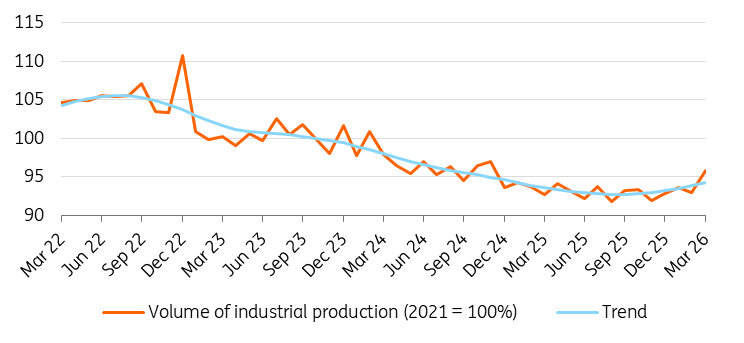
In numerical terms, industrial output increased sharply on a monthly basis at 3.1%, while the working-day-adjusted year-on-year index also jumped to 3.7%. As a result, three out of the past four months have now seen growth, which is clearly visible in the fixed-base index as well. Following the trough reached in November 2025, a more sustained upward trend appears to be emerging. That said, industrial output still remains 4.1% below its 2021 average level.
Volume of industrial production
Source: HCSO, ING
How long this positive momentum can be maintained will depend largely on external factors, most notably developments related to the war in the Middle East, the risk of a prolonged blockade of the Strait of Hormuz, and the resulting shocks to energy markets and global supply chains.
As this was a preliminary release, the HCSO provided only limited details. Nevertheless, even the brief commentary points to an important development. Production increased on a year-on-year basis across the majority of manufacturing subsectors. One has to go back quite far in the industrial flash releases to find a similar statement. Crucially, all major-weight subsectors managed to expand.
Performance of Hungarian industry
Source: HCSO, ING
Among these, electronics manufacturing once again stood out as a strong performer. This time, however, it was joined by the production of electrical equipment, the food industry and, to a lesser extent, vehicle manufacturing. In other words, the recovery was not driven by a single sector coming back online, but rather reflects a broadly improving trend across manufacturing.
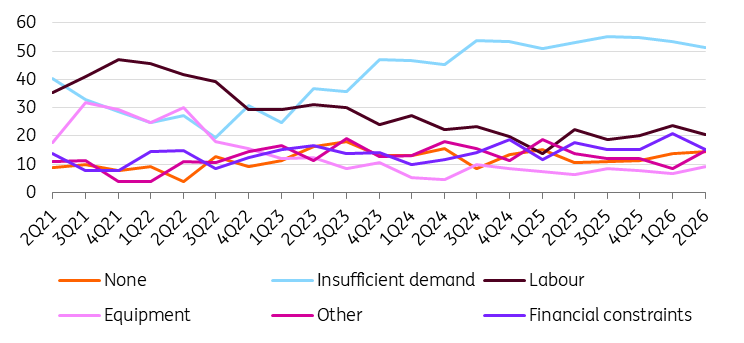
This picture is also consistent with the latest business survey published at the end of April, according to which, capacity utilisation in Hungarian manufacturing rose to 76.9% in the second quarter (seasonally adjusted), its highest level since early 2023. Similarly encouraging is the fact that, over recent quarters, the share of companies citing insufficient demand as a constraint on growth has been gradually but steadily declining. However, we are not out of the woods yet, as roughly every second company still reports demand shortages, leaving ample room for further improvement.
Factors limiting production in Hungarian industry (% of respondents)
Source: Eurostat, ING
Taking all this into account, and assuming that new export capacities coming on stream this year continue to ramp up as expected, there is room for cautious optimism regarding a more durable recovery. Under favourable conditions, the fixed-base index could exceed the monthly average level of 2021 by the end of this year. As a result, Hungary’s industrial output could grow by around 4–5% on average in 2026.
After three years of industrial recession, industry could once again make a positive contribution to the overall performance of the Hungarian economy – provided, of course, that these improving prospects are not derailed by a prolonged disruption in the Strait of Hormuz.
A strong but partly one‑off rebound in Hungarian retail sales in March
Just like industrial production, Hungarian retail sales also delivered a much stronger-than-expected performance in March 2026. Retail turnover rose by 1.9% on a month-on-month basis, marking the eighth consecutive month of expansion. In year-on-year terms, the calendar-adjusted increase of 8.2% points to a pace of growth not seen in quite some time.
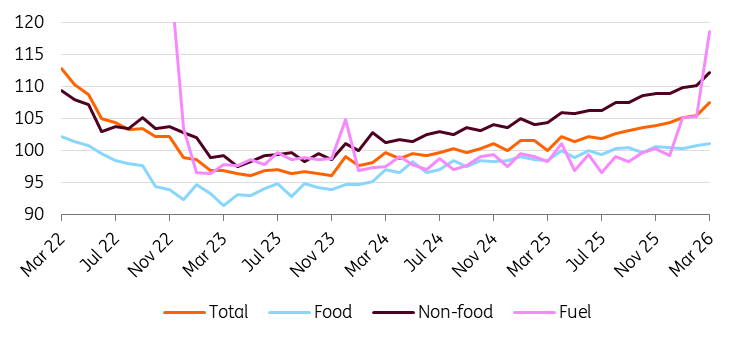
Looking at longer-term trends, retail sales volumes in March were already 7.6% above their average monthly level in 2021. This suggests that the sector has been expanding on a sustained basis, with the upward trend in place since late 2023. At the same time, performance has gradually started to close in on the peak levels recorded in 2022.
Retail sales volume in detail (2021 = 100%)
Source: HCSO, ING
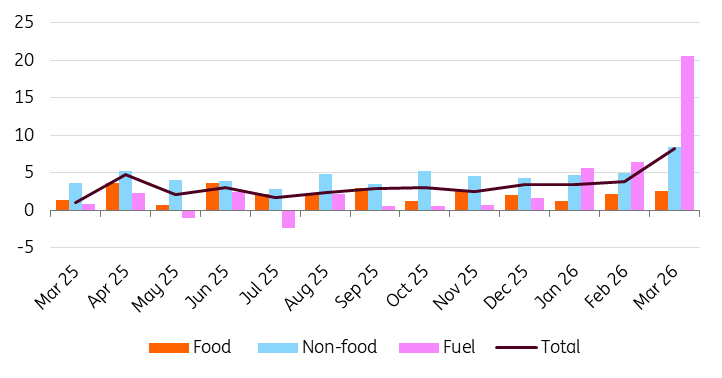
A closer look at the breakdown reveals that food retail sales posted only modest growth on a monthly basis. The source of the strong March performance should therefore be sought elsewhere, namely in non-food retail categories. Activity in this segment increased markedly, with turnover showing a strong monthly expansion at 1.9%. Comparable single-month increases were last seen at the turn of 2023–2024.
Online and mail-order retail sales rose sharply, while stores selling IT equipment and other consumer durables also reported an exceptionally strong March. In addition, clothing retailers as well as furniture and electrical goods stores recorded significant increases in turnover. This clear split between food and non-food retail highlights the underlying driver of growth: government transfers paid out to households were largely channelled into consumption, primarily supporting higher-value purchases.
Fuel sales also increased strongly compared to the previous month, which may reflect the impact of regulated fuel prices. Taken together, the composition of growth points to the importance of specific, short-term factors in boosting retail activity in March.
Breakdown of retail sales (% YoY, wda)
Source: HCSO, ING
In our view, therefore, the exceptionally strong performance of Hungarian retail sales in March was driven primarily by one-off, temporary effects. As a result, we remain cautious regarding the sustainability of this pace of growth. That said, improving consumer confidence, the still favourable inflation environment and robust wage growth could collectively provide a more durable underpinning for retail sales going forward.
Looking at 2026 as a whole, retail turnover could expand by around 6.0–6.5%, even if monthly dynamics moderate from the March peak. These developments reinforce the idea that consumption is likely to be the main driver of economic growth this year, while the key question for the remainder of 2026 remains whether industry, exports and investment can also move onto a more sustainable recovery path.



Comments
Log in or sign up to join the conversation.