


This was expected to be the year of the global economic slowdown. But the year-to-date synchronized rally in global equities has stolen the spotlight.
Chinese equities have been the star performer so far. The MSCI China Index (MXCN) returned 17.69% in the first quarter of 2019, marking the strongest quarter of performance in almost 10 years.1
The year-to-date performance of the WisdomTree China ex-State-Owned Enterprises Index (CHXSOE) has been even stronger than MXCN’s. CHXSOE returned 26.60% in the first quarter of 2019, delivering 891 basis points (bps) of outperformance over MXCN.
A significant source of CHXSOE’s outperformance was the exclusion of companies owned or influenced by the government. CHXSOE invests only in non-state-owned enterprises (non-SOEs), which are defined as companies with less than 20% government ownership.
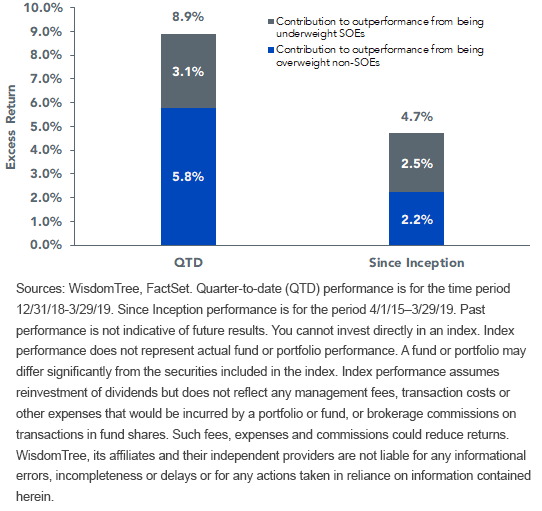
The quarter-to-date and since-inception outperformance of CHXSOE versus MXCN (figure 1) confirms the intuition that non-SOEs are less constrained by the government’s agenda. Thus, they’re better able to drive operational efficiencies in alignment with maximizing shareholder return.
Figure 1: CHXSOE Outperformance vs. MSCI China Index
Dissecting CHXSOE’s excess return in the most recent quarter, we find that the Financials sector has been the greatest contributor to outperformance by a significant margin (figure 2). The Financials sector added 305 bps of outperformance and accounted for about a third of CHXSOE’s excess return in the first quarter of 2019. For context, the added return from the Financials sector was equal to the combined contribution from the next top-three ranking sectors: Consumer Discretionary (+108 bps), Information Technology (+105 bps) and Health Care (+92 bps).
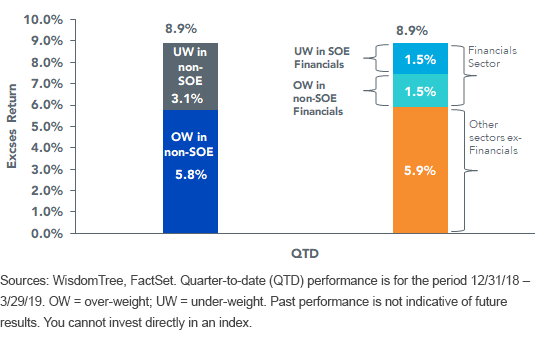
Getting more granular, the contributions from being under-weight in SOE financial companies (+148 bps) and over-weight in their non-SOE competitors (+153 bps) were roughly equal in the first quarter of 2019.
More than half of MXCN’s allocation to the Financials sector is concentrated in the Big Four state-owned banks: Industrial and Commercial Bank of China, China Construction Bank, Agricultural Bank of China and the Bank of China.2 The exclusion of these Big Four banks added 170 bps to CHXSOE’s excess return in the first quarter of 2019.
The majority of CHXSOE’s allocation to Financials is held in Ping An Insurance Company of China and its subsidiary Ping An Bank, which altogether contributed 133 bps of outperformance in the first quarter of 2019.
Comparing the fundamentals of Ping An Bank and Ping An Insurance to the average of the Big Four helps explain CHXSOE’s recent outperformance (figure 3).3
Ping An Bank has driven greater deposit and loan growth, and it has a steeper net interest margin than the SOE-bank average over the last five years. Ping An Bank’s relative strength has benefited its parent company, Ping An Insurance. The insurer has delivered a higher return on equity than the Big Four average, with a similar level of leverage and greater balance sheet growth.
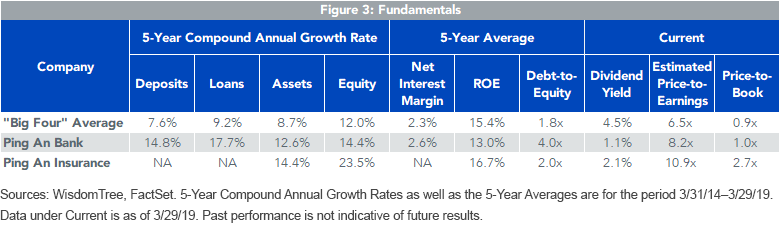
For definitions of terms in the chart, please visit our glossary.
For investors who prefer to limit their exposure to state-owned-enterprises, the WisdomTree China ex-State-Owned Enterprises Fund (CXSE) could be a well-suited investment.
1Sources: WisdomTree, Bloomberg, as of 3/31/19.
2As of 5/1/19, the WisdomTree China ex-State-Owned Enterprises Fund does not hold Industrial and Commercial Bank of China, China Construction Bank, Agricultural Bank of China or the Bank of China
3As of 5/1/19, the WisdomTree China ex-State-Owned Enterprises Fund held 9.4% and 1.0% of its total weight in Ping An Insurance Company of China and Ping An Bank, respectively.



Comments
Log in or sign up to join the conversation.