

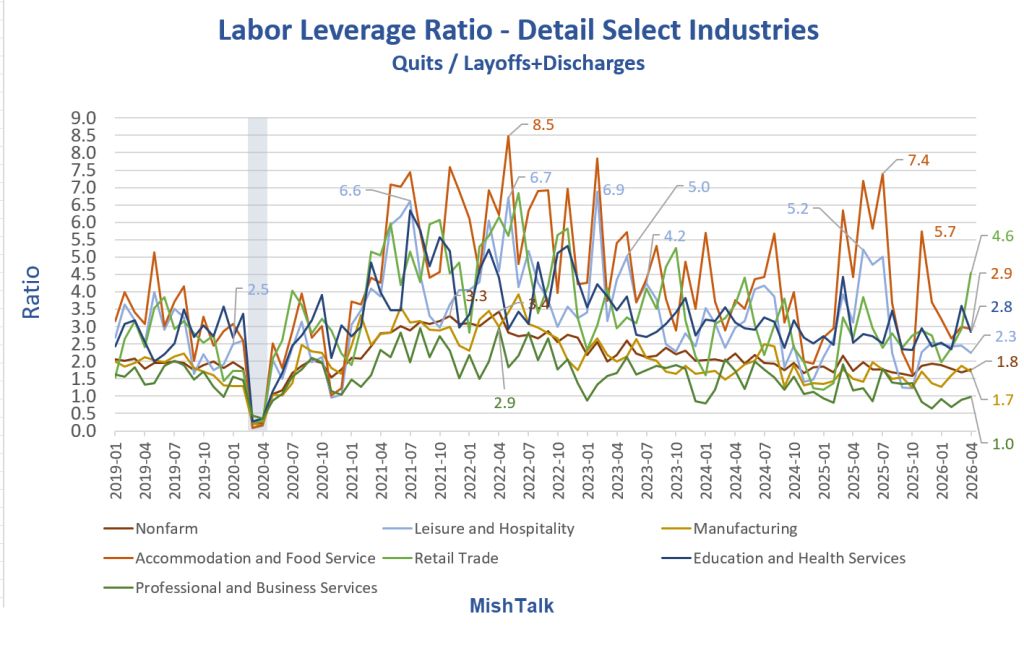
Labor Leverage Ratio
The Labor Leverage Ratio (LLR) is the number of quits divided by the number of discharges, firings, and layoffs initiated by employers.
The series comes from the BLS Job Openings and Labor Turnover Summary. Unlike openings, quits and layoffs are relatively hard data.
The BLS comments “the quits rate can serve as a measure of workers’ willingness or ability to leave jobs.”
The Labor Leverage Ratio is a refinement to the quits rate.
Labor Leverage Ratios by BLS Category
Nonfarm: 1.76
Private: 1.72
Leisure and Hospitality: 2.25
Construction: 1.57
Durable Goods: 1.71
Manufacturing: 1.69
Accommodation and Food Service: 2.93
Retail Trade: 4.55
Education and Health Services: 2.85
Professional and Business Services: 0.98
No sector is harder hit than Professional and Business Services. This is the sector AI is hitting the hardest.
The higher the number, the easier it is for workers to quit and find another job, and the harder it is for employers to retain employees.
According to the U.S. Bureau of Labor Statistics (BLS), Leisure and Hospitality is a broad “supersector”. Accommodation and Food Services is a narrower sector that lives inside it.
Rising Wage Pressures
Leisure and Hospitality
Accommodation and Food Services
Retail Trade
Education and Health Services
Those industries will either raise prices, lose profit margins, lose employees, or some combination of those.
Losing employees is not a great option, so, most businesses will raise prices or suffer from shrinking profit margins.
Raising prices has it own set of issues, mainly falling consumer demand.
Labor Leverage Ratios Select Services and Months
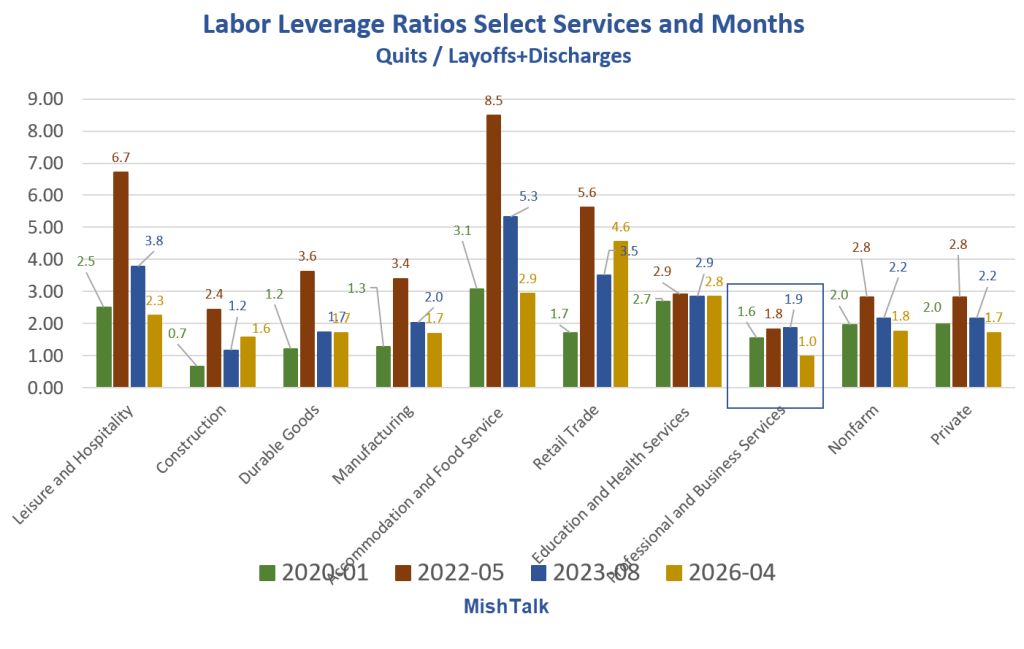
Labor Leverage Ratios generally peaked in May of 2022.
Labor Leverage Ratio – Detail Four Industries
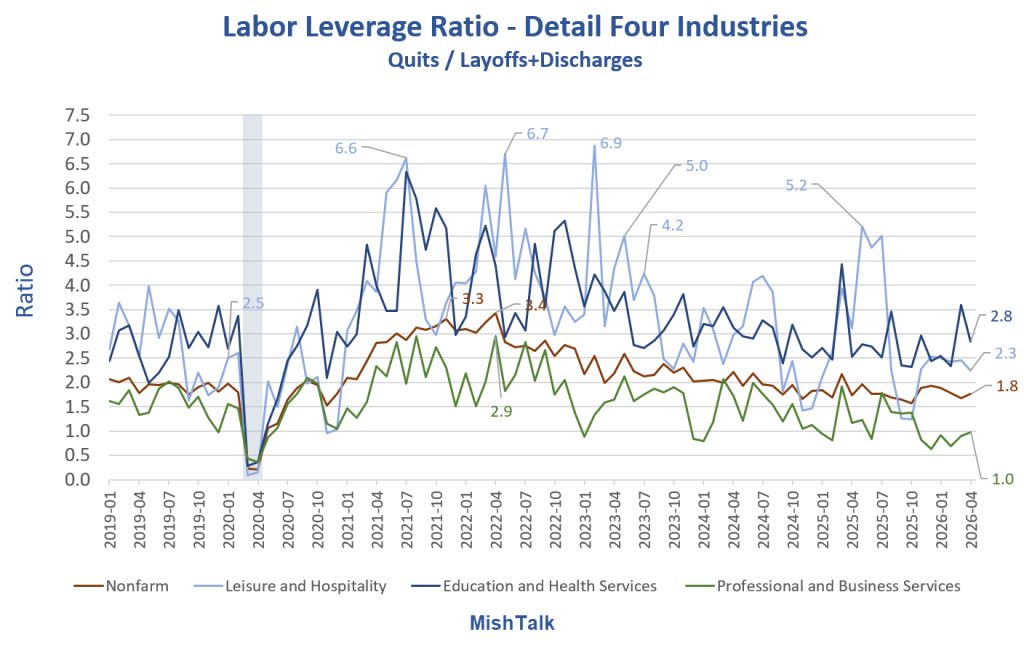
The above chart puts a key spotlight on the jobs AI is killing.
If you lose your job in this sector, your next one may be Leisure and Hospitality.
Meanwhile, there is upward pressure on the price of food, especially eating out, as restaurants need to raise prices to keep up with higher staffing costs.
The same applies to hotels. And airlines are raising prices to accommodate rising jet fuel prices.
All of this is tempered by falling demand and cutting corners by consumers who are cash strapped.
AI Decimates Careers that Were Once a Sure Path to Middle Class
On May 27, 2026, I noted AI Decimates Careers that Were Once a Sure Path to Middle Class
Say goodbye to most customer service jobs.
The labor turnover data confirms the story. Click for more details.
Related Posts
May 26, 2026: Consumer Credit Stress Is Comparable to the Great Recession
Auto delinquencies are at a new record and credit cards are near record high.
May 28, 2026: Inflation Expectations Surge in Two Distinct Consumer Confidence Surveys
57% of consumers say high prices are eroding their personal finances.
May 28, 2026: PCE Inflation Spikes Again, Year-Over-Year Highest Since May 2023
Year-over-year PCE inflation jumped to 3.8 percent. The Fed wants 2.0 percent.

Comments
Log in or sign up to join the conversation.