How Birkenstock Managed Its Private Equity Problem

Birkenstock is cushioning its private equity overhang by redeeming half of a $1 billion secondary offering.

Public companies backed by private equity often carry a hidden tax known as the sponsor overhang. When the sponsor wants to cash out, a large block of existing shares can hit the open market. That sudden increase in tradable supply can pressure the stock price. Birkenstock (BIRK) just laid out how a company can cushion that blow by stepping in as a buyer. The maneuver addresses an immediate supply problem, but it comes with a quiet cost to the balance sheet.

Main Note

Managing the Private Equity Overhang

Birkenstock Holding (BIRK) Quote

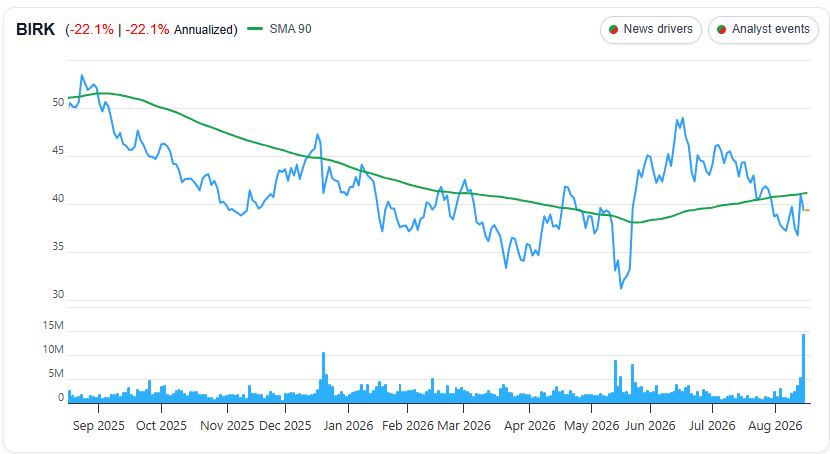
Verdict: Birkenstock structured the sale so half of the base block is expected to move into public hands, while the company redeems and cancels the other half. That limited the immediate increase in public float, but it did not stop the stock from falling about 4% on Friday to the $39.35 offering price. The move reduces the share count, but it swaps part of the sponsor overhang for more balance sheet risk at a time when retail spending is under heavy scrutiny.

What happened

Late last week, private equity sponsor L Catterton priced a roughly $1 billion secondary offering of 25.5 million existing shares at a public offering price of $39.35. The offering is expected to close today, subject to customary conditions. Birkenstock is not issuing new shares and will not receive any of the sale proceeds.

Birkenstock ran interference. Subject to closing, the company agreed to redeem and cancel 12.8 million of those shares at $39.18 each, the amount L Catterton receives after the underwriting discount. That leaves 12.8 million shares from the base offering for public investors, while Birkenstock’s outstanding share count falls by roughly 7%.

Birkenstock Holding (BIRK) 1 Year Chart

Birkenstock Holding (BIRK) 1 Year Chart

Why it matters

This changes the mechanical supply and demand equation for the stock. When a major backer wants to exit, the market typically demands a discount to absorb the incoming block. Birkenstock is using cash on hand, including proceeds from the €900 million debt deal completed in June, to remove about 7% of its outstanding shares. That should help per share results, but a buyback only creates value if the shares are worth more than the $39.18 paid and the added balance sheet risk does not offset the benefit.

What changed in the thesis

The math shifts toward evaluating a more leveraged balance sheet. Birkenstock ended June with €694 million of cash and €1.69 billion of debt, then repaid €80 million on its revolving credit line in July. The company says the $500 million redemption will be funded with cash that includes proceeds from the €900 million notes issued in June. If consumer demand holds up, this can still look like smart capital allocation. If spending slows, the company has less financial flexibility to weather a downturn.

What the market may be missing

The odd part is that this move does not eliminate the private equity problem. After the offering and redemption, L Catterton is expected to still own 44.75% of the company, or 42.43% if J.P. Morgan (JPM) buys every optional share. That keeps the sponsor above the 40% threshold tied to written consent and director removal rules. Another sale remains possible, but there is no public timetable and it is not guaranteed to happen later this year or next.

Valuation and expectations

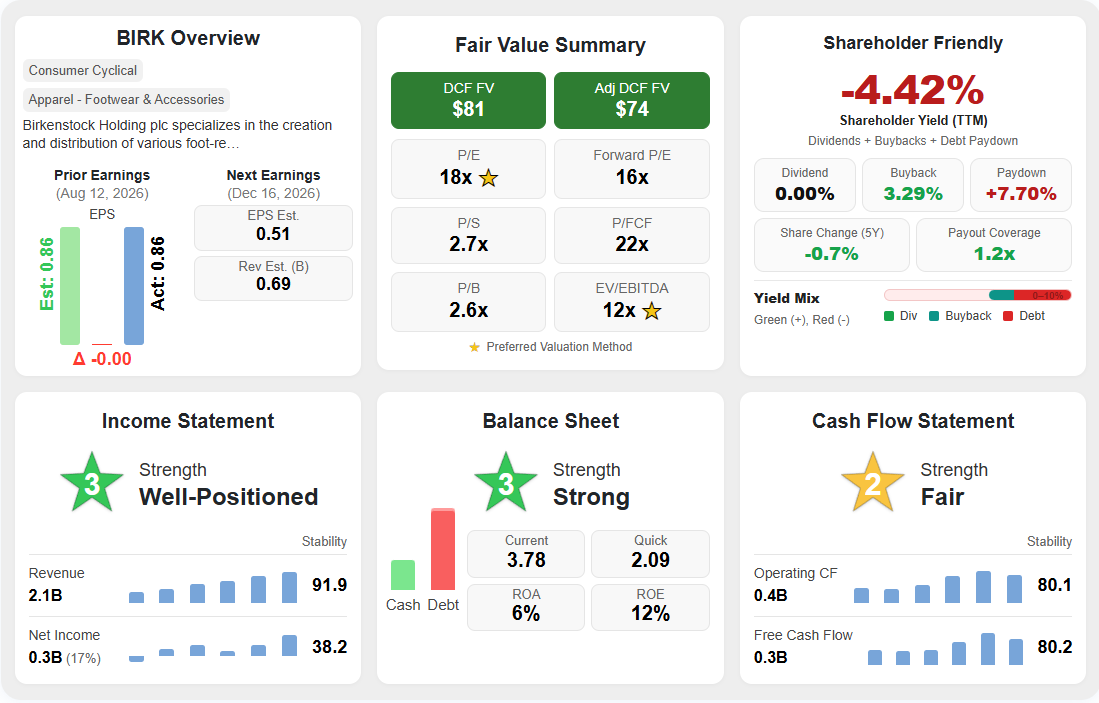
The core debate shifts from share supply back to fundamental earnings power. At Friday’s $39.35 close, the stock traded at roughly 16.5 to 17.8 times Birkenstock’s fiscal 2026 adjusted EPS guidance using an exchange rate near $1.16 per euro. The company raised its constant currency revenue growth outlook to 15%, but adjusted gross margin already fell 130 basis points, including a 70 basis point hit from higher US tariffs. That is not an obvious bargain, so the buyback only creates real value if earnings keep compounding fast enough to justify the added leverage.

Birkenstock Holding (BIRK) Summary Scores

Birkenstock Holding (BIRK) Summary Scores

Bottom line

Using corporate cash to absorb part of a private equity exit is a luxury move. It can work brilliantly when business is booming. It leaves the company with less room for error if the footwear cycle turns down.

Pre Market Pulse

  • US equity futures traded slightly mixed early Monday. S&P 500 futures edged higher, Nasdaq 100 futures gained about 0.5%, and Dow futures slipped about 0.1%.

  • The broader market focus is shifting toward Home Depot (HD) earnings Tuesday, Target (TGT) and Lowe’s (LOW) Wednesday, Walmart (WMT) Thursday, and the Fed’s July meeting minutes Wednesday afternoon.

  • European equities edged higher, while softer US retail sales and consumer sentiment pulled the dollar and Treasury yields lower.

Why it matters this morning

Retail sales fell 0.6% in July but remained 5.0% above a year earlier, while preliminary consumer sentiment dropped to 51.0 in August. That makes this week’s retail earnings more important, but one soft month does not prove the consumer is breaking. It simply raises the bar for companies using cash raised through debt to repurchase shares.

Peer Read Through

Deckers (DECK)

The parent company of Hoka and Ugg operates with massive cash flow and a pristine balance sheet, making it the benchmark for financial flexibility in footwear.

Crocs (CROX)

A clear example of how debt taken on for acquisitions or buybacks can weigh on valuation multiples even when core brand momentum remains decent.

On Holding (ONON)

Another premium running and lifestyle brand that relies heavily on direct to consumer sales to maintain its high gross margins.

Group takeaway

The broader footwear industry is splitting between companies with bulletproof balance sheets and those stretching their leverage to solve structural problems or chase growth. Markets are increasingly paying a premium for clean capital structures.

What to Watch

  • The expected close of the offering today, subject to customary conditions, and whether J.P. Morgan exercises its 30 day option for up to 3.8 million additional shares.

  • Direct to consumer sales growth to confirm the brand is not losing momentum in key markets like the Americas and Asia Pacific.

  • Gross margin trends in the fourth quarter to see whether the 70 basis point tariff hit reported in the third quarter gets better or worse.

  • Progress on the 15% constant currency revenue growth target.

Bottom line

The sponsor overhang is the mechanical story. The actual business fundamentals will dictate whether redeeming these shares at $39.18 was a smart use of capital.

STOCKS IN THIS ARTICLE

Also Mentions:

Comments