


Ticker: HONA
Price: $169.4 (at time of writing, Aug 13/26)
In The Matrix, Cypher cuts into a steak he knows is not real. He tells Agent Smith that ignorance is bliss and takes the deal anyway, betraying his crew. Honeywell (HON) Aerospace investors got the same offer this summer. They bought the spinoff on management’s guidance, and for five weeks the steak tasted fine. Then came the first earnings call, and investors got a rude awakening as the stock cratered 23%, the biggest drop in its short history.
Honeywell used to make everything from the thermostat on your wall to the engines that help us fly. However, the conglomerate decided to break the company into three independent companies, one of which became Honeywell Aerospace, or HONA. In this article, I will cover the company, the latest earnings fiasco, valuation compared to its peers, and whether the steak will ever become juicy again.
Company
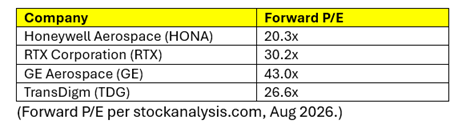
Honeywell Aerospace spun out of Honeywell in June 2026, with the original company focused on automation. It is a key pillar in the aerospace and defense industrial complex, with the company providing avionics, navigation, engines, power and thermal systems, along with auxiliary power units. The company has a 60/40 mix of commercial and defense revenue, with commercial aftermarket sales being one of its main value drivers. The company reports through three segments: 1) Engines & Power Systems, 2) Electronic Solutions, and 3) Control Systems. According to the company’s latest investor presentation, approximately 90% of global aircraft use at least one Honeywell avionics or navigation product, showcasing a substantial moat in the aerospace industry. At the time of writing, the stock is trading at $169.4 with a market capitalization of $53.7 billion and a forward P/E of 20.3x. With such a moat and deep integration in the aerospace sector, why is the company trading at a lower multiple than its peers? The answer lies in the disastrous earnings call and management’s expectations.
The Fall from grace – Q2 Earnings
Honeywell Aerospace recently reported Q2 earnings, and it was a disaster, with the company missing both top- and bottom-line estimates. Revenue came in at $4.522 billion, an estimated 1.9% below expectations, adjusted EPS came in at $1.87, down 32% year over year and below the roughly $2.12 Wall Street estimate. That said, the backlog grew to $18.15 billion, and TTM orders, up around 8%, did show strong appetite and demand for products. However, management completely fumbled the first earnings call, because the data presented to investors on Investor Day did not highlight any significant challenges.
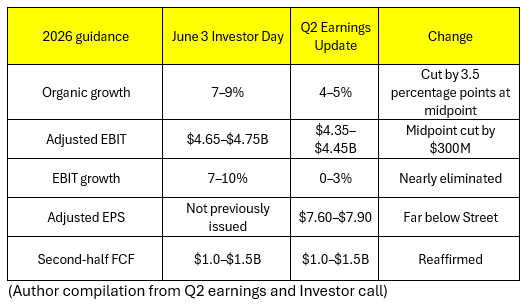
Management blamed supply chain bottlenecks as the main issue for the downward guidance; however, not noticing these bottlenecks just a month before earnings casts doubt on whether management was asleep at the wheel. The company said that expected improvements on supply-side bottlenecks were overestimated and did not materialize in time to achieve the desired results.
Segment-wise results showed growth in the Electronic Solutions segment, which encompasses the avionics moat, with a healthy margin but EBIT growth down 3%, while Control Systems produced the most efficient margin at 29%, with EBIT growth up 8%. However, the Engines & Power Systems segment was a disaster for the company, with EBIT growth down 32%, only a low-teens margin, and almost flat revenue growth of 1%.
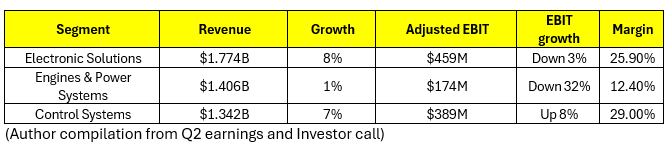
The Engines segment should have been the company’s growth driver, given healthy demand in business jet orders and commercial OEM systems; however, flat growth due to supply chain issues and management’s inefficiency in resolving bottlenecks significantly hurt operational efficiency and overall results.
Given this operational reset, the real question for current and future investors is whether HONA’s current share price reflects a discount that is deserved or one that is overdone.
Valuation and Risks
Honeywell now trades at a forward P/E of roughly 20.3x — a real discount compared to its closest peers. The company is trading at close to a 25–50% discount to its peers, with the market believing that the company has structural headwinds that are not going to be easily fixed.
I disagree with that assessment. Based on the cash flow and financial metrics, the company has a backlog growing 9% YoY to $18.15 billion. The moat in its Electronic Solutions segment is intact, with EBIT margin in the mid-20s. The company also left its FCF guidance for the second half of the year unchanged at $1.0–1.5 billion, indicating that management expects modest growth, which should support the share price. However, since management’s credibility has already been tested, I would take this figure with a pinch of salt. That said, the Street’s caution about re-rating the stock is understandable — the company carries $15.85 billion in gross debt against roughly $1 billion in cash and equivalents. The major source of that debt was the $15.1 billion in cash distributed to its former parent company upon separation, highlighting that the spin-off was a debt-funded transaction. HONA’s current net debt/EBITDA is around 3.0x, which is higher than its peers, which trade in a range of below 1x to 1.7x. Also, management said it is working with and qualifying more than 100 new suppliers to reduce supply-chain bottlenecks and increase throughput, with 70% of new capex going toward supporting suppliers with the tooling required for castings. The effect of the casting bottleneck was visible in the financial metrics for Engines & Power Systems, where most components are made from cast material. However, as someone who has worked in the aerospace industry for more than a decade, my personal experience tells me that getting production-ready is a difficult task, especially when complex manufacturing is involved. Any new supplier will require tooling, production ramp-up, and appropriate quality control, which requires sharing costs with the customer — in this case, Honeywell. As such, management outlined that capex would rise 9% YoY to approximately $650 million to support these production initiatives. All this shows that even though the company is trading below the market multiple, it deserves this price range given the uncertainty in its future debt and cash-flow metrics.
Takeaway
Honeywell Aerospace is one of the industry leaders in Aerospace and Defense. The company, having just been spun out of its parent, is finding its feet — managing investor expectations while dealing with inherent supply-chain concerns. However, showing a rosy picture to potential investors on Investor Day and then pulling the rug out from under them has left a bad taste on Wall Street. The company does have a significant backlog, and customers are showing trust in it, but converting that backlog into cash will be key going into the next earnings call and beyond. Management has decided to serve me a steak I’m not fully confident is cooked right — but I’m taking a small bite rather than sending the whole plate back, and I’ll decide whether to order more after Q3 earnings.



Comments
Log in or sign up to join the conversation.