

Yields are rising as the bond market sells off, and the Federal Reserve just hiked interest rates. Anticipating a high interest rate environment in the months ahead, many people are selling gold and silver.
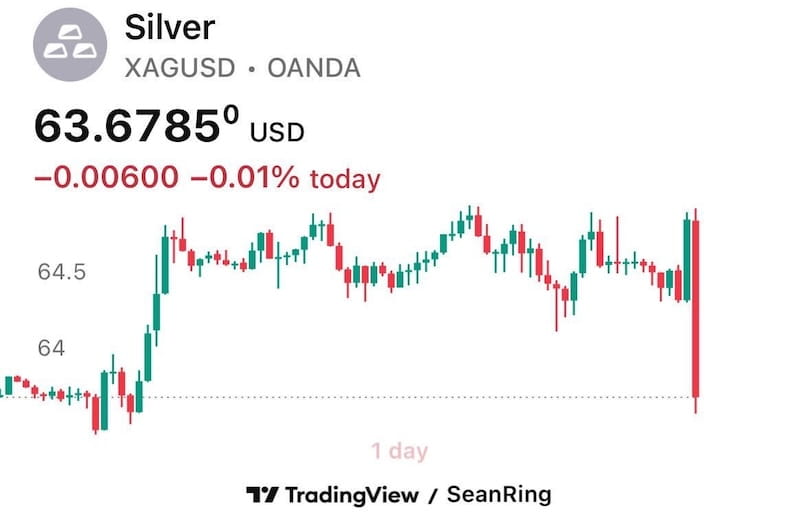
You can see the dip on this silver chart after the Fed announced its rate hike on September 16.
But should investors sell gold and silver just because interest rates are going up?
Conventional wisdom holds that because they are non-yielding assets, gold and silver become less attractive in a high interest rate environment and tend to face significant price headwinds. However, conventional wisdom isn’t always wise.
A higher-rate environment can indeed be bearish for gold and silver, but historically, that hasn’t always been the case.
Consider the 1970s, a period that seems parallel to today, with stagflation coupled with out-of-control government spending.
As Adam Sharp, a long-time financial writer and Fed watcher for the Daily Reckoning, pointed out, “Investors who thrived did so by buying hard assets. Gold, silver, real estate, commodity producers.”
Gold rose by nearly 2,329 percent in the 1970s.
And bond yields rose at roughly the same rate.
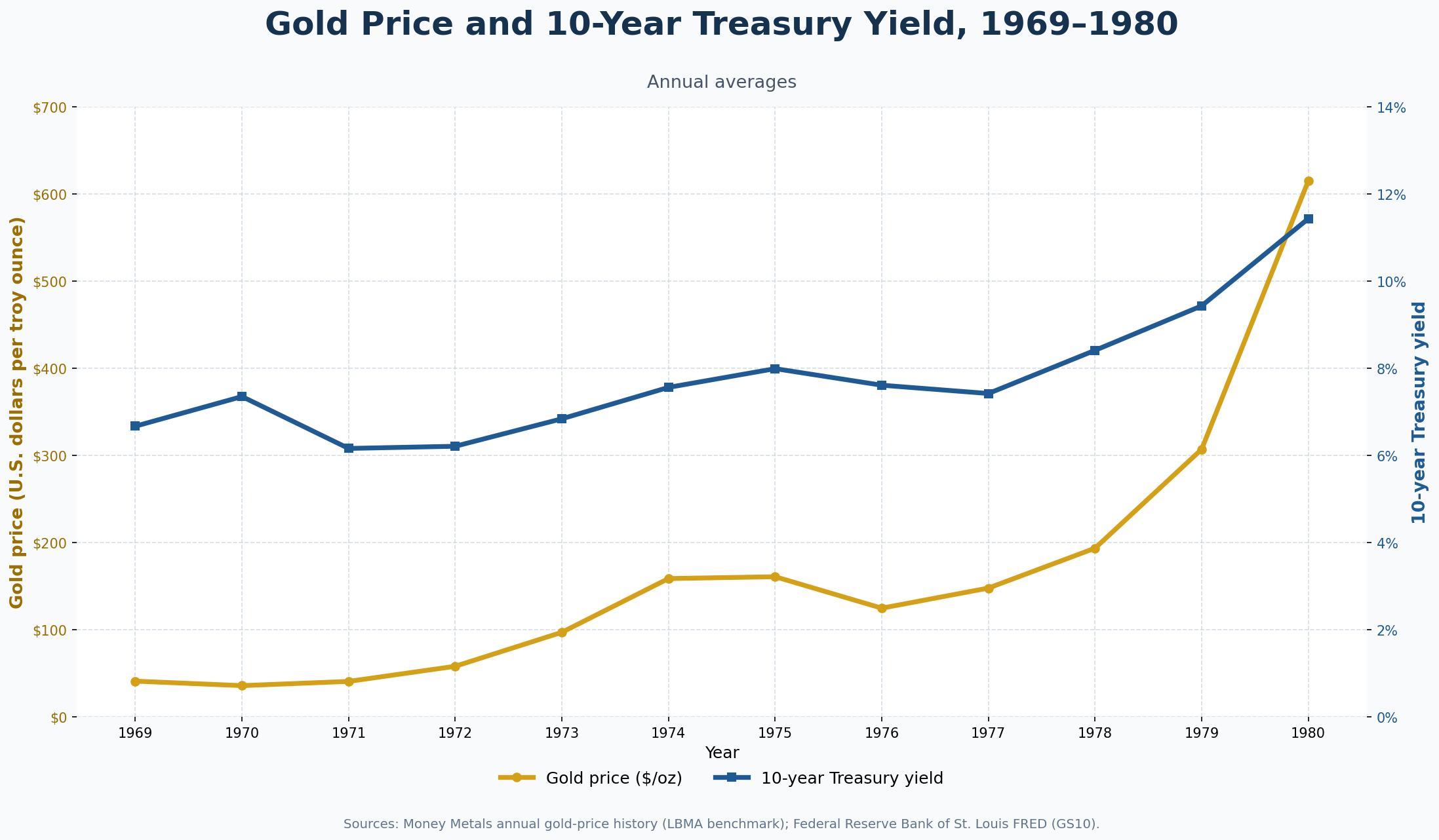
The conventional wisdom clearly broke down in the 1970s. A high interest rate environment was not bearish for gold. Interest rates and gold rose in tandem.
But why?
Because you must account for real interest rates.
What Are Real Interest Rates?
When interest rates are higher, holding gold and silver comes with an opportunity cost when you could own bonds that generate interest income or stocks that pay dividends. However, when real interest rates fall or turn negative, those income-producing alternatives lose their comparative advantage. In such an environment, the relative cost of holding precious gold and silver diminishes, making the metals more attractive as safe-haven and wealth-preservation assets.
What do we mean by “real” interest rates?
The real interest rate is simply the stated rate you hear on the news adjusted for price inflation.
To calculate the real interest rate, you take the quoted nominal rate and subtract CPI.
For example, say a 10-year Treasury bond is yielding 4 percent. That seems like a pretty good return. But if the CPI is running at 3.5 percent, the real interest rate on that bond is only 0.5 percent (4-3.5=0.5).
Note that in a low-interest-rate environment or if price inflation is particularly high, real interest rates can go negative.
If that same 10-year Treasury only yields 3 percent and CPI is 5 percent, your real interest rate is -2 percent. That means you will lose money in real terms if you buy and hold that bond (Assuming everything remains static).
Sharp broke down the numbers using the 3-month T-bill. It yielded 7.4 percent in 1974, which sounds like a pretty darn good return. However, price inflation based on the CPI peaked at 12 percent that year.
In other words, the real interest rate on the 3-month T-bill was running in the neighborhood of -4.6 percent.
Adams also noted that “from August 1976 to January 1980, gold rose more than 7x!”
Meanwhile, interest rates exploded to a peak of nearly 20 percent in the early ‘80s as Paul Volcker initiated a real war on inflation.
“Clearly, gold can thrive during periods of rising interest rates. Because when the Fed is raising rates, it’s usually due to inflation. Which drives people into gold,” Adams said.
Gold also defied conventional wisdom during the gold bull market of the 2000s. The yellow metal took off in 2004 as interest rates began to spike. Gold continued to surge after the Fed slashed rates in the wake of the 2008 financial crisis.
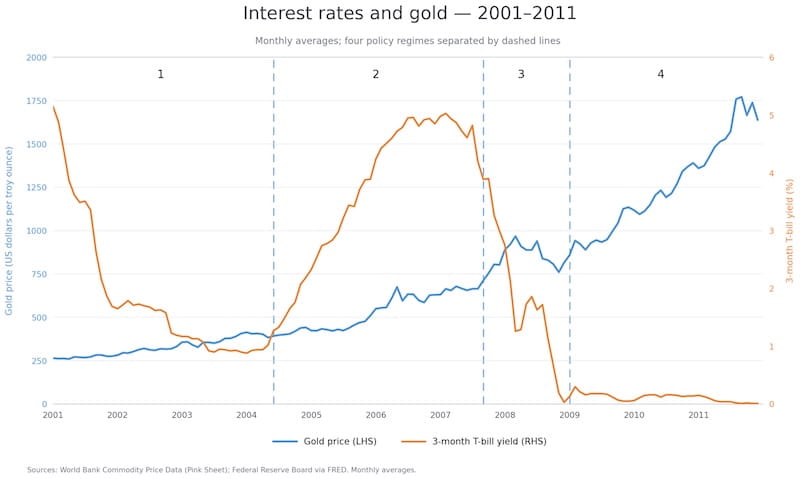
As Adams pointed out, “Gold rose steadily, almost throughout the entire period. As interest rates rose and fell, gold marched on. With a few brief dips, particularly during the global financial crisis.”
Adams is correct. It’s not as simple as “lower rates = higher gold” and “higher rates = lower gold.”
Sometimes it’s the exact opposite.
“When the Federal Reserve and other central banks raise rates, it’s almost always due to problematic inflation. The same reason people buy gold and silver. So, even if the Fed does continue to raise rates for the next few years, it’s not necessarily bad for precious metals.”
Notably, Adams agrees with me. He doesn’t think the Fed will be able to raise rates much higher because it would be “very problematic for our debt situation”
“No matter what they do from here, more inflation is coming. They can’t hike rates to the 10 percent-plus level they’d need to be to kill inflation. It’d kill our debt-bloated economy and end up making deficits soar even higher.”
The lesson here is: don’t sell your gold just because you think the Fed is going to raise rates. You might be sorry!
Comments
Log in or sign up to join the conversation.