

The consumer accounts for nearly 70% of the economy (GDP), and understanding what is driving their sentiment can provide valuable insight into future economic growth. At the moment, one variable having a direct impact on the consumer is the level of inflation working its way through the economy.
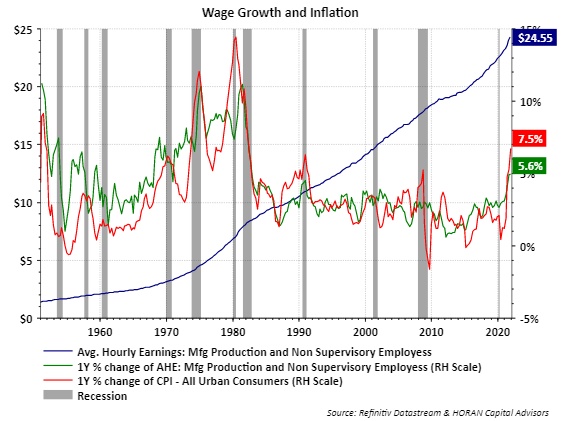
Some might believe inflation is not that bad for consumers as it enables individuals to receive higher wage increases. Higher wages is certainly a result, but this rarely fully compensates one for the increasingly higher prices. What tends to occur is the level of wage increase lags a higher growth rate of inflation, thus reducing consumers' purchasing power.
With inflation currently running at a 7.5% annual rate, it is at a level last seen in the early 1980's.
The correlation between inflation and sentiment is about minus .50. That is, higher inflation pushes down sentiment. This relationship is shown in the chart below.
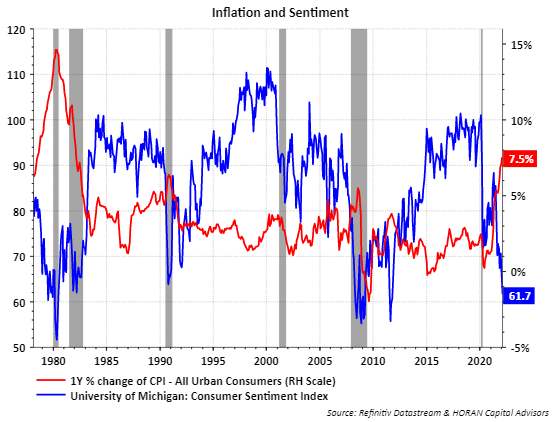
This higher level of inflation is one factor having a negative impact on consumer sentiment. According to last week's University of Michigan Consumer Sentiment Report for February, sentiment fell "a stunning 8.2% from [January's] and 19.7% from last February." Noted in the report's release were some consumer comments.
- "The impact of higher inflation on personal finances was spontaneously cited by one-third of all consumers, with nearly half of all consumers expecting declines in their inflation adjusted incomes during the year ahead."
- "Fewer households cited rising net household wealth since the pandemic low in May 2020, largely due to the falling likelihood of stock price increases in 2022."
- "The recent declines have meant that the Sentiment Index now signals the onset of a sustained downturn in consumer spending."
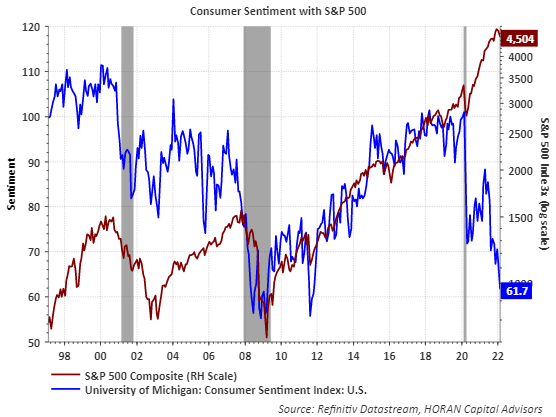
Lastly, correlation does not necessarily mean causation, but consumer's expectation around their household wealth is a factor taken from the February report. And as the chart below shows, the weaker sentiment level likely contributes to the equity market's year-to-date decline of 7.29%.
There does seem to be pockets or areas where supply chain issues are being resolved, yet other areas, like lack of some grocery store items or higher energy prices, to name a few, continue to contribute to elevated inflation.
Lastly, the Board of Governors of the Federal Reserve will hold a special meeting on Monday, Feb. 14 for "review and determination by the Board of Governors of the advance and discount rates to be charged by the Federal Reserve Banks."
In a post I wrote last month, I highlighted the fact the Fed seems to be behind the curve on rate hikes. Monday's meeting might be acknowledgement of this same fact and the desire to begin removing the punch bowl.
Comments
Log in or sign up to join the conversation.