


For more than two years, investors have boiled down U.S. monetary policy to a single indicator: the Federal Reserve’s policy rates. As long as these rates remain high, the consensus view is that monetary policy remains restrictive. Yet, week after week, this interpretation is becoming increasingly incomplete. Despite unchanged rates, several indicators show that the money supply is already beginning to grow rapidly again.
The M2 money supply reached a new all-time high of $23.155 trillion in June, up 5.6% year-over-year. Specifically, M2 measures the amount of money immediately available in the economy: paper currency, coins, checking accounts, savings accounts, and short-term deposits. It is, in a sense, the “fuel” that drives consumption, investment, and the financial markets.
The even broader M4 aggregate, meanwhile, is growing by 6.5%. It also includes deposits and cash held by businesses, financial institutions, and other economic players. In other words, not only is the money held by households continuing to grow rapidly, but liquidity throughout the entire financial system is also accelerating.
This trend is far from insignificant. As the graphic below shows, growth in the global money supply generally precedes that of the stock markets by a few months.
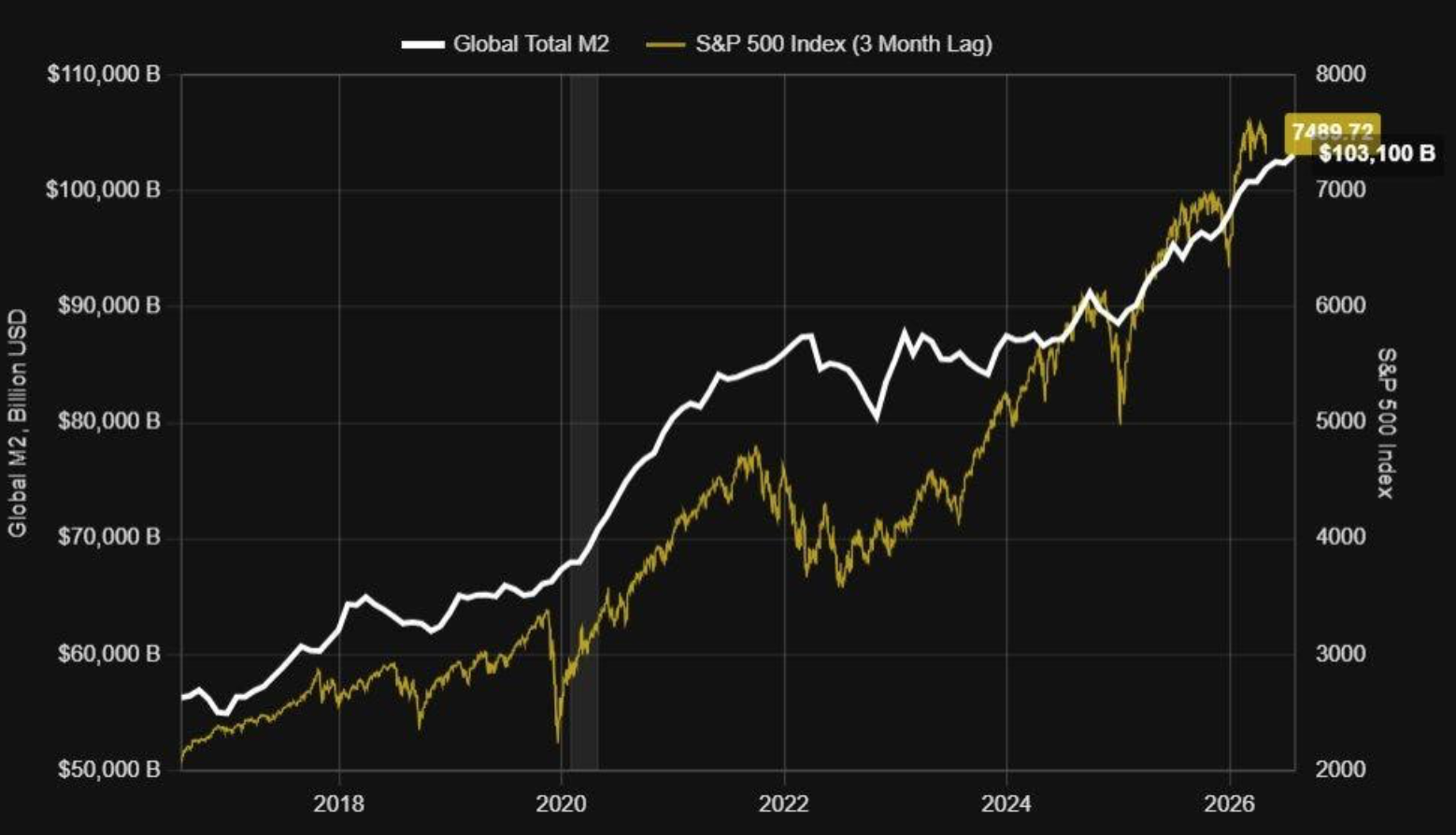
For several years now, the S&P 500 has tracked global liquidity trends remarkably well. New stock market records are therefore not driven solely by corporate earnings; they are also fueled by an ever-increasing amount of money in circulation. In other words, as long as central banks and banking systems continue to inject liquidity, financial assets benefit from strong monetary support.
This is precisely what makes the current interpretation of monetary policy misleading. Investors are focusing on the level of key interest rates and concluding that the Federal Reserve’s policy remains restrictive. Yet the amount of money available in the economy is already rising sharply. Interest rates tell one story; the money supply tells another. Over the long term, however, asset markets have often tracked the latter more closely than the former.
After several years of monetary contraction, liquidity is therefore beginning to grow again at a pace that is hardly compatible with the idea of a truly restrictive policy. This paradox is not really a paradox at all. Central banks do not merely control the price of money through interest rates; they also control its quantity. It is precisely through this second lever that the shift in policy is taking place.
This acceleration comes as no surprise when one considers the U.S. government’s financing needs. In fact, the Treasury has just raised its borrowing estimate for the July–September period to $739 billion — $68 billion more than it had anticipated just two months ago. In other words, financing needs continue to accelerate despite already very high projections. Each upward revision means more bonds to be placed on the market and increases pressure on private investors, banks, etc... and, ultimately, on the Federal Reserve itself.
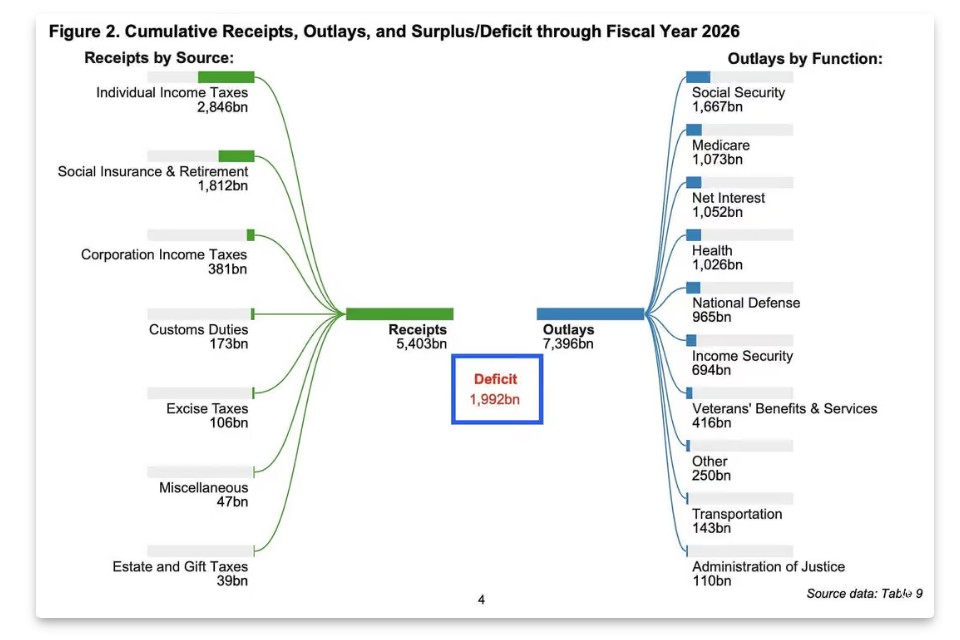
This trend is directly linked to the trajectory of U.S. public finances. The Treasury is now borrowing nearly $8 billion a day, an unprecedented pace in times of peace.
Part of this debt is gradually being absorbed by the Federal Reserve through its Reserve Management Purchases, which are officially intended to maintain an adequate level of bank reserves. The amounts are still modest — around $1 billion in daily purchases — but the signal is crucial. After several years of shrinking its balance sheet, the Fed is gradually resuming its support for Treasury financing. This is a form of QE in all but name.
History also shows that this type of operation rarely occurs at the beginning of a cycle. When the Fed must resume its purchases to maintain the level of bank reserves, it is generally because the private banking system is no longer able to absorb the flood of new bond issuances on its own. In other words, it is no longer just the Fed choosing to buy more Treasuries; it is the market that is gradually beginning to impose this role on it.
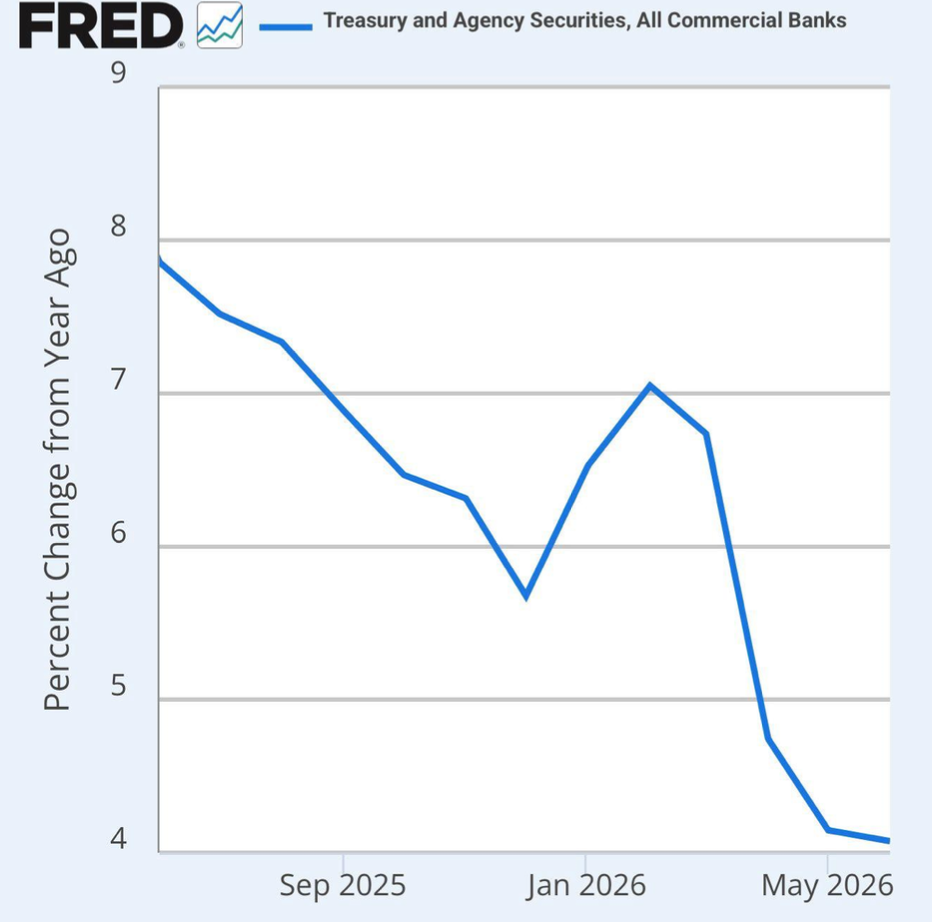
The graphic above perfectly illustrates this trend. U.S. commercial banks are gradually reducing their purchases of Treasuries and agency bonds. Their annual growth rate has fallen from about 8% to just 4% in a matter of months. Banks are not shunning U.S. bonds; they are simply reaching the limits of their balance sheets and regulatory constraints. The more Treasury issuance increases, the more difficult it becomes for the private sector alone to absorb this mountain of collateral.
This loss of appetite is not limited to U.S. banks, however. Foreign central banks are also becoming increasingly reluctant to absorb new Treasury issuance.
The case of Japan is particularly telling. As the United States’ largest foreign creditor, Japan would normally be expected to sell a portion of its Treasuries to obtain the dollars needed to defend the yen. More broadly, the continued rise in the U.S. Treasury’s financing needs is logically leading investors around the world to reduce their exposure to U.S. bonds. As the supply of Treasuries increases and yields rise, portfolios are rebalanced, and major foreign holders naturally become sellers.
Japan is no exception. Yet it is precisely this trend that Scott Bessent is now seeking to prevent. A massive sale of Treasuries by Tokyo would put additional pressure on U.S. interest rates and, above all, risk triggering an unwinding of the yen carry trade, with potentially destabilizing consequences for financial markets.
The paradox is that this selling pressure on Treasuries stems largely from U.S. fiscal policy itself. By running up deficits and issuing more debt, Washington is creating the conditions that prompt investors to sell bonds… while simultaneously putting measures in place designed to discourage them from doing so.
The main risk identified by the U.S. Treasury is now an unwinding of the yen carry trade. For years, investors have been borrowing trillions of yen at very low cost to buy U.S. assets, particularly Treasuries and stocks. If this carry trade were to collapse suddenly, they would have to sell these assets en masse in order to buy back yen and repay their loans. The result would be a sharp correction in the stock markets, a wave of Treasury sales, a renewed surge in U.S. yields, and a sudden tightening of financial conditions.
In this context, Scott Bessent reportedly sought to convince the Bank of Japan to slow its rate-hiking cycle in order to preserve the low cost of yen-denominated financing. The implicit goal would be simple: to avoid a premature unwind of the carry trade. In return, Washington reportedly offered its support to Japan through two mechanisms. First, coordinated interventions in the foreign exchange market — which appears to be what happened on Friday when the U.S. Treasury intervened to support the yen by selling euros. Second, easier access to the Federal Reserve’s FIMA Repo facility.
This latest development is fundamental. Traditionally, when a country like Japan needed dollars to defend its currency, it would sell a portion of its Treasuries. Now, Washington is encouraging it to do exactly the opposite: hold onto its U.S. Treasuries and use them as collateral to temporarily borrow dollars from the Fed. This mechanism avoids immediate sales of Treasuries, but it merely postpones the problem. The borrowed dollars will have to be repaid, with interest. The U.S. administration’s real gamble is that, in the meantime, the fiscal situation will have improved enough to make this financing sustainable.
The market, however, appears to be interpreting this strategy in an unexpected way. If the U.S. Treasury is now prepared to defend the yen, the potential for the Japanese currency to weaken becomes more limited. As a result, some of the speculation seems to be shifting from the foreign exchange market to the Japanese bond market. Investors are no longer betting solely on a weaker yen; they now anticipate that the Bank of Japan will nevertheless have to gradually continue its cycle of rate hikes in order to preserve the credibility of its currency.
The result is dramatic. The yield on the two-year JGB has just hit a more than twenty-year high, rising nearly 5% in a single trading session.
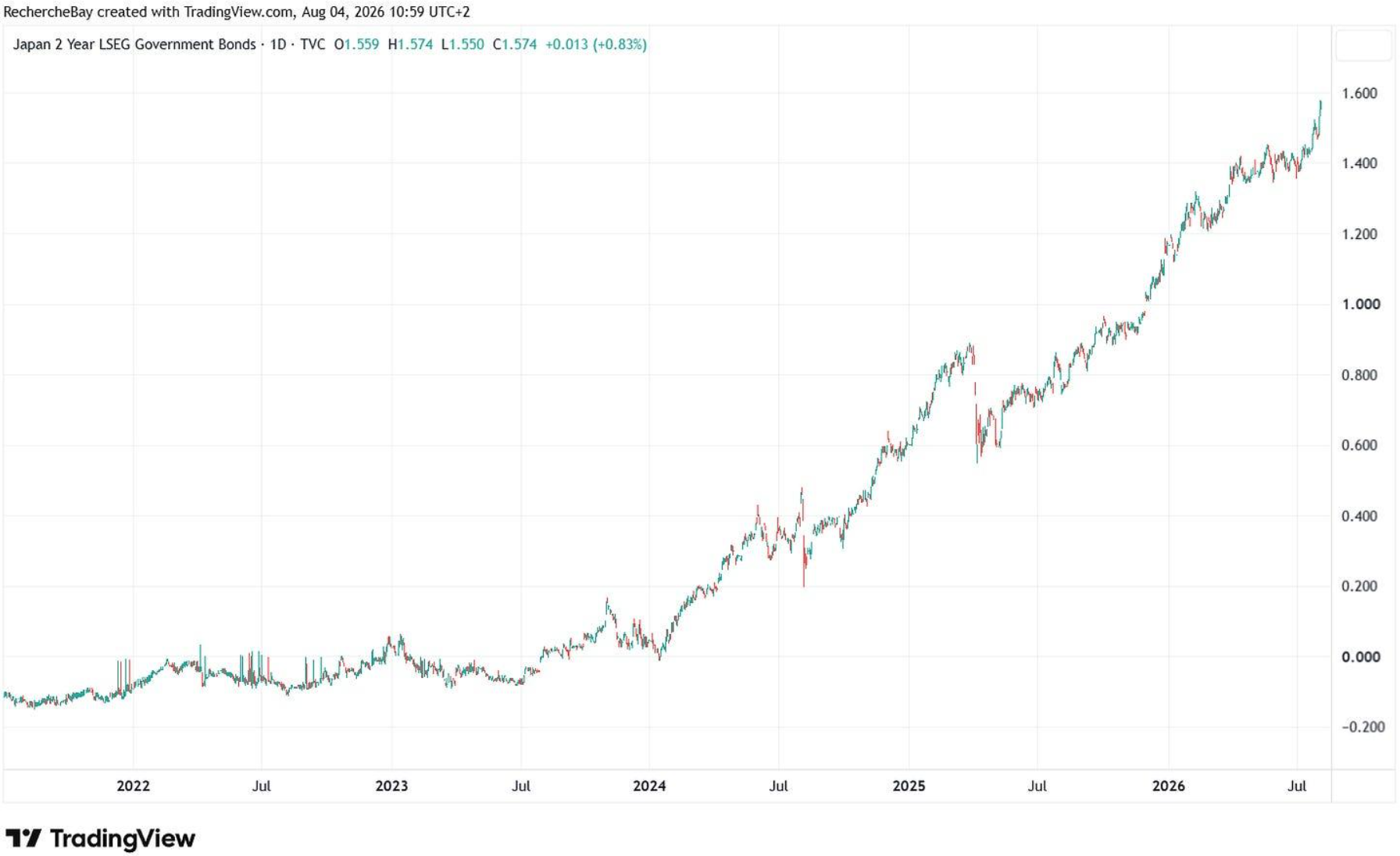
That is precisely where the paradox lies. By seeking to preserve the carry trade today, Washington risks making it even more fragile tomorrow. The more Japanese interest rates rise, the higher the cost of yen-denominated financing becomes, and the more the economics of the carry trade deteriorate. U.S. intervention therefore does not eliminate the risk; it merely shifts it over time and from one market to another.
This sequence of events ultimately tells a story far more significant than the Japanese case alone. The United States officially continues to pursue a restrictive monetary policy, but the reality is already different. The money supply is beginning to grow again, the Fed is gradually resuming its Treasury purchases, banks are absorbing less and less public debt, foreign central banks are being discreetly encouraged to hold onto their U.S. bonds, and the Treasury is now intervening directly in the foreign exchange market to preserve this balance.
In other words, financial asset prices are increasingly less determined by economic fundamentals alone and increasingly influenced by interventions by the authorities. History shows that these policies can buy time. It also shows that they never permanently eliminate the imbalances they seek to contain.
This series of interventions also helps explain why the price of gold has been moving much less dramatically over the past several months than its fundamentals would suggest. If the markets were left to their own devices, the simultaneous surge in U.S. deficits, public debt, long-term interest rates, and money supply would likely have already triggered a much larger shift of capital toward gold. However, these imbalances are now constantly being cushioned by interventions from monetary and fiscal authorities. Support for the bond market, currency interventions, refinancing facilities, and active liquidity management: each new measure delays the natural price adjustment. Gold thus finds itself mired in a system where authorities are constantly seeking to smooth out the consequences of imbalances they can no longer resolve.
This strategy may work for a time. It may even create the illusion that tensions are dissipating. But in reality, it merely shifts risks from one market to another and postpones adjustments. The more these interventions multiply, the more they reinforce the markets’ dependence on permanent public support.
The day one of these dams breaks — whether it be the U.S. bond market, the yen, the carry trade, or a liquidity shock triggered by oil — real assets, foremost among them gold, could then, within a matter of weeks, absorb the imbalances that have accumulated over several years.


Comments
Log in or sign up to join the conversation.