


Gold price (XAU/USD) holds steady near $4,335 after pulling back from an early-June top near $4,450 during the early Asian trading hours on Wednesday. The precious metal faced some selling pressure in the previous session as Treasury yields surged to their highest levels in decades.
Long-term borrowing costs from the US to Japan and Germany hit their highest levels in decades, undermining non-yielding gold. Thirty-year bond yields in the US hit their highest since 2007 on Tuesday, while expectations that the Bank of Japan (BoJ) could raise interest rates as early as September pushed 10-year borrowing costs to a three-decade high. In Europe, Germany’s 10-year Bund yield reached its highest since 2011, and French yields were at their highest since 2008.
Furthermore, rising energy prices on ongoing US-Iran tensions and uncertainty surrounding the Strait of Hormuz could stoke inflation worries and weigh on non-interest-bearing bullion. US President Donald Trump said on Tuesday that no talks are underway or scheduled with Iran, per CNN. MarineTraffic data also showed that commercial vessel traffic through the critical Strait of Hormuz and Bab al-Mandeb channels remains depressed.
“The steepening of the yield curve poses a headwind for gold, while firmer oil prices are also a factor behind today’s weakness,” said Peter Grant, vice president and senior metals strategist at Zaner Metals.
On the other hand, the run of softer US inflation data has led investors to scale back expectations of a rate hike by the US Federal Reserve (Fed). This, in turn, could drag the US Dollar (USD) lower and support the USD-denominated commodity price.
Markets are now pricing in for a September quarter-point hike, flipped to a near-65% chance of a hold, after softer consumer price inflation and weaker retail sales.
Gold demand hinges on inflation hedging as rising yields pose near-term risk
BNY’s strategists observe that investors “appear to prefer explicit inflation protection through gold rather than positioning for a broader reflationary upswing,” with the metal increasingly favoured as a direct hedge against rising price pressures. At the same time, they caution that “with yields moving sharply higher, the metal could struggle in the near term, unless monetary policy remains far more dovish than expected,” underscoring the delicate balance between inflation hedging demand and the headwind from higher rates.
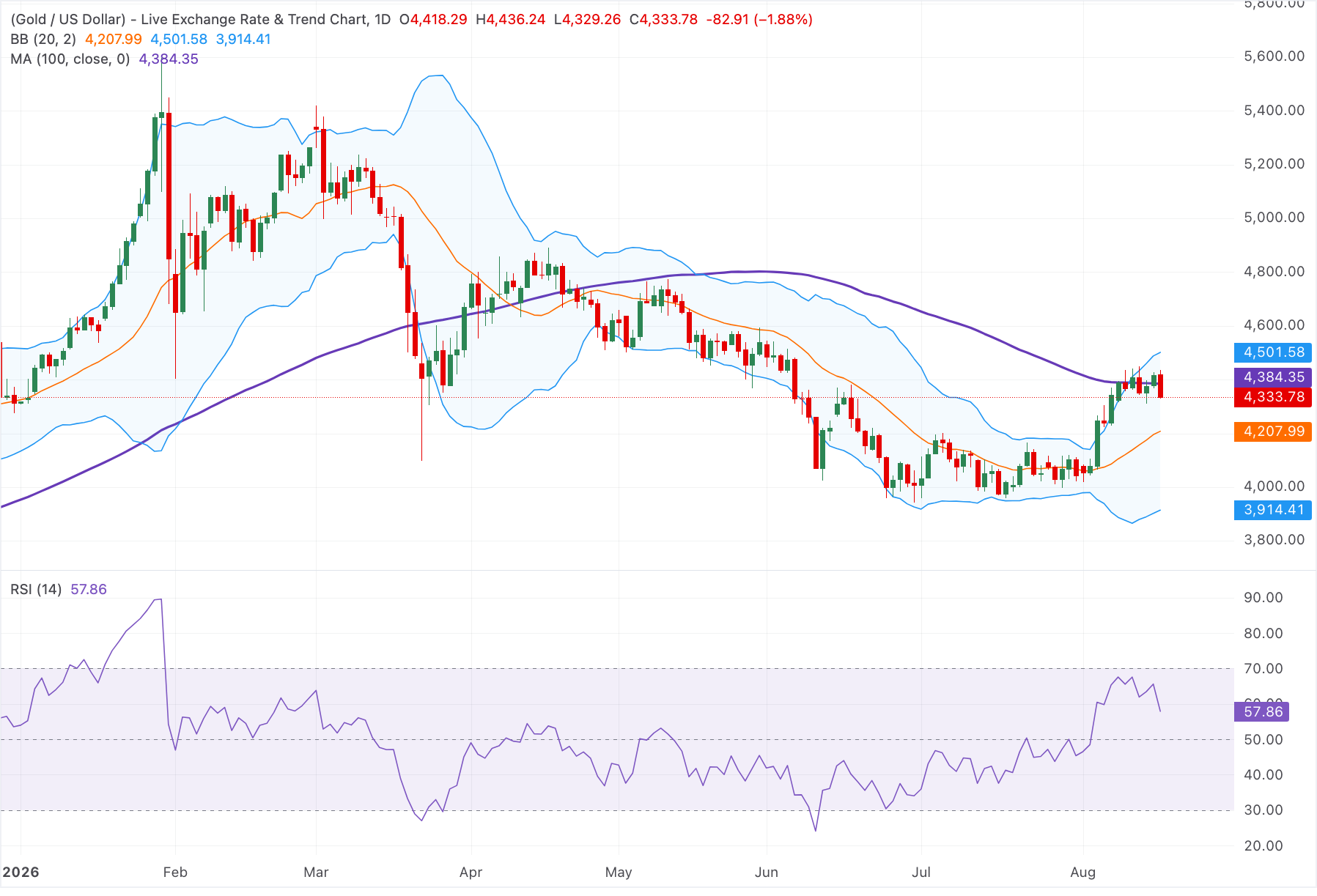
Technical Analysis: Gold
In the daily chart, XAU/USD remains under a bearish near-term bias as price holds below the 100-day simple moving average (SMA), keeping the broader uptrend context out of reach. At the same time, spot is trading above the 20-day Bollinger middle band, suggesting a corrective bounce within a still-capped structure, while the Relative Strength Index (14) around 58 points to firm but not overextended bullish momentum.
On the topside, initial resistance is seen at the 100-day SMA near $4,385, ahead of the upper Bollinger band at roughly $4,500, where rallies would likely meet stronger supply. On the downside, immediate support comes from the 20-day Bollinger middle band around $4,210, with deeper demand parked near the lower Bollinger band at about $3,915; a daily close below the mid-band would reopen a slide toward the lower envelope, whereas a sustained break above $4,385 would be needed to soften the current bearish bias.


Comments
Log in or sign up to join the conversation.