


West Texas Intermediate (WTI), the US crude oil benchmark, is trading around $86.40 during the early European trading hours on Thursday. WTI falls after President Donald Trump's Republican Party lost control of Congress in midterm elections.
The Democrats won a majority in both the US Senate and House of Representatives on Tuesday, taking control from Republicans. The election outcome raises prospects of political gridlock in the US and lowers expectations that Trump will resume military strikes against Iran.
Trump said on Tuesday that Washington had no immediate plans to strike Iran, and on Wednesday acknowledged that the Iran war had played a role in his party's sweeping defeat in the midterm elections. His comments exert some selling pressure on the WTI price.
"The Democratic control of Congress could also tighten US military spending in the Middle East and further heighten the possibility of a peace deal sooner rather than later," said Dennis Kissler, senior vice president of trading at US financial services firm BOK Financial.
US crude oil inventories declined by less than expected last week. According to the Energy Information Administration (EIA), crude stockpiles dropped by 865,000 barrels in the week ending October 30, compared to a fall of 1.892 million barrels in the previous week. The market consensus was for a decline of 900,000 barrels.
Brent outlook anchored by Middle East diplomacy narrative
According to TD Securities, a persistent “diplomacy headline drag remains” on crude, with “the expectation for a deal as opposed to escalation in the Middle East” still seen as “the main drag on crude oil prices,” a view that has been “further” reinforced by the US midterm election results. The bank argues that, beyond the “potential for a near-term overshoot,” crude is likely to “settl[e] into a higher-for-longer regime, with fair value for Brent crude oil remaining in the $90-100/bbl range,” and sees “potential for upside via risk premium so long as the Middle East and Russia-Ukraine conflicts remain unresolved.”
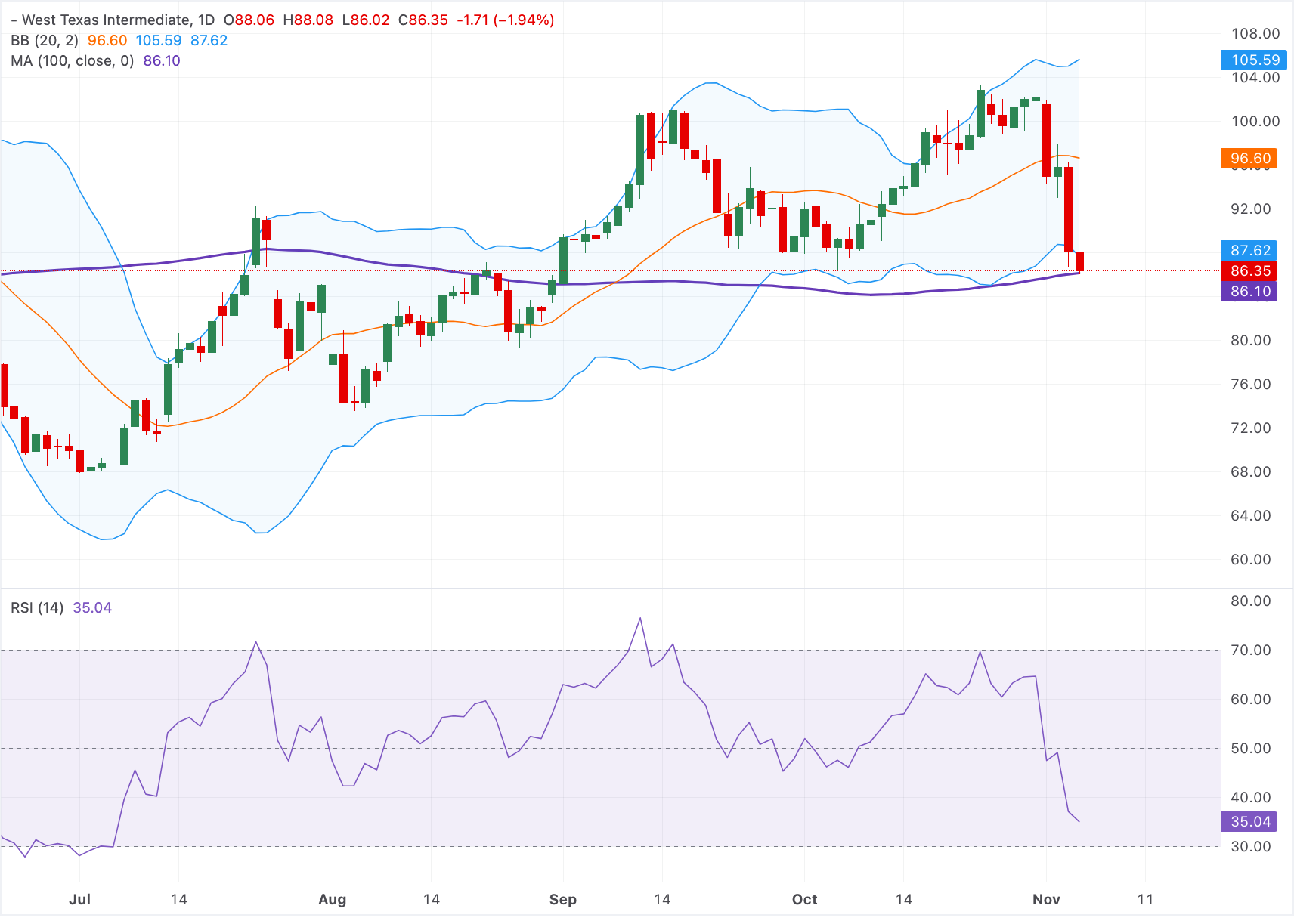
Technical Analysis: WTI remains above the 100-day SMA
In the daily chart, WTI US Oil holds just above the 100-day Simple Moving Average (SMA), but the overall structure is bearish as it remains well under the 20-day Bollinger middle band, indicating a market capped by medium-term resistance overhead. The Relative Strength Index (14) near 35 points to weak momentum, hinting that selling pressure still dominates despite the proximity of trend support.
On the topside, initial resistance emerges at the lower Bollinger band around $87.60, with stronger barriers at the Bollinger middle band near $96.60 and the upper band around $105.60 if a rebound extends. On the downside, the 100-day SMA at $86.10 offers immediate trend support; a sustained break beneath this floor would likely open the way to deeper losses, in line with the subdued RSI profile.



Comments
Log in or sign up to join the conversation.