


The EUR/USD pair trades on a weaker note around 1.1195 during the early European trading hours on Friday. Markets might turn cautious later in the day ahead of the German Industrial Production, Eurozone Retail Sales and US employment reports, which are due later on Friday.
Safe-haven flows after a sell-off in AI stocks worldwide could provide some support to the US dollar (USD) against the Euro (EUR). "The dollar is getting some support from safe-haven demand," said Dilin Wu, research strategist at Pepperstone.
However, the Democrats' victory in the US midterm elections prompts traders to reduce their bets on further Fed rate hikes. Fed funds futures scale back the probability of a 25-basis-point interest rate increase in December to around 70.9% from more than 82.7% on Wednesday, according to the CME FedWatch tool.
US jobs data will take center stage on Friday, as it might offer some hints about the Fed's rate path. The US Nonfarm Payrolls (NFP) is projected to show a rise of 65,000 job additions in September. Meanwhile, the Unemployment Rate is estimated to stay unchanged at 4.2% during the same period.
Euro inflation data anchors swaps as Eurozone yields retreat
Analysts at Deutsche Bank note that yesterday’s session was light on data, “although we did get the Euro Area flash CPI print for October.” They highlight that the release “came in as expected by the consensus, with headline inflation up to a 3-year high of +4.0% in October, whilst core inflation remained at +2.5%.” In rates, Deutsche Bank points out that “yields on 10yr bunds (-5.8bps) fell to 3.27%, whilst 10yr OATs (-17.6bps) saw their biggest daily decline since April, falling to 4.77%.” That move “also pushed the Franco-German 10yr spread down by -11.8bps to 150bps, marking its tightest level in the last couple of weeks.” Against this backdrop, they stress that “that led to a huge decline in inflation expectations, with the Euro 1yr inflation swap (-25.9bps) down to a two-month low of 3.10%, whilst the 1yr US inflation swap (-24.9bps) hit a two-month low of 2.16%.”
Lagarde flags persistent inflation risks and tariff uncertainty
ECB President Lagarde’s speech scores 6.2/10 on FXS Speechtracker, modestly above the historic average of 5.6/10, signaling a slightly more hawkish tone. The emphasis on it being “still necessary to apply tools to avoid inflation running away” and the difficulty in disentangling supply- and demand-driven shocks points to a European Central Bank that remains cautious about easing, which is broadly supportive of the Euro on the margins.
Lagarde’s comments that US tariffs are unlikely to be revisited quickly and that US mid-term votes may affect tariffs only over time highlight lingering trade and growth uncertainties, tempering any strong Euro bullish reaction. The reference to the energy shock and AI pulling in opposite directions underlines a complex macro backdrop, suggesting the ECB will rely on incoming indicators between now and December, keeping the Euro sensitive to data and policy headlines.
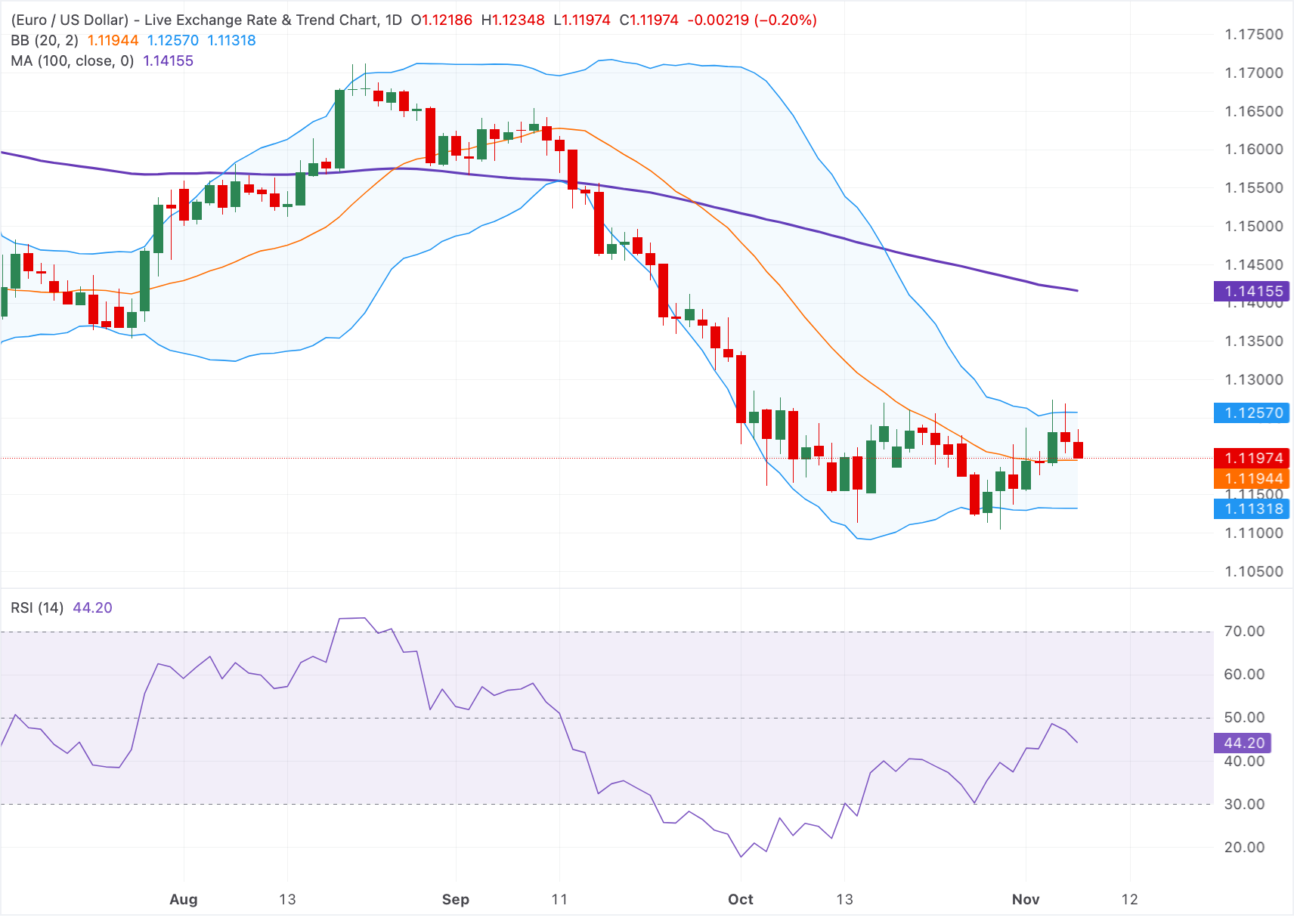
Technical Analysis: EUR/USD holds a bearish outlook below the 100-day SMA
In the daily chart, EUR/USD remains in a bearish near-term configuration, with spot capped below the 100-day simple moving average (SMA). Price is hovering just above the 20-day Bollinger middle band, hinting at tentative demand around the current area, while the Relative Strength Index (14) at 44 stays below the neutral 50 line, suggesting only modest recovery momentum within a broader downside bias.
On the topside, initial resistance level emerges at the upper boundary of Bollinger band near 1.1255, en route to the July 28 low of 1.1353 and the more significant barrier at the 100-day SMA around 1.1415. Any follow-through buying above this level could see a rally to the August 7 high of 1.1581.
On the downside, immediate support level is aligned with the lower limit of Bollinger band near 1.1132. A break under this latter zone would open the path toward the 1.1100 psychological level, followed by the May 12, 2025 low of 1.0951.



Comments
Log in or sign up to join the conversation.