


Gold (XAU/USD) extends its decline to the lowest level since March on Tuesday as the US Dollar (USD) rebounds amid uncertainty surrounding a possible end to the war in the Middle East, while a hawkish Federal Reserve (Fed) outlook continues to weigh on the non-yielding metal.
At the time of writing, XAU/USD is trading around $4,260, down 1.60% on the day after retreating from an intraday high near $4,350.
US President Donald Trump said in a Truth Social post that Iran had shot down a US Apache helicopter patrolling over the Strait of Hormuz. Trump said both pilots were safe and uninjured, but added that the United States would need to respond to the attack.
Earlier on Tuesday, Trump said negotiations with Iran are in the "final throes" and that an agreement could be reached within days. "We're in the final throes of what will be a very, very good deal," Trump told reporters on Tuesday. He added that the Strait of Hormuz would reopen as soon as a deal is finalized.
The conflicting headlines dented hopes for a near-term peace deal, helping the US Dollar recover from earlier losses. The US Dollar Index (DXY), which tracks the Greenback's value against a basket of six major currencies, is trading around 100.00, rebounding from an intraday low of 99.68.
The next hurdle for Gold: US inflation
Traders are bracing for the US Consumer Price Index (CPI) report due on Wednesday.
Inflation has drifted further away from the central bank's 2% target, as higher Crude Oil prices following the outbreak of the war in the Middle East in late February have added to inflationary pressure. Annual CPI rose to 3.3% in March and 3.8% in April, with economists expecting a further increase to 4.2% in May.
A stronger-than-expected reading would cement bets on a rate hike later this year and increase pressure on Gold, which tends to perform well in a low-interest rate environment. In contrast, a softer inflation reading could allow the Fed to remain patient and trigger a short-term rebound in the precious metal.
Still, gains may be capped as markets remain convinced that interest rates will stay elevated for longer, unless a US-Iran agreement leads to a sustained decline in Oil prices and eases inflation concerns.
Technical analysis: XAU/USD stabilizes, but the technical picture remains fragile
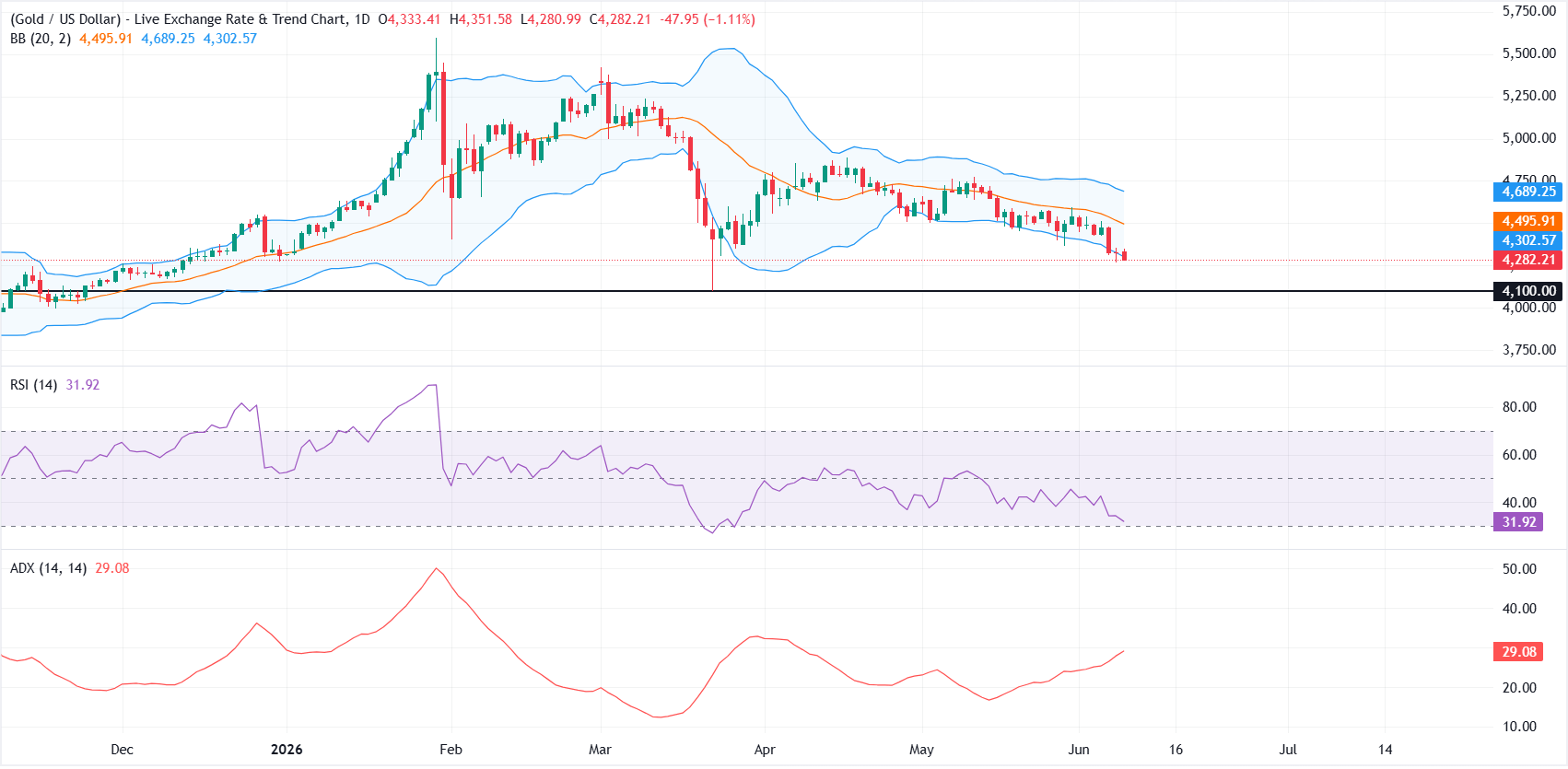
On the daily chart, XAU/USD holds below the Bollinger Bands’ 20-period Simple Moving Average near $4,496 and slips beneath the lower band around $4,306, keeping the near-term tone bearish. The Relative Strength Index (RSI) hovers in the low 30s, hinting at persistent but not yet extreme downside pressure, while the Average Directional Index (ADX) near 29 points to a strengthening trend backdrop rather than range-bound trade.
On the topside, initial resistance emerges at the lower Bollinger Band near $4,306, with the 20-period SMA around $4,497 acting as a more meaningful cap, ahead of the upper band close to $4,687. On the downside, the next noteworthy cushion sits at the horizontal support line near $4,100, where a break would open the door to a deeper corrective leg within the broader bearish configuration.


Comments
Log in or sign up to join the conversation.