


Gold (XAUUSD) remains under pressure as markets react to a hawkish Federal Reserve and a stronger US Dollar. Expectations for higher interest rates continue to weigh on sentiment and limit gold's upside potential. At the same time, investors are monitoring developments surrounding the interim agreement between the United States and Iran. These factors suggest that gold may remain sensitive to monetary policy expectations and geopolitical developments in the near term.
Gold Slides as Hawkish Fed and Strong Dollar Limit Upside
Gold stays under pressure during its current pullback as a stronger US Dollar supports bearish sentiment. Markets are responding to the Federal Reserve's latest policy signals, which support a higher interest rate environment. The central bank kept interest rates unchanged between 3.5% and 3.75%, as expected. However, policymakers delivered a more hawkish message than markets anticipated. This shift has strengthened the US Dollar and reduced demand for gold.
The updated Summary of Economic Projections revealed a more hawkish outlook from the Federal Reserve. Nine Fed officials now expect at least one interest rate increase this year. The central bank also removed language that previously pointed to a future rate cut. These changes suggest that policymakers remain committed to controlling inflation. Higher interest rates tend to weigh on gold because the metal does not offer interest income, making it less attractive than interest-bearing assets.
Geopolitical developments are also influencing sentiment. Gold has largely ignored optimism surrounding the interim agreement between the United States and Iran. Reports that US Vice President JD Vance cancelled a planned trip to Switzerland briefly increased uncertainty. However, negotiations remain active and both sides continue to work on implementing the current framework agreement while pursuing a broader long-term deal.
Gold Corrects Toward Key Support within a Multi-Year Ascending Wedge
The gold chart below shows a large multi-year ascending wedge that has guided price movements since 2023. The lower boundary has consistently acted as support, while the upper boundary has limited major advances. Gold respected this structure throughout its long-term rally and remained inside the pattern for several years. The wedge reflects a strong long-term trend that gradually accelerated over time.
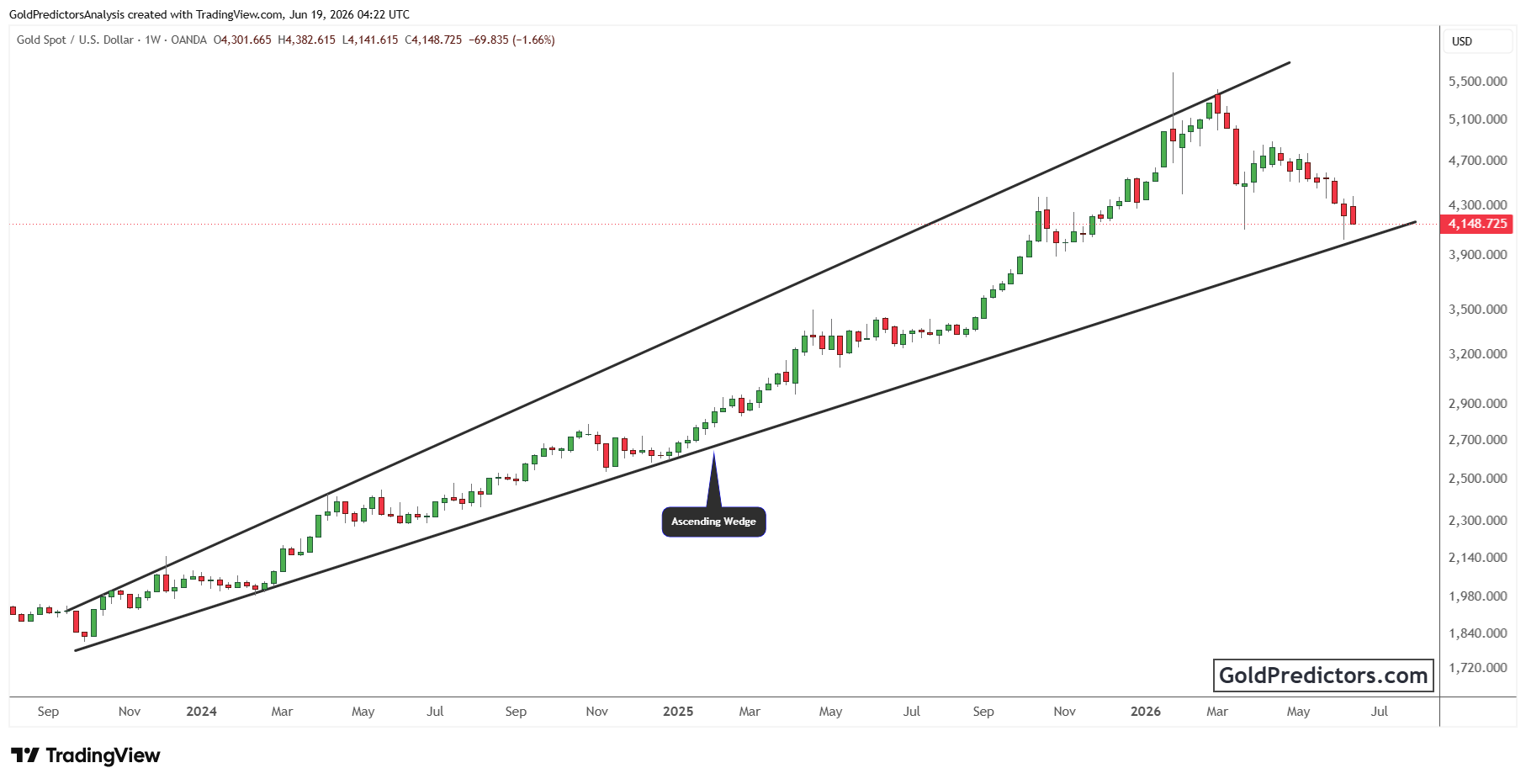
Gold later climbed to record highs above the $5,000 region before entering a corrective phase. Price then moved lower and began to retreat from the upper boundary of the wedge. The decline suggests that momentum has weakened after an extended rally. Gold is now moving closer to the lower boundary of the pattern. This area may become an important support zone if the decline continues.
The recent correction has brought gold back near the $4,100 region. Price remains inside the ascending wedge despite the pullback. Holding above the lower boundary could help stabilize momentum and support consolidation. However, a decisive move below this support area could increase downward pressure and extend the correction.
Gold Price Forecast: Hawkish Fed and Strong US Dollar Weigh on Gold Prices
Gold continues to face pressure as hawkish Federal Reserve expectations and a stronger US Dollar limit upside momentum. Geopolitical developments surrounding the United States and Iran remain an important factor for market sentiment. Gold is also undergoing a correction after reaching record highs, while the long-term ascending wedge continues to guide price movements. The lower boundary of this pattern now represents a key area to monitor. Holding above this support could help stabilize prices, while a breakdown could extend the current correction and increase downward pressure.



Comments
Log in or sign up to join the conversation.