

Gold rebounds from a two-month low as US Treasury yields and the US Dollar ease.
High-for-longer Fed expectations and elevated borrowing costs continue to cap the upside.
The technical setup remains fragile, with $4,100 providing the first line of support.

Gold (XAU/USD) rebounds on Tuesday as a modest pullback in US Treasury yields weighs on the US Dollar (USD), helping the metal recover after falling to a two-month low of $4,104 during Asian trading hours. At the time of writing, XAU/USD trades around $4,156, up 0.41% on the day.
The benchmark 10-year US Treasury yield eases to around 5.269% after touching 5.349% on Monday, its highest level since 2002. Meanwhile, the US Dollar Index (DXY), which tracks the Greenback’s value against a basket of six major currencies, retreats toward 102.00 after reaching a fresh year-to-date high of 102.53 the previous day.
The pullback gives Gold some breathing room, although the rebound leaves its recent consolidation intact. The metal remains largely confined between $4,100 and $4,200, with buyers struggling to build a sustained recovery as yields hold near multi-year highs.
Elevated yields increase the opportunity cost of holding non-yielding Gold and help keep demand for the US Dollar firm. Sticky inflation, rising government debt concerns and a resilient US growth outlook have pushed borrowing costs higher, reinforcing expectations that interest rates will stay high for longer.
However, recent US employment figures and the Federal Reserve’s (Fed) preferred inflation measure have shown signs of cooling, reducing pressure on the central bank to raise interest rates again at the October 27-28 meeting. The CME FedWatch Tool shows an 80% chance of a hold.
The distinction matters for Gold. An October pause offers near-term support, but a broader recovery may remain difficult as markets anticipate further tightening. The Fed’s commitment to bringing inflation back toward its 2% target keeps the door open to a December rate hike.
The stalemate between the United States and Iran keeps energy-driven inflation risks elevated, with Oil prices still above pre-war levels. However, recovering Gulf exports and emergency reserve releases are weighing on Oil prices, with West Texas Intermediate (WTI) trading around $87, near one-month lows.
Against this backdrop, a stronger Gold recovery would likely require a meaningful shift toward a less restrictive Fed outlook, accompanied by a sustained decline in Treasury yields and the US Dollar. Wednesday’s Federal Open Market Committee (FOMC) minutes could offer fresh insight into how officials view the need for further rate hikes.
Over the longer term, Gold remains supported as the same debt and fiscal concerns pushing borrowing costs higher also strengthen its appeal as a store of value. Meanwhile, strong central-bank demand and inflows into Gold-backed exchange-traded funds further underpin demand for the metal.
Technical analysis: XAU/USD remains bearish below mid-Bollinger SMA
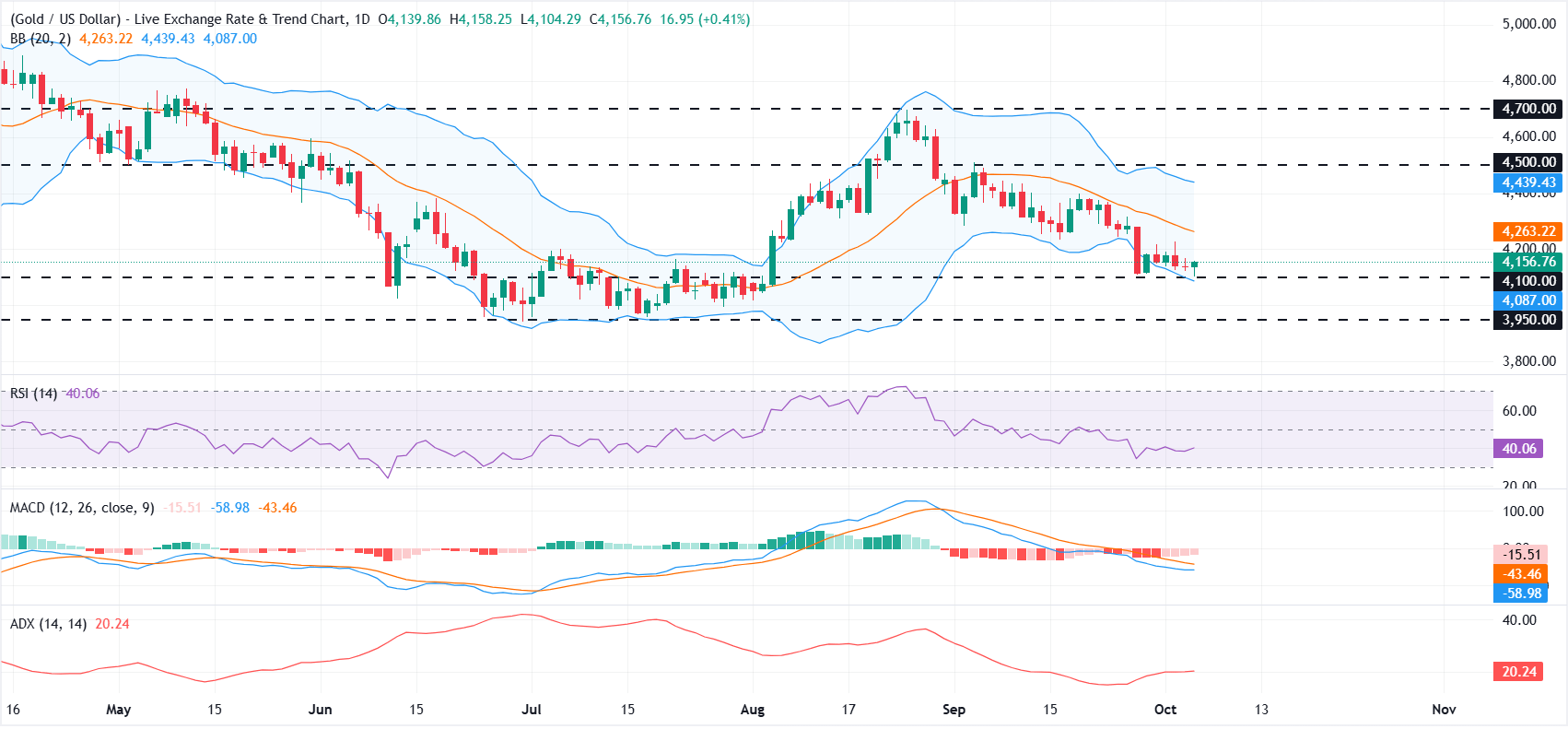
On the daily chart, XAU/USD maintains a bearish near-term tone as it holds below the 20‑day Bollinger simple moving average (SMA) at $4,263. Momentum is soft, with the Relative Strength Index (RSI) hovering around 40, while the Moving Average Convergence Divergence (MACD) remains in negative territory, hinting that recent downside pressure is not yet exhausted despite a modest stabilization above nearby support.
On the downside, initial demand is seen near the psychological $4,100 level, closely aligned with the lower Bollinger Band around $4,087. A break below this area could expose the deeper horizontal support zone around $4,000-$3,950.
On the topside, a first cap emerges at the mid‑Bollinger SMA at $4,263, ahead of the upper band resistance near $4,439 and the charted horizontal barriers at $4,500 and $4,700, which together define a dense supply zone that gold would need to clear to shift the bias back to constructive.



Comments
Log in or sign up to join the conversation.