

Gold (XAUUSD) continues to hold its recent gains as changing interest rate expectations help maintain the current momentum. Weak US labor data has reduced expectations for a September rate hike. Attention now turns to the upcoming US CPI report for further direction on interest rates. At the same time, uncertainty surrounding the Strait of Hormuz continues to support safe-haven demand. These developments could continue to influence gold’s direction in the near term.
Gold Price Maintains Recovery as Markets Reassess Fed Rate Hike Expectations
Gold is maintaining its recent gains as markets shift their attention toward the upcoming US CPI report. Recent weakness in the labor market has changed expectations for the Federal Reserve’s next policy decision. The inflation data could provide further signals on the direction of interest rates. A softer reading may support gold, while renewed inflation pressure could limit further gains.
The latest US labor data has reduced expectations for further policy tightening. Nonfarm payrolls fell by 23,000 in July, missing forecasts for an 85,000 increase and signaling weakness in employment conditions. The unemployment rate slipped to 4.1%, partly reflecting a smaller labor force. Following the report, markets lowered the probability of a September Fed rate hike to around 44%. Attention now turns to inflation data for further guidance on the Fed’s next policy move.
Uncertainty in the Middle East continues to provide support for gold. Iran and Oman are discussing a new mechanism for maritime traffic through the Strait of Hormuz, but an agreement on reopening the waterway has yet to emerge. Tehran has maintained that additional conditions must be addressed before traffic can return to normal. The uncertainty surrounding this key energy route continues to raise concerns over oil supplies. Higher energy prices could increase inflation risks, while continued regional tensions may keep safe-haven demand for gold elevated.
Gold Price Extends Recovery after Breaking above Triangle Resistance
The gold chart below shows price moving within a large triangle pattern. A descending resistance trendline has continued to limit advances, while a horizontal support area has prevented deeper declines. These levels have gradually narrowed the pattern and brought gold closer to a key turning point.
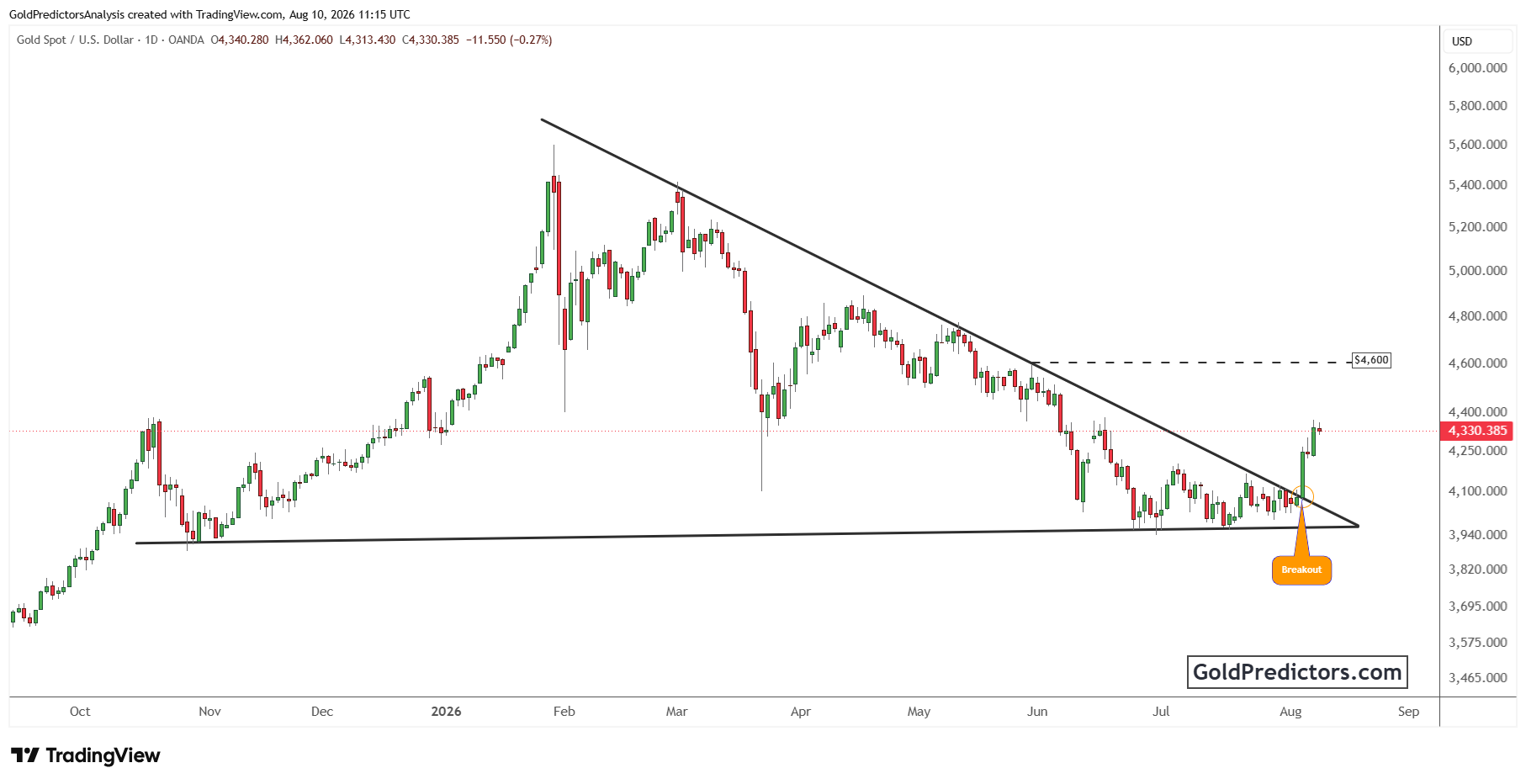
Gold has now broken above the descending resistance trendline after remaining below it for several months. Price accelerated after clearing this level and extended its advance toward the $4,300 region. This development marks a notable shift in the near-term structure. Price continues to hold well above the former resistance line, keeping the current recovery in place.
The next key area stands near $4,600. Continued strength above the descending trendline could support further gains toward this resistance level. However, a decline back toward the broken trendline could weaken the current momentum.
Gold Price Outlook: Inflation Data and Middle East Risks in Focus
Gold remains well supported as markets assess the inflation outlook and expectations for the Fed’s next policy move. Weak labor data has reduced expectations for further policy tightening, while Middle East uncertainty continues to support safe-haven demand. Gold has also moved above descending resistance, improving the near-term structure. Holding above this former resistance could keep the focus on the next key resistance area. The upcoming CPI report and developments in the Strait of Hormuz could provide the next major direction for gold.



Comments
Log in or sign up to join the conversation.