


Gold (XAUUSD) prices remain under pressure as geopolitical tensions and inflation concerns continue to influence market sentiment. The renewed conflict between the United States and Iran has increased uncertainty and pushed oil prices higher, while investors also assess the latest US inflation data and the Federal Reserve's policy outlook. Markets now await fresh economic data and geopolitical developments for direction.
Gold Price Drops as Strait of Hormuz Disruption Fuels Inflation Fears
Gold prices weakened further as renewed tensions between the United States and Iran continued to drive risk sentiment. US President Donald Trump announced the reimposition of a naval blockade on Iranian ports and warned of further military action if negotiations do not resume. At the same time, Iran confirmed that the Strait of Hormuz will remain closed while military operations continue. The latest escalation has raised concerns about global energy supplies and increased uncertainty across financial markets.
The ongoing conflict pushed oil prices higher, keeping inflation concerns elevated across financial markets. The Strait of Hormuz carries a significant share of global oil shipments, making any disruption a major concern for energy markets. Higher oil prices increase production and transportation costs and may keep inflation elevated. This environment supports expectations that the Federal Reserve could maintain a restrictive monetary policy for longer, limiting demand for non-yielding assets like gold.
Recent US inflation data briefly eased pressure on precious metals after June Consumer Price Index figures came in softer than expected. Core inflation remained weaker than forecasts, reducing immediate inflation concerns. However, Federal Reserve Chair Kevin Warsh maintained a cautious tone during his congressional testimony and indicated that inflation risks have not fully disappeared. Markets now await the US Producer Price Index report and additional comments from Federal Reserve officials for further guidance on interest rates. These events could influence the next move in gold prices.
Gold Price Analysis: XAU/USD Approaches Critical Wedge Support
The gold chart below shows price trading within a long-term ascending broadening wedge that has guided price action since late 2023. The lower boundary has repeatedly provided support during corrective phases, while the upper boundary has capped major rallies. Price has respected both trendlines several times, highlighting the importance of this long-term technical structure.
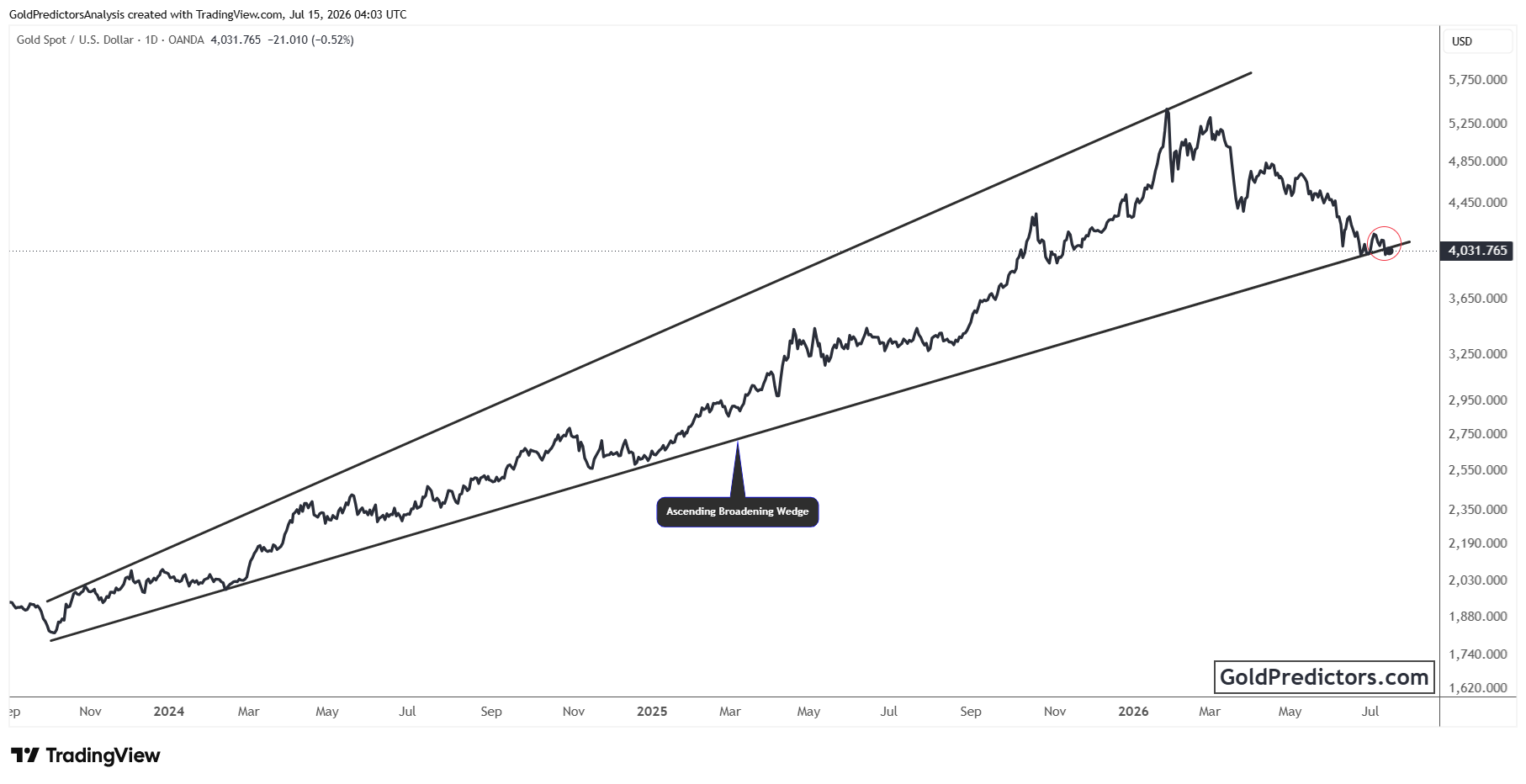
Recently, gold rallied to the upper boundary of the wedge earlier this year before reversing lower. The correction continued for several months and gradually brought the price back toward the lower boundary. This decline has reduced upside momentum and shifted attention to the wedge's lower trendline, which has acted as an important technical reference throughout the pattern.
Gold is now trading close to the lower boundary of the ascending broadening wedge. Holding this trendline could help maintain the broader wedge structure. However, a sustained break below the lower boundary would weaken the current technical outlook and increase the risk of a deeper corrective phase.
Gold outlook: Geopolitical risks and key support keep markets on edge
Gold remains under pressure as renewed geopolitical tensions, higher oil prices, and expectations of restrictive Federal Reserve policy continue to weigh on market sentiment. Although softer US inflation data provided temporary support, cautious comments from Fed Chair Kevin Warsh and ongoing conflict in the Middle East have kept downside risks in focus. Technically, gold is testing the lower boundary of a long-term ascending broadening wedge. Holding above this support could stabilize prices, while a sustained break below it may extend the current corrective phase.



Comments
Log in or sign up to join the conversation.