

If you only looked at the price of gold in September, you’d be forgiven for believing the bull market had run out of steam. The yellow metal fell 6.3% during the month, and some in the financial press were quick to say it had failed as a safe haven.
I’ve spent my entire professional life in gold and gold mining stocks, and I can tell you that one bad month rarely tells the whole story. When you look at the full third quarter, a very different picture emerges.
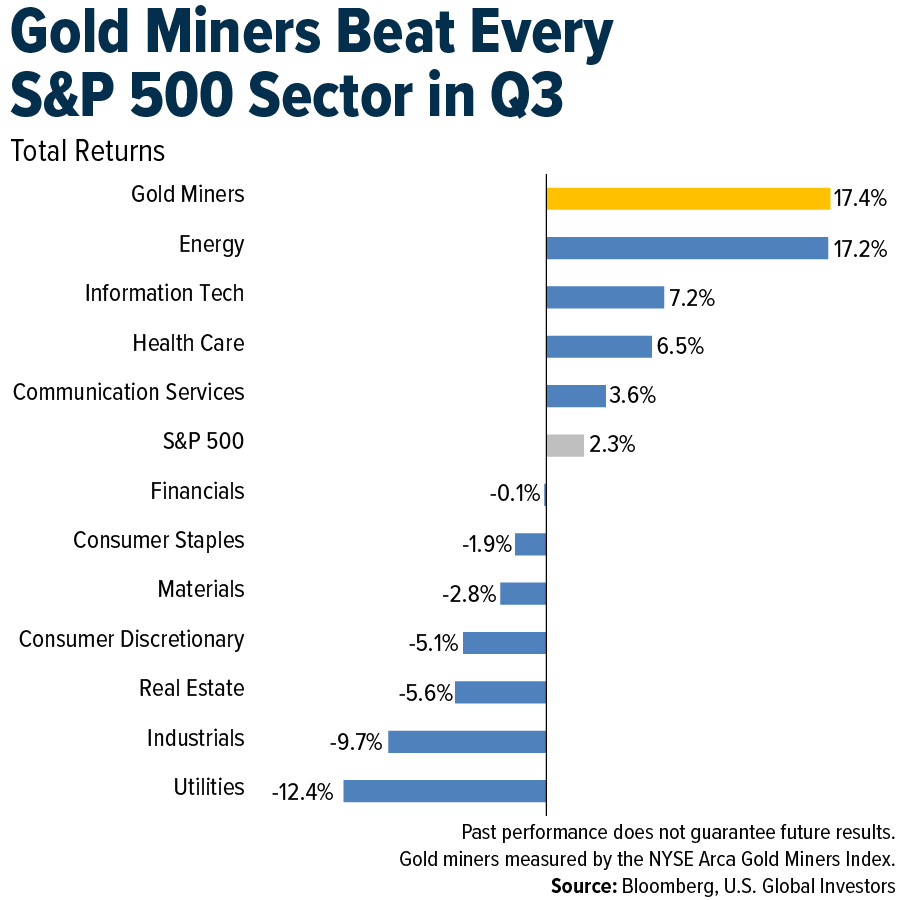
Gold mining stocks, as measured by the NYSE Arca Gold Miners Index, delivered a total return of 17.4% in the three months ended September 30. That was enough to beat every single sector in the S&P 500, including energy, which rode higher oil prices to a 17.2% gain. The S&P 500 itself returned just 2.3% in Q3.
The Bond Market Took Center Stage
September was all about interest rates. On September 16, the Federal Reserve raised rates for the first time in more than three years and signaled more hikes could follow. Two days earlier, the 10-year Treasury yield crossed 5% for only the second time since the 2008 financial crisis.
This wasn’t just an American story. Bond yields climbed around the world. In the U.K., the 30-year government bond yield topped 6% on October 1, its highest level since 1998.
As we all know, gold doesn’t pay interest. When you can earn close to 5% on a two-year Treasury note, the cost of holding a metal that pays nothing goes up.
The number that matters most is called the real yield. That’s what a 10-year Treasury pays you after inflation. It closed September at 2.93%, its highest level since November 2008, jumping about half a percentage point in September alone and a full point since the start of the year.
The U.S. Dollar Index, meanwhile, rose more than 2% in September. Since gold is priced in dollars, a stronger greenback makes it more expensive for buyers overseas.
Put it all together, and you have a recipe for a tough month. September has historically been gold’s weakest month of the year, and this one was worse than any September in the past decade.
Gold Has Been Here Before
The Wall Street textbook says gold falls when real yields rise. Sometimes it does. In 2013, real yields jumped about 1.5 percentage points and gold lost 28%, one of its worst years in decades.
But the rule is far from ironclad. From 2005 through 2007, real yields hovered between 2% and nearly 3%, right around where they are today, and gold nearly doubled. In 2022, real yields swung from deeply negative to positive, a move of more than 2.5 percentage points, and gold finished the year essentially flat. Then it went on one of the greatest runs in its history while yields stayed high.
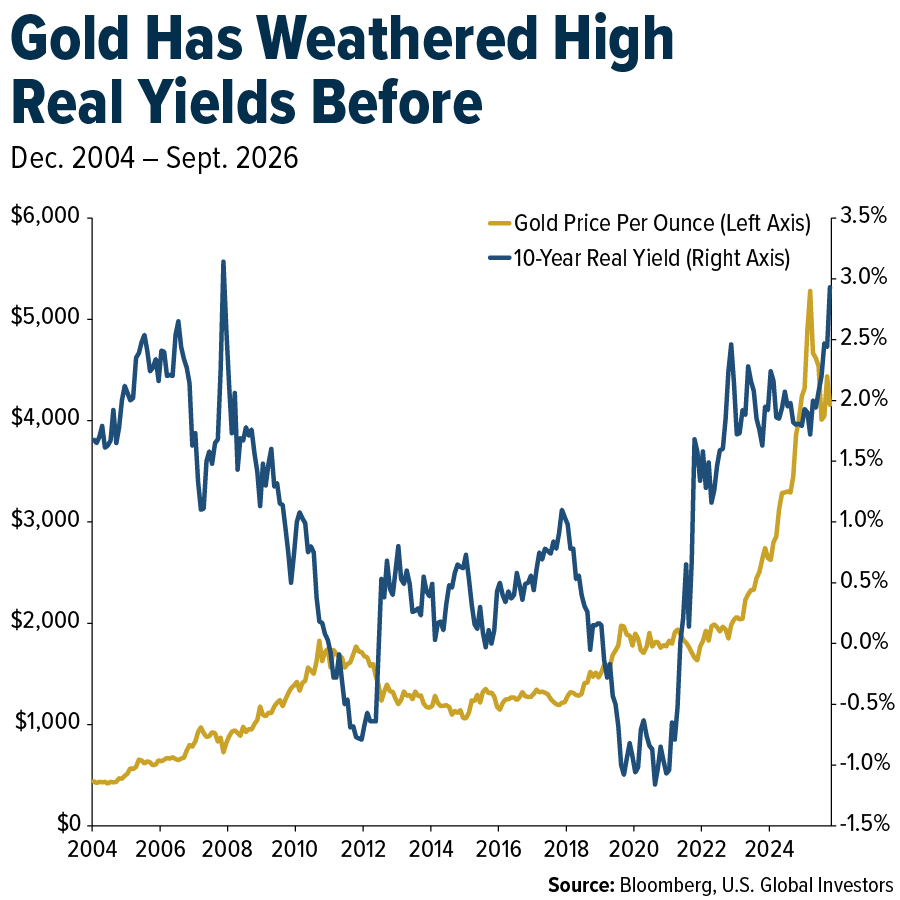
What separates those periods? Who’s doing the buying. In 2013, Western investors were dumping gold. Today, the biggest buyers are holding firm and adding more.
That helps explain why gold is down only 4% so far this year as of October 2, despite a full percentage point increase in real yields.
The Love Trade Didn’t Miss a Beat
Loyal readers know I’ve long said that gold is driven by two forces, the Fear Trade and the Love Trade. The Fear Trade is investors reacting to inflation, interest rates and government policy. The Love Trade is the cultural buying of gold as gifts and savings, especially in China and India.
The Fear Trade had a rough September. The Love Trade, along with central bank buying, kept right on going.
China’s central bank added more than 20 tonnes of gold in August, its biggest monthly purchase since 2023. That stretched its buying streak to 22 straight months. China also imported a record 1,141 tonnes of gold in the first eight months of the year, already more than in all of 2025. Poland keeps buying, and South Korea’s central bank plans to buy gold in December for the first time since 2013.
Why are governments doing this? Reserve security. After watching Russia’s reserves get frozen in 2022, many nations want as asset that another government can’t seize with the stroke of a pen.
The timing is also worth noting. Last week was the start of China’s Golden Week holiday, which traditionally kicks off the country’s peak gold buying season.
Investors Bought the Dip
It’s not just central banks. Everyday investors who buy gold through exchange-traded funds (ETFs) held their ground too.
For most of the past year, the amount of gold held by ETFs moved right in step with the price. Then, in late August, the two went their separate ways. The gold price slipped from around $4,650 an ounce to $4,157, but ETF holdings kept climbing to about 100.9 million ounces, matching their highest level of the past year.
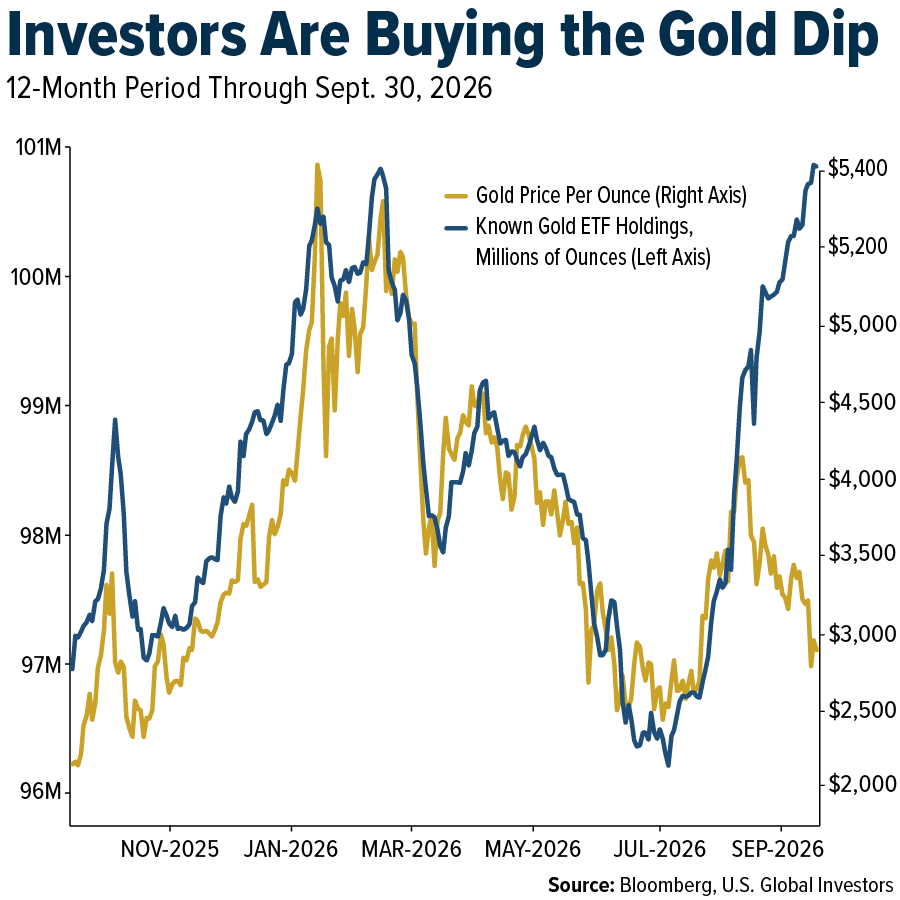
U.S.-listed physical gold ETFs took in $3.8 billion in September, following $7.9 billion in August. When prices fall and investors keep buying, that tells me conviction is still strong.
Gold Stocks Are Still Overlooked
This brings me back to gold miners. Their strong quarter wasn’t a one-off. Over the past five years, the NYSE Arca Gold Miners Index has returned about 240%, compared with about 137% for the price of gold itself.
Even so, most investors still aren’t paying attention. Mining stocks make up roughly 2% of global stock markets, their smallest share in 55 years. The 50 largest gold miners in the world, combined, are worth less than Nvidia (NVDA) alone.
That’s hard to square with the fundamentals. Free cash flow per share for miners has grown tenfold since 2020, and the sector’s earnings yield of about 12% is the highest of any sector, according to Jeff Clark of Paydirt Prospector.
Put simply, these companies are making a lot of money relative to what investors are paying for them.
The industry’s own insiders seem to agree. Large miners are bidding for one another again, including a $27 billion offer for Northern Star that was rejected last week as too low.
Meanwhile, the broader stock market is near record highs and leaning heavily on a handful of giant tech names. JPMorgan recently reminded investors that owning an index fund isn’t the same as being diversified. I couldn’t agree more.
Don’t Let One Bad Month Discourage You
The bond market will stay in the driver’s seat for now. The good news is that inflation came in cooler than expected in August, and traders have scaled back their bets on another Fed hike in October.
The calendar also turns more friendly from here, if history is any guide. Over the past decade, gold has averaged a gain of about 1.6% in October, and December and January have been its two strongest months. Past performance is no guarantee of future results, of course, but it lines up with the Love Trade buying season now underway.
Gold has had a volatile year, and I expect more swings ahead. That’s exactly why I’ve always recommended a 10% weighting in gold, with 5% in physical gold and 5% in high-quality gold mining stocks, rebalanced regularly. Don’t let one tough month shake you out of a position that’s built for the long haul.



Comments
Log in or sign up to join the conversation.