


Summary
European gasoil refining margins hit roughly $94 over Brent, a 36-year record and well past the 2022 crisis peak of $71.
Ukrainian drone strikes on Russian refineries are the cause; processing capacity rebuilds far slower than crude reroutes.
The fiscal 2027 request doubles procurement to $413 billion and R&D to $344 billion, while maintenance grows just 20%.
Drone equities are down 28% over 12 months against gains of 10% for aerospace and defense and 18% for the S&P 500 (SPY).
I’ve spent my entire career in capital markets, and what I’ve learned is that stocks tell you what people hope, while commodities tell you what’s actually happening to the stuff the world runs on.
So when I say the most important number in the drone story isn’t a defense stock, I hope you’ll hear me out.
Two weeks ago, the refining margin on European gasoil, the benchmark that sets the price of diesel and heating oil across much of the world, closed at roughly $94 a barrel over Brent crude, according to Bloomberg data. That figure is normally somewhere between $12 and $18. The worst of the 2022 energy crisis, after Russia invaded Ukraine and Europe scrambled for fuel, topped out around $71.
We’re now well past that. And we’ve been past it since late March.
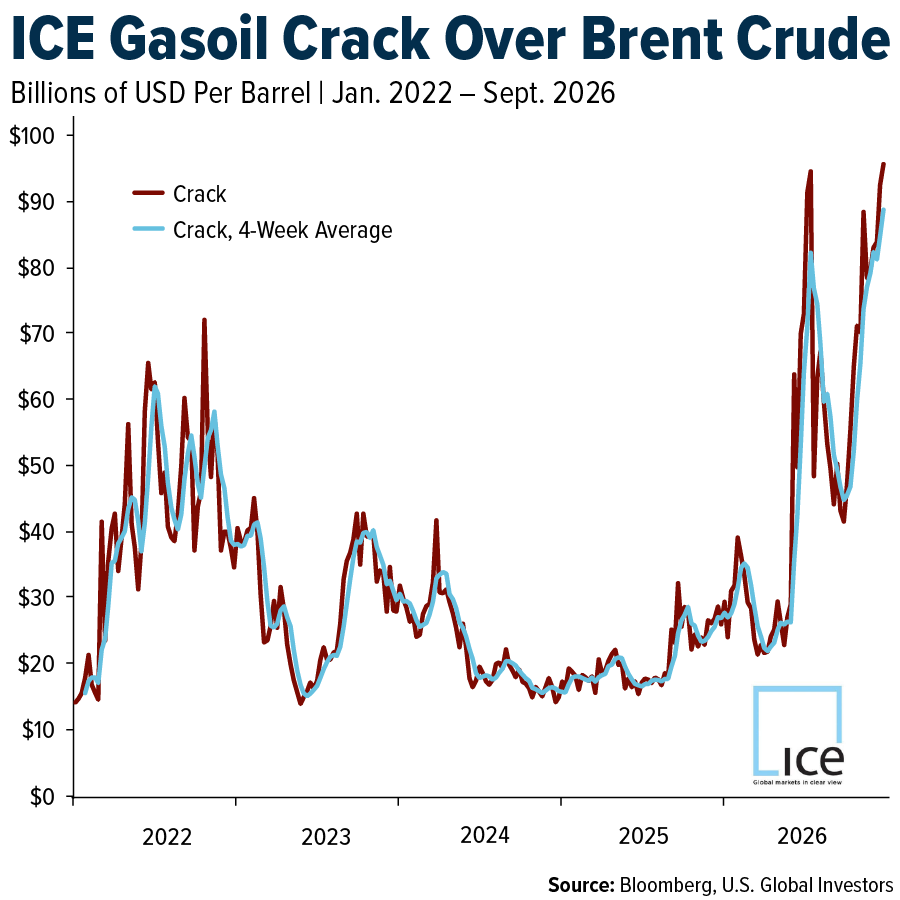
This didn’t happen because a cartel cut production or because a hurricane took out the Gulf Coast. It happened because cheap drones have been systematically destroying the equipment that turns crude oil into diesel fuel, and that equipment takes a great deal longer to rebuild than it takes to blow up.
Five Dollars a Shot Against a $20,000 Machine
A first-person-view attack drone can be assembled for somewhere around $500 to a few thousand dollars. An Iranian-designed Shahed-136 runs in the tens of thousands. The missiles historically used to shoot those things down cost millions of dollars each.
Obviously, that’s not a sustainable exchange rate. You can’t spend $4 million to destroy a $20,000 machine and expect to be solvent at the end of the war, no matter how good your aim is.
Ukraine figured this out and now produces drones by the hundreds of thousands per month. What started as a battlefield improvisation is now the organizing problem of Western defense procurement.
The fix is to get the cost of stopping a drone down near the cost of the drone itself. That’s the entire logic behind directed energy weapons. This month, the U.S. Army awarded AeroVironment $464.8 million to produce LOCUST high-energy laser systems. Believe it or not, the company puts the cost of an engagement at under five dollars a shot. The Army calls it the first production contract for a high-energy laser weapon in its history.
Five dollars against $20,000. That’s the exchange rate the Pentagon wants, and the scramble to get there is where the money is going.
What It Costs to Defend a Single American Base
Last autumn, unidentified drones shut down airports across northern Europe. Poland scrambled NATO aircraft over its own territory. German authorities found explosives at an airport in Leipzig. Romania sent fighter jets over a natural gas platform in the Black Sea. More than a dozen NATO countries have reported airspace violations in the past two years, and not one of them triggered a formal response. Why? Each incident was calibrated specifically to sit just below the threshold that would require one.
Closer to home, the Pentagon has been working with the Department of Homeland Security (DHS) and the FAA on the authority to bring drones down over American airports. The Congressional Budget Office (CBO) has priced what protecting a single military installation would cost. The answer is roughly $74 million to install and $5 million a year to operate, which works out to about $7.4 billion for 100 sites.
The Pentagon Is Suddenly Buying More Than It Is Fixing
In the chart below, you can see the dramatic response in the budget.
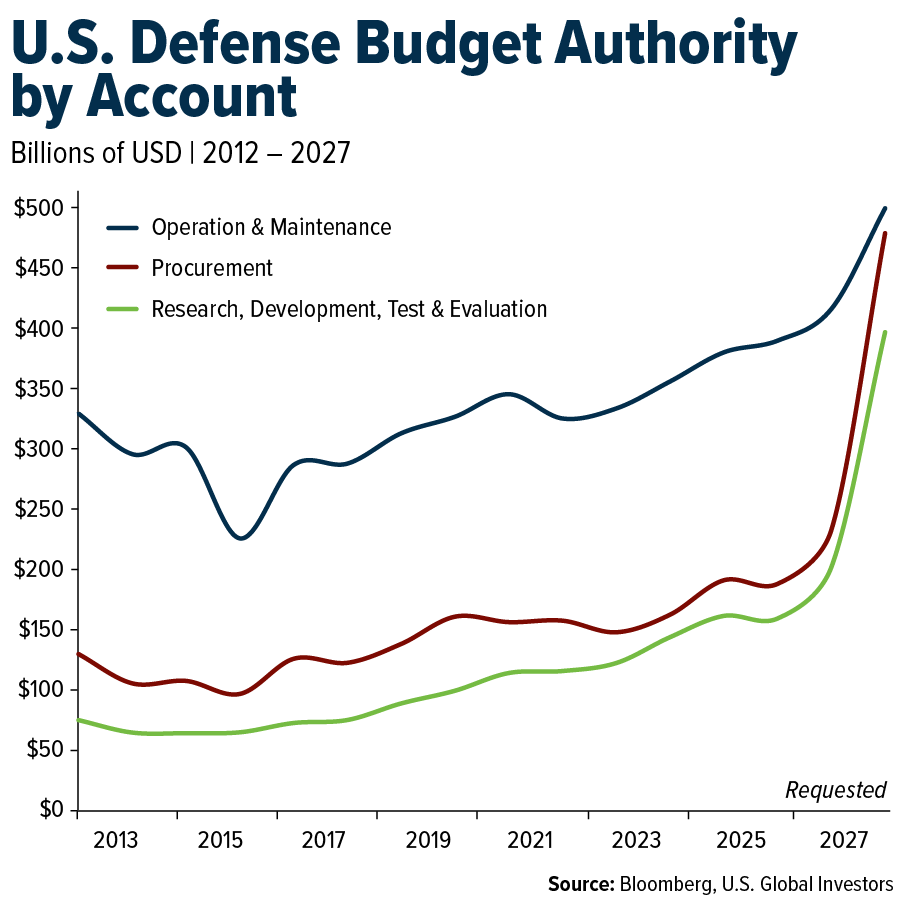
In the fiscal 2027 request, procurement roughly doubles, from $205 billion to $413 billion, according to Bloomberg data. Research and development nearly doubles, from $179 billion to $344 billion. Operation and maintenance, the account that pays for keeping the lights on, grows about 20%.
Buying and inventing things now takes precedence over maintaining what we already have, by a huge margin.
Europe is doing the same thing. NATO has committed around $40 billion over five years, while the European Union is building a radar and sensor line along its eastern border that’s meant to be operational by 2027.
Cheap Machines Are Rewriting the Math of War
Take a look at the chart below. I put together a basket of seven publicly traded names with exposure to drones and counter-drone technology. Over the past 12 months, that basket is down about 28%. Over the same stretch, the Dow Jones U.S. Aerospace and Defense Index gained roughly 10% and the S&P 500 gained nearly 18%.
The peak came in October 2025, the same week the European airport closures were dominating the news. Since then, it’s fallen about 47%.
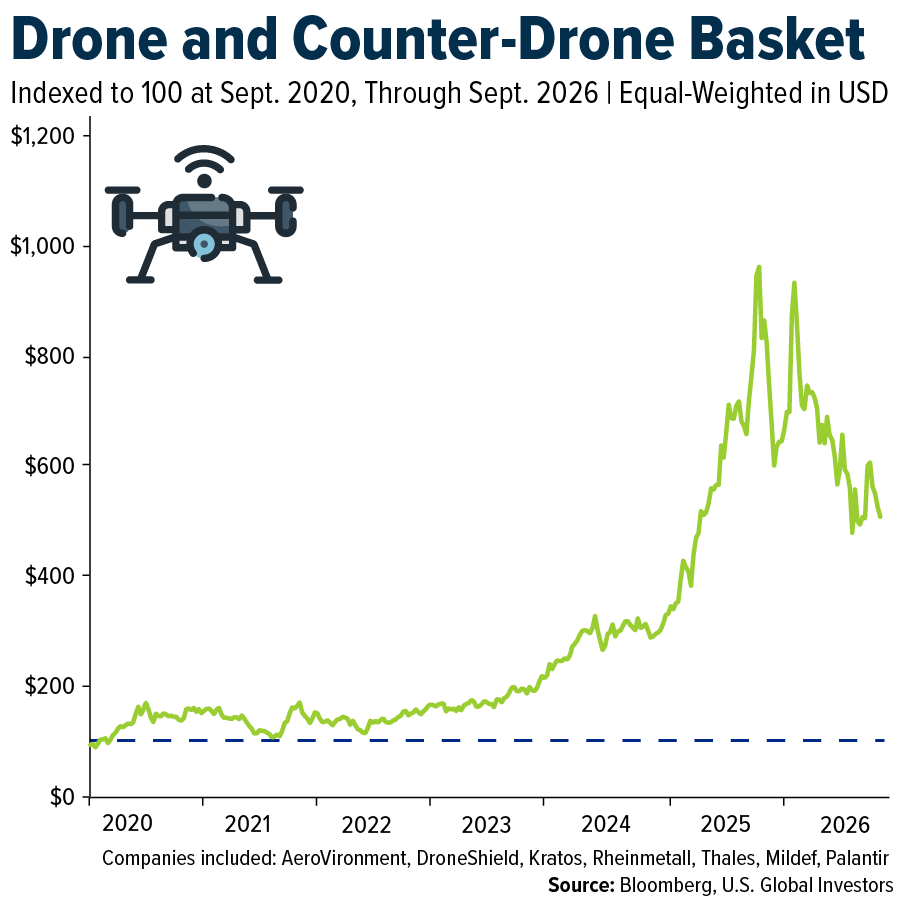
Look at AeroVironment (AVAV), which is about as close to a pure play as the public markets offer. The company just reported record funded backlog of $1.5 billion, up 37% from a year ago, with bookings running about 1.4 times revenue. That’s huge demand, yet revenue grew only 6%. The stock is down about 40% over 12 months, even as a vast majority of analysts covering it rate it a buy.
DroneShield, an Australian firm that makes detection and jamming equipment, grew revenue 74% year-over-year and swung to a meaningful operating loss doing it. Its shares are down about 46%.
Where the Money Actually Went
The thesis was right. Warfare has been restructured by cheap, expendable, autonomous machines, and the West is spending enormous sums to catch up.
Where the thesis actually paid, so far, was not in the shares of the companies making the drones. It was in the price of the fuel that comes out of the refineries the drones destroyed. Diesel near $200 a barrel is a cost borne by every trucker, every farmer, every airline and every household with an oil burner in the basement.
That’s the part I’d be watching.



Comments
Log in or sign up to join the conversation.