

In the first quarter of this year, as the Strait of Hormuz closed and oil prices exploded, Berkshire Hathaway made a couple of moves that might have flown under people’s radars.
It cut its stake in Chevron (CVX) by roughly a third. Then it bought an airline.
Berkshire, now run by Greg Abel, disclosed a $2.6 billion stake in Delta Air Lines (DAL) as of the end of March. In the second quarter, it added another 44%, bringing the position to about 57 million shares. The position was valued at roughly $5.4 billion at the end of June.
To be clear, Berkshire hasn’t walked away from oil. It still owns more than $30 billion of Chevron and Occidental (OXY), and Delta makes up just over 1% of its stock portfolio. But the timing tells an important story.
The Oracle Changes His Mind About Airlines
Few investors have been as hard on airlines as Warren Buffett. He once called the industry a “death trap” for capital and joked that investors would have been better off if the Wright Brothers’ plane had been shot down at Kitty Hawk.
He warmed up in 2016, when Berkshire bought into the four biggest U.S. carriers. Then Covid hit, and in the spring of 2020, Berkshire sold every airline share it owned. Buffett said “the world changed for airlines” and later called the investment a mistake.
I disagreed at the time. In May 2020, I argued that few industries had proven as resilient to outside shocks.
I’ll always count Buffett among the greatest investors of all time. Nobody bats a thousand. But Berkshire has now come back to airlines in the middle of another crisis, with jet fuel pushing $5 a gallon.
Grounded by Fuel
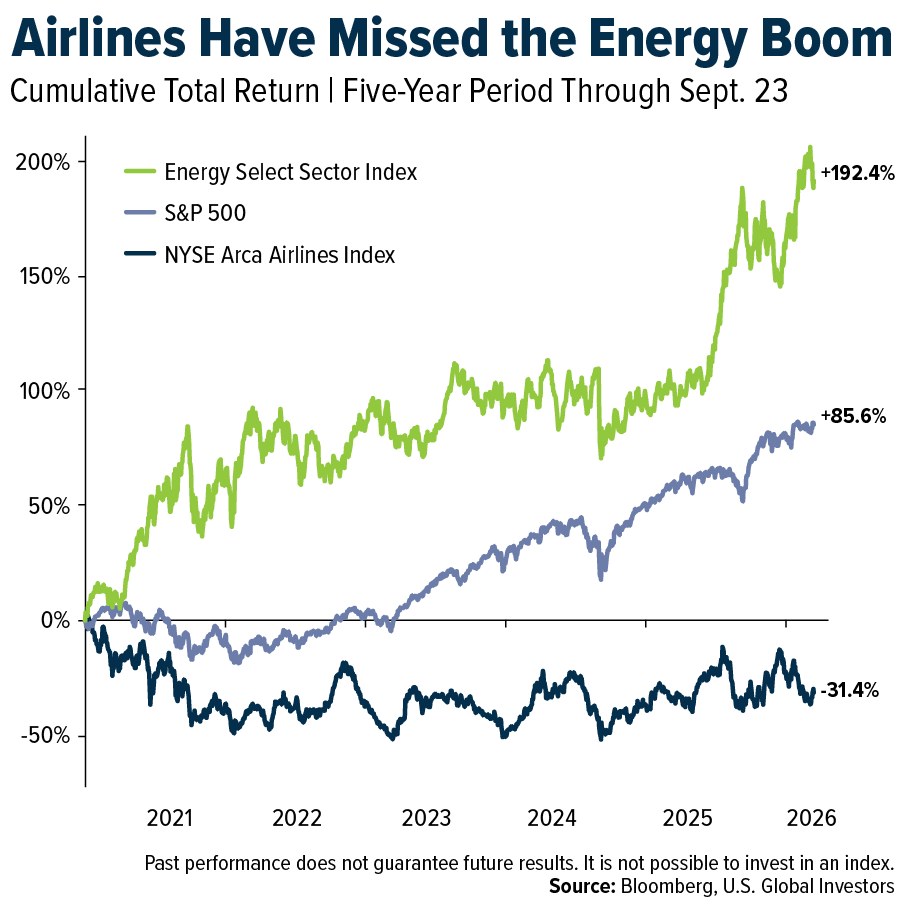
Over the past five years, one of the widest gaps I’ve ever seen between sectors has occurred. The NYSE Arca Airline Index has lost about 31%, including dividends, while energy stocks returned more than 192%. The S&P 500 returned about 86%.
Airlines had clawed back most of those losses by early 2026. Then Hormuz closed, jet fuel roughly doubled and the stocks gave it all back.
As many of you know, fuel is an airline’s biggest expense. At a Morgan Stanley conference this month, American Airlines' (AAL) CFO said fuel running about $1 a gallon above plan adds roughly $1 billion to a single quarter’s fuel bill. United (UAL) has already pulled flights from its December schedule.
So why would anyone buy now?
The Refining Squeeze
Let’s look at New York Harbor diesel futures. They’re the closest traded stand-in for U.S. jet fuel. As of September 24, the contract for this month traded around $5 a gallon. The contract for June 2027 traded at $3.73. That’s $1.27 lower, more than the dollar that adds a billion to American’s quarterly fuel bill.
What surprised me is where the relief comes from. Only about a third of it comes from cheaper crude oil. The other two-thirds comes from the refining premium shrinking.
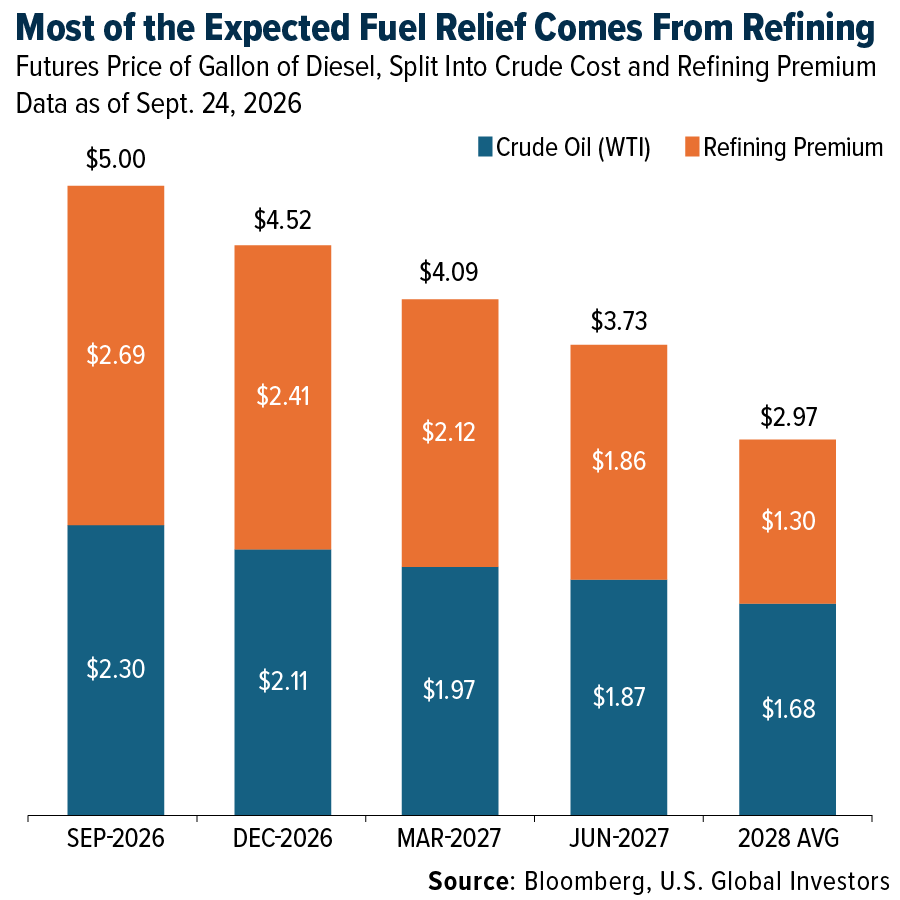
That premium is the extra cost of turning crude into jet fuel. In 2024 and 2025, jet fuel in New York typically sold for $20 to $30 a barrel more than crude, according to Bloomberg data. This month, the gap topped $100 as the war in Iran and Ukrainian strikes on Russian refineries choked off fuel exports.
The airlines’ pain has been the refiners’ windfall, with Valero (VLO) and Phillips 66 (PSX) shares up 127% and 96% so far this year. But some analysts are calling for refining earnings to fall more than 23% next year, according to Yardeni Research data.
The commodity traders and the stock analysts are telling the same story: the squeeze should ease.
Now, futures prices are not forecasts. I don’t believe cheap jet fuel is right around the corner. The International Air Transport Association (IATA) notes the refining premium was already running well above its pre-Covid average before the war, and U.S. refining capacity shrank last year. Relief looks likely, but a return to the old normal does not.
Why No Fuel Hedge Could Pay Off
U.S. airlines largely gave up fuel hedging years ago. Southwest (LUV) ended its famous program in late 2025, just before the shock hit.
European carriers took the opposite approach. According to Reuters, Lufthansa (DLAKY) has hedged 86% of its 2026 fuel, and Ryanair (RYAAY) has locked in about 80% of next year’s needs at prices based on $67 oil.
That’s why U.S. carriers took the full hit this year. But if the futures market is right, those airlines will feel the relief first and fully, while their European rivals stay locked into their hedges.
Quality Over Quantity
Not all airlines are created equal, and I believe this is the key to Berkshire’s choice. In 2016, the firm bought the whole sector. This time, it bought one airline.
Delta owns its own refinery outside Philadelphia, which earns back part of that refining premium in the Northeast, where it’s been highest. Analysts estimate the refinery could lower Delta’s fourth-quarter fuel cost by around $0.40 a gallon. The company’s operating income covers its interest expense more than eight times over. By contrast, American’s operating income currently doesn’t cover interest at all, according to Bloomberg data.
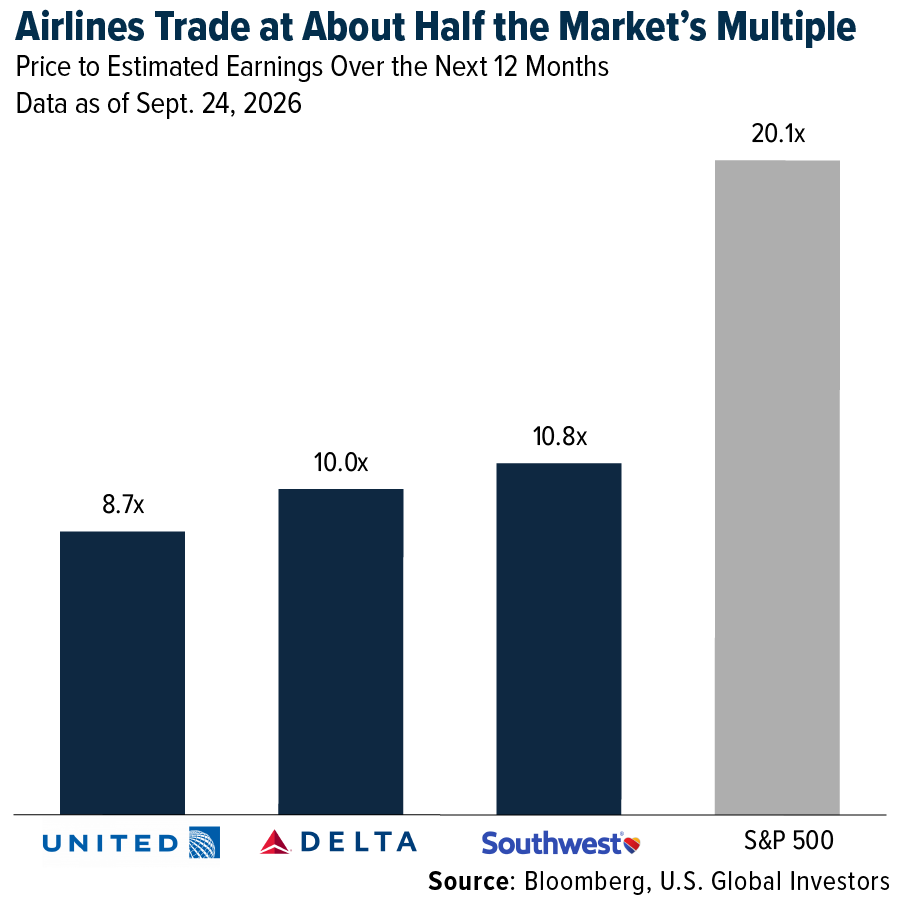
Valuations are modest. Delta, United and Southwest trade at roughly 9 to 11 times forward earnings, about half the S&P 500’s multiple of around 20. Airlines have always traded at a discount to the market given how cyclical they are, but UBS analysts argue quality carriers could earn structurally higher valuations over time now that the industry has shown real pricing power.
Buckle Up for Earnings Season
Earnings season starts October 9 with Delta. Fuel is running above what several carriers guided, so third-quarter earnings will take a hit, which Wall Street largely expects. I’ll be watching fourth-quarter revenue guidance instead, and whether pricing strength can outrun the fuel bill.
If the Middle East conflict drags on, the futures market could be proven wrong. And the recent jump in the 10-year Treasury yield could cool consumer spending.
There’s also policy risk. The administration is weighing a ban on diesel exports. Last week, dozens of industry groups warned the president that a ban would force refiners to cut output and raise jet fuel prices, a view it’s said Energy Secretary Chris Wright and Interior Secretary Doug Burgum share. As I often say, government policy is a precursor to change.
Buying Through the Storm
Airline stocks are priced as if this fuel shock will last forever. The futures market says it won’t. Travelers are paying up, and capacity is disciplined.
Berkshire isn’t betting that jet fuel goes back to $2 a gallon. It appears to be betting on the airline best positioned to win when fuel costs more than it used to, and it’s been buying through the worst of the storm.
Comments
Log in or sign up to join the conversation.