

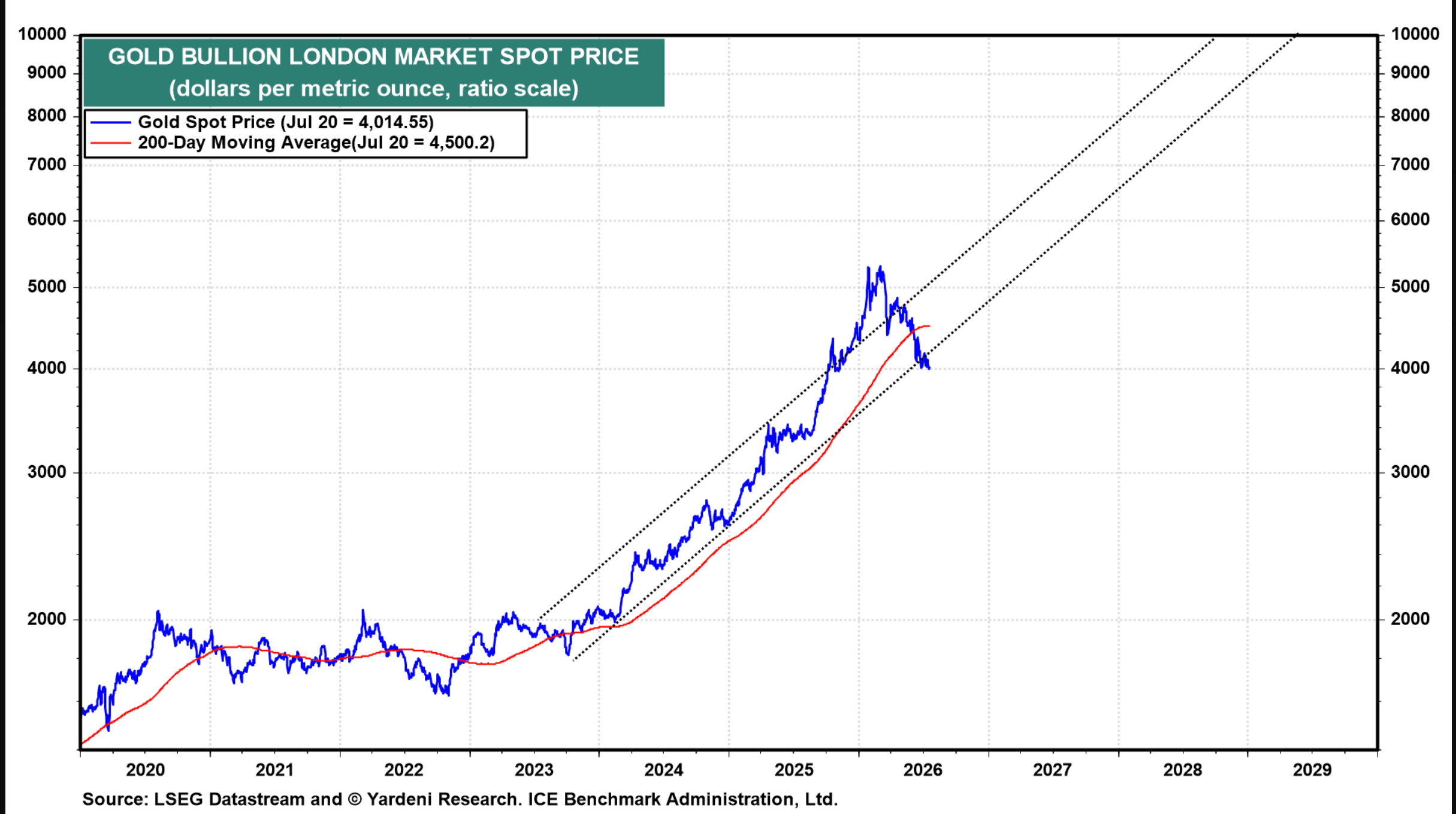
When the price of gold peaked at $5,500 in January, it was technically overbought. Now the dynamics have flipped, with gold “massively” oversold.
“Oversold” is a technical term meaning that an asset has declined so rapidly or so far that momentum indicators indicate selling pressure may be exhausted, and a rebound is likely in the near future.
The 200-day moving average currently indicates an oversold market.
Gold tends to find support when the price falls to 90 percent of the 200-day moving average. We are currently well below that level, with the 200 DMA at around $4,559.
In an interview with Kitco News, Sprott managing partner and market strategist Paul Wong noted the 200-day moving average and said the charts look remarkably similar to previous pullbacks.
“The percentage below the 200-day moving average, that's just a technical measure. Internally, I have five or six other measures that show minus two or minus three standard deviations oversold. I tend to think about things more in terms of probabilities: where are you on the distribution curve probabilities? Are you oversold? Give me a number. According to this measure, it's minus two standard deviations. According to this measure, it's minus two and a half, minus three, whatever. Add them all up, and what does it mean? It means that it's harder and harder to push down the price of gold. That's what the probability says.”
Wong emphasized that it’s not just one metric signaling an oversold gold market.
“I've built up all these indicators over the years, so I fire them all up, and if all of them are saying minus two standard deviations or lower, then chances are it's oversold. It doesn't mean it's the low; it just means the bulk of the selling is probably done. And now you're switching to look for an entry point, or if you're a massive fund, you just start buying, and on down-dip days when it drops 1 percent or 2 percent on some news or whatever, you just buy a little bit more.”
However, that doesn’t mean gold will necessarily start to rally tomorrow. Most investors still have a bearish outlook, imagining that the Federal Reserve will keep interest rates higher for longer to battle price inflation. With the conflict between the U.S. and Iran heating up again, we will likely see continued selling pressure. Wong said we need a catalyst for gold to break higher.
“What is it going to get to spark it back up? That's the whole thing.”
Gold is also fighting against seasonal weakness, with the yearly low historically coming in August. Wong said that historic summertime bottom could be viewed as an entry point. Last year, gold hit a low of around $3,300 in late August, coinciding with Jerome Powell’s Jackson Hole speech. From there, it rallied to around $4,500 in October.
Wong said he thinks we will see a similar price movement this year.
“Probably sometime in August, whether it's Jackson Hole or something sooner, or something blows up in the Middle East, or the bond market goes bonkers. There'll be some sort of event, a catalyst, that all of a sudden sparks gold up again.”
The Debasement Trade: Bonds Are the Battlefield
Wong emphasized that the debasement trade that drove gold to record highs remains in play despite gold’s recent correction and sideways trading. This is reflected in rising bond yields. Wong called it “a grumpy bond market,” and many analysts think we are in the early stages of a secular bond bear market.
“Anywhere in the world, bond markets are not happy,” Wong said.
And why would they be?
Governments keep borrowing money. At some point, debt levels rise too high, and investors stop lending as the risk grows. Wong noted that the U.S. national debt has grown by $3.8 trillion in the last year or so, a nearly 10 percent increase.
“Rates are rising. Your interest expense is now greater than your military. Those are deficit-busting numbers. You can see that there's absolutely zero desire from any party in the U.S. to address debt.”
Wong pointed out that the debt problems aren’t limited to the United States. On top of that, there seems to be a “de-globalization” scheme that is exacerbating debt growth.
“That means duplication of everything. You're reshoring everything; that's duplication of supply chains. It's duplication of demand for commodities across the board. You're building inventories because nothing is safe anymore. After this Iran war, everyone's going to be stockpiling energy. Storage is going to go up. You're going to build more [nuclear plants], you're going to build more solar, because those are renewables, and those are secure. Even metals, they're going to be stockpiling more. Meanwhile, governments around the world are changing. They're charging more, they're taxing more, they have more export controls. Everything is going to go up in price.”
For the last couple of years, I’ve argued that the Federal Reserve is in a Catch-22. It needs to simultaneously keep rates higher to fight persistent inflation, and lower rates to stimulate and support the debt-riddled bubble economy. It can’t do both.
Wong recognizes this reality, saying there isn’t a whole lot the central bank can do in this environment.
"What can the Fed do? Not a lot. They can talk a lot. They can try and give confidence, which is what I think Warsh accomplished in June – which sank gold markets – he came out quite forcefully saying sustainable inflation is not going to happen."
However, Wong emphasized the growing pressure in the bond market, saying that Warsh & Company will have to make a “clear choice” at some point in the not-too-distant future.
“You're going to have to give up something. Either you lose control of the bond market – but you can't because you have to keep financing the debt – or you debase the currency. That's the heart of the debasement trade. It's still on, it's still there, and the pressure's still building.”
Wong said he’s not bullish on gold because he thinks gold is some kind of hot investment trend. He thinks gold is destined to continue climbing because governments have no choice but to continue debasing their currencies to ensure fiscal stability.
“Inflation is rising, your debt and deficits are rising, yields are going to go up. You're moving closer and closer to the tipping point in terms of what the bond market will allow. You're going to get a rebellion in the bond market, and you’ve got to keep the bond market happy. And [currency debasement] is your only release valve. Really, that's the bottom line.”

Comments
Log in or sign up to join the conversation.