


Something has shifted in how Washington talks about gold, and most investors are missing it because it’s happening in three separate news cycles instead of one headline.
Let’s connect them.
First, back in July, Treasury Secretary Scott Bessent went on Fox News and, almost as an aside, reminded the country that the dollar “used to be backed by silver, sometimes gold.” He wasn’t making a policy announcement. He was just narrating history. But a sitting Treasury Secretary doesn’t casually bring up the old backing arrangement unless gold is already back in his head as a monetary reference point, not just a commodity.
Then came the second part of that same appearance: Bessent confirming that all of America’s gold at Fort Knox is “present and accounted for,” valued at over $1 trillion at current market prices. He was quick to add that none of it backs the dollar today. Fair enough, technically…
But notice what he didn’t do.
He didn’t dismiss the question as a fringe conspiracy and move on. He answered it seriously, with numbers, on national television, because the White House understands that in 2026, the state of the gold vault is no longer a trivia question. It’s a confidence question, at a moment when the dollar’s share of global reserves is sitting near a 25-year low and central banks have been buying ~1,000 tonnes of gold a year, roughly double the prior decade’s pace.
Now the third piece, and this is the one that should have gotten more attention than it did. On Monday, Bessent stood at the Treasury podium and unveiled “Operation Economic Outcast,” a sweeping new sanctions campaign against Iran. Buried inside the list of targeted sectors, alongside digital assets, aviation, shipping and technology, was gold.
Yes, the United States government just formally classified gold as a sanctionable strategic asset class, in the same breath as crypto and jet fuel.
That is not a small thing, and it is not random. Iran has been leaning on gold precisely because it doesn’t answer to SWIFT. Iranian gold imports ran roughly sixfold higher this year versus the same stretch last year, and a former Iranian central bank official openly said gold has “vaccinated” the country’s economy against Western sanctions for 46 years. Washington knows this. The Treasury’s own people track it. Putting gold explicitly inside the sanctions net is an admission that the metal has become a functioning alternative settlement rail for a regime locked out of the dollar system, and a signal that the US intends to fight for control over that rail rather than concede it.
Put the three pieces together, and a pattern emerges that goes well beyond “gold is a good hedge.”
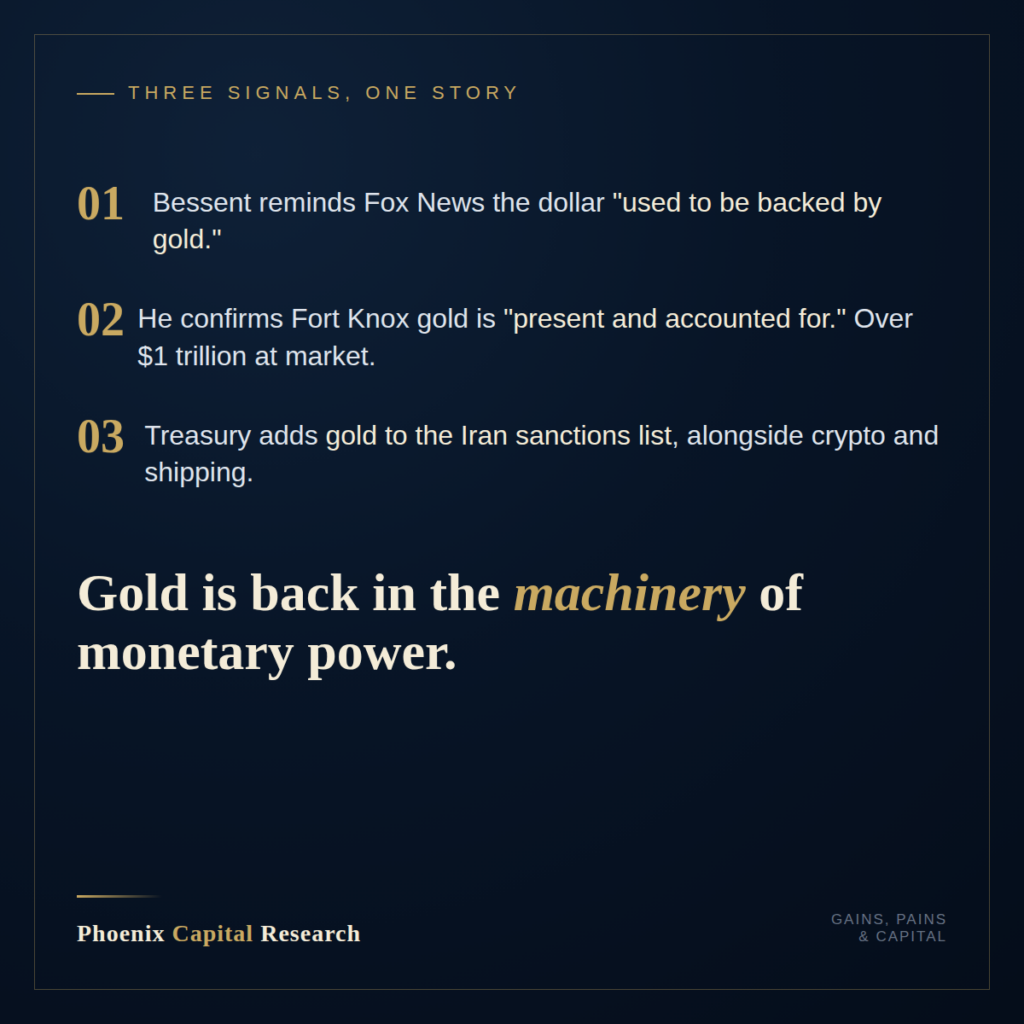
Gold is re-entering the architecture of the financial system, not just the price charts.
For fifty years the story was simple. Nixon closed the gold window in 1971, gold became a relic that sat in a vault at a statutory $42.22 an ounce while the market priced it in the hundreds and then the thousands of dollars. Throughout this period, the dollar ran the world on faith and Treasury paper alone. Gold was a hedge you owned as a hedge against currency debasement. But it was not part of the plumbing.
That framing is now visibly cracking on both ends.
On one end, the Treasury Secretary of the United States is fielding questions about physical gold audits and reserve valuation on prime-time television, something that would have been unthinkable ten years ago when gold was treated as a barbarous relic by every Fed chair.
On the other end, the same Treasury Secretary is treating gold as a sanctionable financial instrument, meaning the US now formally recognizes gold as a channel that nation states use to move value outside the dollar system entirely.
You cannot have it both ways for long.
Either gold is irrelevant to monetary power, in which case you don’t bother sanctioning it, or gold is relevant enough to move real money around sanctioned regimes, in which case questions about how much of it the US actually holds, and whether that $42.22 book value should ever be revalued to market, stop being fringe questions and start being balance sheet questions.
I’ve been making the case in these pages for years that gold functions as a critical mineral and a national security asset, not merely a portfolio diversifier. This week gave us the clearest confirmation yet. When a Treasury sanctions desk puts gold on the same target list as semiconductors and shipping lanes, it is telling you, in the driest bureaucratic language possible, that gold has monetary utility that governments care about controlling.
What this means for you
None of this requires Bretton Woods III or a formal return to a gold standard to matter for your portfolio. It requires something much simpler: the reintroduction of gold as a tool of state power, after five decades of being treated as a museum piece.
That reintroduction changes the demand picture.
Central bank buying at roughly double the historical pace was already the story of the last four years. Layer on a Treasury Secretary who feels compelled to publicly defend the reserve, and a sanctions regime that treats gold as a strategic chokepoint worth policing, and you have two separate government-level forces converging on the same asset from opposite directions, one defensive, one offensive, both bullish for the metal’s role in the system.
I’ll keep tracking the mining equities and the physical exposure names in the portfolio with this framework front and center. But the headline for today is simple. Gold spent fifty years as a relic. This week it started acting like a weapon and a liability at the same time, and that is a very different animal to own.


Comments
Log in or sign up to join the conversation.