

Gold price (XAU/USD) tumbles to near $4,150 during the early Asian session on Thursday, pressured by elevated US Treasury bond yields. Traders await the US September employment data for fresh impetus, which will be released later on Friday.
The 10-year Treasury was up about 4 basis points (bps) at 5.298% in the previous session, while the 30-year Treasury yield was last up nearly 5 bps to 5.642%. Additionally, oil prices rose as US-Iran talks aimed at ending their war stalled.
Higher energy prices can fuel inflation by raising costs across the economy. Gold is widely viewed as a hedge against inflation, but a high interest rate environment increases the opportunity cost of holding the non-yielding metal.
"With energy moving higher, bonds have given up gains and put metals back under pressure; it's a disappointing day for gold even as the odds of an October rate hike have dropped substantially after the softer-than-expected core PCE result," said independent metals trader Tai Wong.
Cooler-than-expected US inflation data reduced expectations for an immediate Federal Reserve (Fed) rate hike. Data released by the Commerce Department's Bureau of Economic Analysis on Wednesday showed that the Personal Consumption Expenditures (PCE) Price Index rose 3.4% YoY in August after a downwardly revised 3.4% in July. This figure came in below the consensus of 3.7%. Core PCE increased 3.0% YoY in August after a downwardly revised 3.0% advance in July, softer than the 3.3% expected.
Gold under pressure as oil gains and yields rise
Analysts at OCBC report that gold has "extended its decline, falling to a 7-week low" as the recent rise in oil prices has "reinforced inflation concerns and expectations for further Fed tightening." They note that "higher US Treasury yields and a firm USD added to the pressure," while "the break below 4200 likely exacerbated technical selling," leaving "oil and the corresponding rates response" as the key near-term swing factors. OCBC adds that "softer US data (such as core PCE, NFP) or some easing in yields could help gold stabilise, while another leg higher in oil and yields would keep downside pressure intact."
Kashkari questions policy tightness as resilient economy keeps FED hawkish
Fed's Kashkari delivered a notably hawkish-leaning message, with a 7.1/10 FXS Speechtracker score standing above the 6.2/10 historical average, underscoring concern that inflation near 3% remains too high even as the economy proves resilient. By openly questioning whether monetary policy is truly tight, highlighting a potentially higher and elevated neutral rate, and penciling in one more hike this year plus another in 2027, the speech signals a bias toward maintaining restrictive settings despite hopes of achieving disinflation with only modest action. The emphasis on strong consumer spending and broad labor market strength, alongside skepticism that the economy is weak outside the AI sector, reinforces a narrative of enduring economic momentum that justifies a cautious stance on easing.
The FXS Fed Sentiment Index slipped by 0.42 points to 143.28, indicating a modest pullback in perceived hawkishness but still firmly in hawkish territory well above the neutral 100 mark. Despite the slight decline, the combination of elevated index level and an above-baseline FXS Speechtracker score confirms that markets should continue to price a FED reaction function biased toward keeping rates higher for longer, even as sentiment edges off peak hawkishness.
Technical Analysis: Gold retains a negative outlook below the 100-day SMA
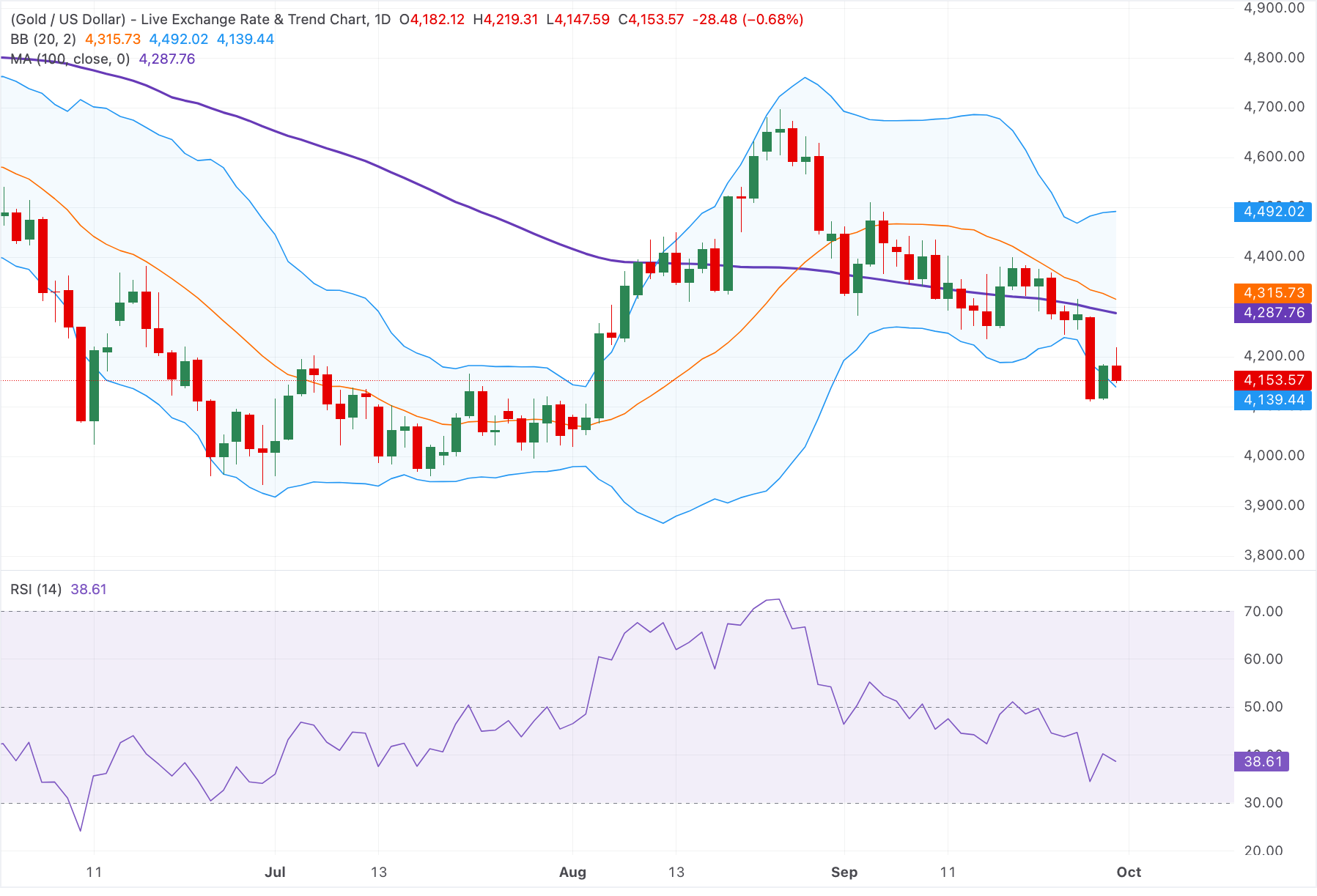
In the daily chart, XAU/USD maintains a bearish near-term tone as spot holds under the 100-day simple moving average (SMA) and the 20-day SMA, which coincides with the Bollinger middle band. Price is hovering just above the Bollinger lower band support, while the Relative Strength Index (RSI) at 38.61 sits below neutral, hinting at subdued buying interest after the recent pullback.
On the topside, initial resistance appears at the 100-day SMA near $4,285, followed by the 20-day SMA/Bollinger middle band at $4,315, with a stronger cap emerging at the Bollinger upper band around $4,490. On the downside, immediate support is defined by the Bollinger lower band at $4,140; a decisive break below this floor would open the way for a deeper corrective phase, while holding above it keeps the metal in a consolidative drift beneath the clustered moving-average resistance.

Comments
Log in or sign up to join the conversation.