


The EUR/USD pair trades in negative territory around 1.1360 during the early European session on Tuesday. The Euro (EUR) weakens to its lowest since July 28 against the US Dollar (USD), pressured by surging US Treasury bond yields and hawkish signals from the Federal Reserve (Fed) officials. Traders await the Fedspeak later on Tuesday.
Expectations of Fed rate hikes grow after Fed policymakers said further rate increases may be needed to curb unacceptably high inflation, following September’s quarter-point hike in the benchmark rate.
Cleveland Fed President Beth Hammack said on Friday that inflation risks remain high and that restrictive monetary policy should be maintained. Additionally, Fed Governor Michael Barr said that “further policy adjustments are likely to be needed” to get inflation under control.
Markets are now pricing in nearly a 70.3% probability of a quarter-point rate hike from the Fed at the October meeting, according to the CME's FedWatch tool. Traders are almost fully pricing in four quarter-point hikes over the next 12 months.
Dollar strength forces another downgrade to EUR/USD outlook
Analysts at Societe Generale highlight how persistent Dollar strength has steadily forced down EUR/USD projections this year. “At the start of this year, consensus forecasts expected EUR/USD to reach 1.20. We projected 1.14. Now, the consensus has moved down to 1.16, while our forecast stands at 1.15 (and I'm regretting the change),” they note, underscoring how sentiment has shifted in favor of the Dollar.
According to the bank, feedback from recent client meetings suggests positioning may be even more skewed than published forecasts imply: “The impression we get from client meetings is that the market is, overall, considerably more dollar-bullish than even those forecasts suggest.” Societe Generale argues that “elevated oil and other commodity prices, robust US economic data, and a more risk-averse global environment have bludgeoned bearish dollar views,” reinforcing the move lower in EUR/USD expectations.
Looking ahead, the team cautions that the current macro backdrop could soon test key levels, warning that “higher inflation and resilient real-economy data could propel the Dollar Index to a near-2026 high (just 0.7% away) or push EUR/USD to a new low (only 0.5% away).”
Cook flags AI and geopolitical risks as inflation drivers, keeps Dollar bulls alert
Fed’s Cook delivers a slightly more hawkish-than-usual tone, with a 7/10 FXS Speechtracker score marginally above the 6.9/10 historical average, as Cook highlights “continued inflation pressure” ahead from artificial intelligence and Middle East conflict. While acknowledging modest disinflation from AI-driven productivity over the next few years, Cook stresses that these gains will not arrive in time to counter the broadening inflation pressures this year and underscores that the labor market is “well positioned” to absorb further rate increases, even as Cook remains highly attentive to a scenario where AI temporarily lifts unemployment. The emphasis on data-dependent “number and magnitude” of future rate moves, coupled with concern that cutting rates to cushion AI-related job losses could reignite inflation, reinforces a bias toward keeping policy restrictive for longer.
The FXS Fed Sentiment Index slipped by 0.63 points to 146.89, signaling a modest pullback in perceived hawkishness despite the speech’s above-baseline tone on inflation risks. With the FXS Fed Sentiment Index still deep in hawkish territory well above the neutral 100 mark, the move suggests markets see Cook’s remarks as a reaffirmation rather than an escalation of the existing restrictive stance, aligning with the slightly elevated FXS Speechtracker score but not enough to push overall sentiment further into hawkish extremes.
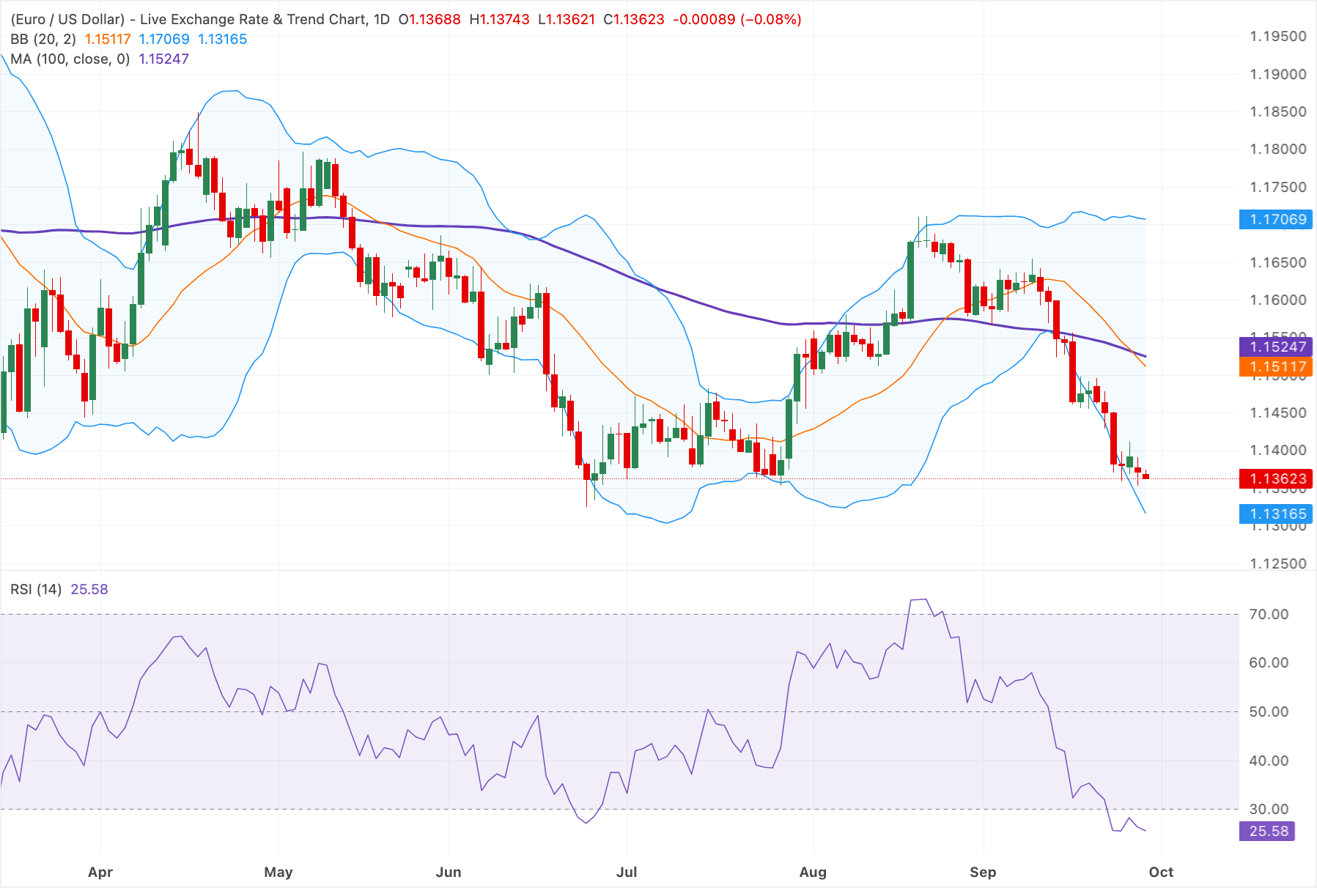
Technical Analysis: Negative outlook of EUR/USD remains intact amid oversold condition
In the daily chart, EUR/USD maintains a bearish near-term bias, holding below the 100-day simple moving average (SMA) and the Bollinger middle band, which together cap recovery attempts. The Relative Strength Index (14) at 25.6 sits in oversold territory, hinting that while downside pressure is dominant, the sell-off could be stretched in the short term.
On the topside, an initial resistance level emerges at the September 25 high of 1.1411. Any follow-through buying above this level could pave the way to the Bollinger middle band around 1.1510, followed by the 100-day SMA at 1.1525 and then the September 9 high of 1.1654. A stronger upside barrier is located at the Bollinger upper band near 1.1705.
On the downside, the immediate support level is aligned with the lower linit Bollinger band at 1.1315. A clear break beneath this level would open the door toward the May 29, 2025 low of 1.1210, followed by the May 21, 2025 low of 1.1050 and the 1.000 psychological level.



Comments
Log in or sign up to join the conversation.