


The GBP/USD pair loses momentum to near 1.3225 during the early European trading hours on Wednesday. Surging US Treasury yields and the hawkish stance of the Federal Reserve (Fed) provide some support to the US Dollar (USD) against the British Pound (GBP).
Chicago Fed President Austan Goolsbee said on Tuesday that inflation remaining above the Fed's target represents a dangerous situation that may require policy action. Meanwhile, Fed Governor Michael Barr warned that further rate increases will likely be needed to slow inflation.
Markets are now pricing in nearly a 47.1% odds of a Fed rate hike in October and a 92.5% chance of an increase in December, according to the CME's FedWatch Tool.
The US ADP employment and Personal Consumption Expenditures (PCE) Price Index reports will be the highlights later on Wednesday. If the reports show better-than-expected outcomes, this could reinforce expectations that the US central bank will further boost interest rates and lift the DXY in the near term.
Pound outlook darkens as UK growth risks collide with BoE tightening expectations
Analysts at HSBC warn that “weak UK labour demand and sluggish private sector momentum could weigh on the GBP in the near term, particularly as the US economy is looking more resilient.” They note that “markets are already pricing around 100bp of tightening from the BoE by July 2027,” but caution that “higher energy prices create a difficult policy mix: inflation risks are rising even as growth momentum faces a challenging outlook.” HSBC adds that the “run-up to the budget update on 28 October may add further pressure, with elevated gilt yields and difficult fiscal choices ahead for the new Chancellor,” reinforcing a challenging backdrop for GBP/USD.
Goolsbee flags AI-driven overheating risks, reinforcing hawkish Fed tone
Fed's Goolsbee delivers a notably hawkish-leaning message, with a 7.1/10 FXS Speechtracker score modestly above the 6.7/10 historical average, underscoring heightened concern about persistent inflation and fiscal stimulus. The warning that expectations of future AI-driven productivity gains create a “high danger of overheating now,” combined with comments on prolonged overshooting of the inflation target, supply shocks, and massive deficits as stimulus, points to a Fed stance that is more alert to upside inflation risks and less inclined to placate bond or stock markets, a backdrop typically supportive of the Dollar and yields. The emphasis on watching productivity and demanding clear evidence that inflation is returning to 2% reinforces a bias toward keeping policy restrictive for longer.
The FXS Fed Sentiment Index rose by 1.01 points to 145.30, firmly in hawkish territory and consistent with the above-baseline FXS Speechtracker score. This elevated level signals that, relative to the established baseline, Goolsbee’s remarks are interpreted as reinforcing expectations of sustained tight policy, a configuration that tends to underpin the Dollar against lower-yielding peers.
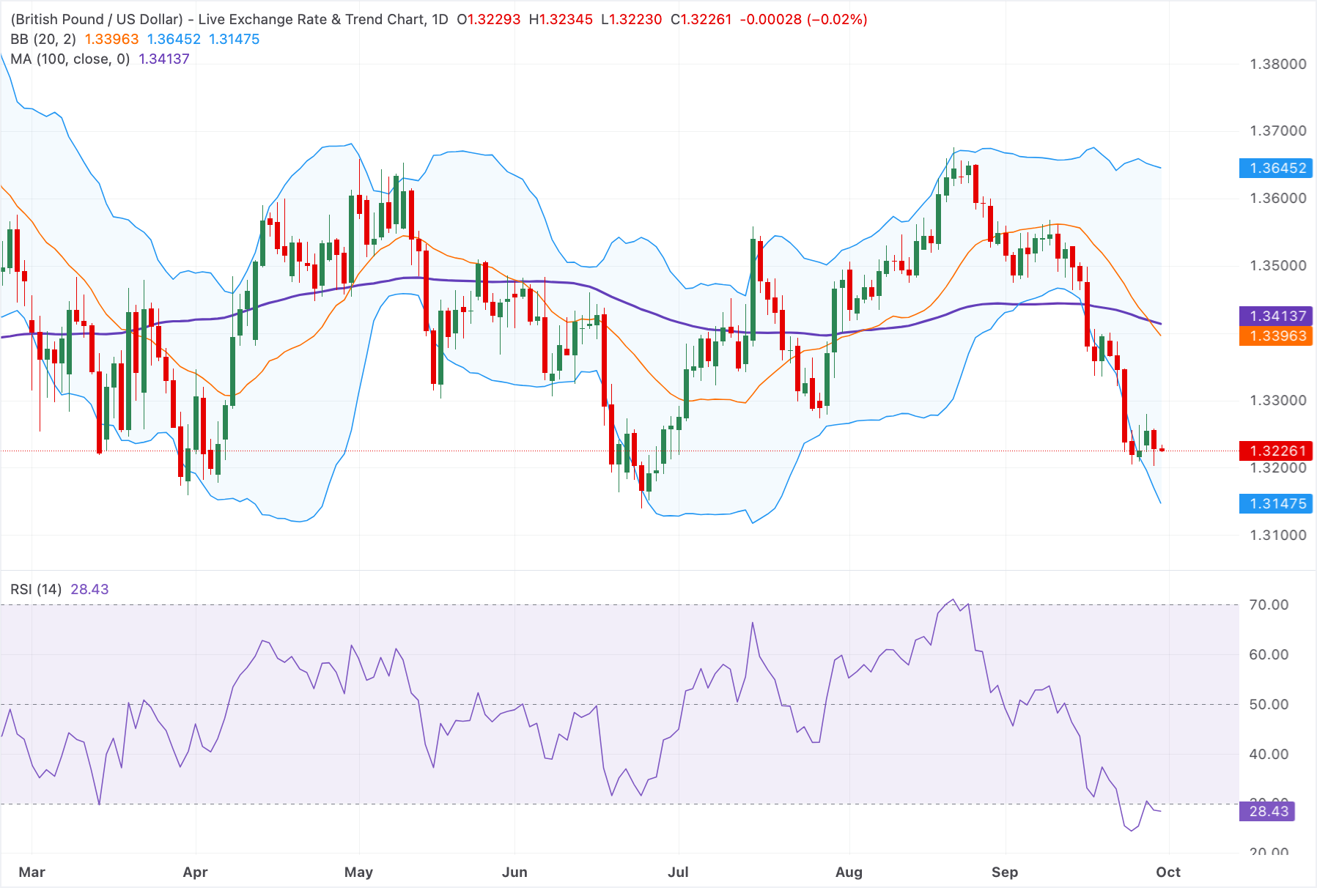
Technical Analysis: GBP/USD remains capped below the 100-day SMA amid oversold conditions
In the daily chart, GBP/USD holds a bearish near-term bias as spot remains below the 20-period Bollinger simple moving average and the 100-day simple moving average (SMA). The pair is drifting toward the lower half of the recent volatility envelope, with price closer to the 20-period Bollinger lower band than to the upper band. The Relative Strength Index (14) at 28.43 sits in oversold territory, hinting that downside momentum is stretched but not yet signalling a clear reversal while key moving average resistance stays overhead.
On the downside, the first support level is located at the September 29 low of 1.3202, followed by the 20-period Bollinger lower band at 1.3145. A daily close below this floor would expose further weakness toward the November 20, 2025 low of 1.3038 and then the 1.3000 psychological level.
On the bright side, initial resistance appears at the September 28 high of 1.3280. Any follow-through buying above this level could pave the way to the Bollinger middle band near 1.3395, followed by the 100-day SMA at 1.3415, which together form a dense supply zone capping any recovery attempts. A sustained break above these levels would open the door toward the Bollinger upper band around 1.3645.



Comments
Log in or sign up to join the conversation.