


Gold price (XAU/USD) tumbles to near $4,290 during the early Asian session on Thursday. The precious metal loses momentum as hawkish signals from Federal Reserve (Fed) policymakers bolstered rate hike expectations, weighing on non-yielding bullion. Traders will take more cues from the Fedspeak later on Tuesday for fresh impetus.
Fed policymakers struck a hawkish tone this week, with Governor Michael Barr said on Wednesday that “further policy adjustments are likely to be needed” to get inflation under control. Richmond Fed President Tom Barkin and Boston Fed President Susan Collins both backed the recent interest rate increase, citing continued inflationary pressures.
The probability that the US central bank would hike rates by a quarter percentage point in October stood around 69.7% following the developments, according to the CME FedWatch tool. That’s up from 48.7% one week ago. Higher interest rates typically weigh on gold because the precious metal does not pay interest, making yield-bearing assets relatively more attractive.
"Post-FOMC Fed speak has been fairly hawkish. So the market is building in expectations of at least one more rate hike before the end of the year. And that's putting gold under pressure,” said Peter Grant, vice president and senior metals strategist at Zaner Metals.
China gold demand surges as imports hit record and ETFs expand
Analysts at ING report a sharp acceleration in China’s physical gold inflows, noting that “Chinese gold imports rose 39.3% year-on-year to 141.7 tonnes in August, taking year-to-date imports to a record 1,141.2 tonnes, up 72.2%.” They attribute the strength in buying to “lower gold prices, a stronger yuan and persistent domestic price premiums” that have encouraged inflows, while banks have also “drew on remaining import quotas under the licensing regime introduced by the PBoC in June.” The firm adds that investor demand has been similarly robust, with “Chinese gold ETFs added around 44 tonnes through August, an 18% increase from the start of the year, according to the Shanghai Gold Exchange,” at a time when “global ETF holdings were broadly unchanged,” underscoring the China-focused nature of the recent demand impulse.
Fed’s Barr flags more hikes as inflation risks rise, supporting Dollar upside
Fed’s Barr delivers a distinctly hawkish tone, with the FXS Speechtracker score at 8/10, above the 7/10 historical average and signaling a stronger-than-usual tightening bias. The assertion that “further rate hikes likely needed to ensure timely return to 2% inflation,” alongside comments that inflation risks have increased while labor market risks have receded, underscores a clear preference for additional policy tightening despite solid growth and a robust labor market. The admission that the Fed was “out of position” and needed to recalibrate policy reinforces the message that the current stance may still be too loose, a backdrop typically supportive for the Dollar and negative for risk-sensitive currencies.
The FXS Fed Sentiment Index rose by +0.42 points to 148.81, firmly in hawkish territory well above the neutral 100 threshold and consistent with the elevated FXS Speechtracker reading. This incremental move higher confirms that recent Fed communication, led by Barr’s remarks, is nudging market expectations toward a more prolonged period of restrictive policy, underpinning Dollar yields and keeping pressure on Euro, Yen and other major counterparts.
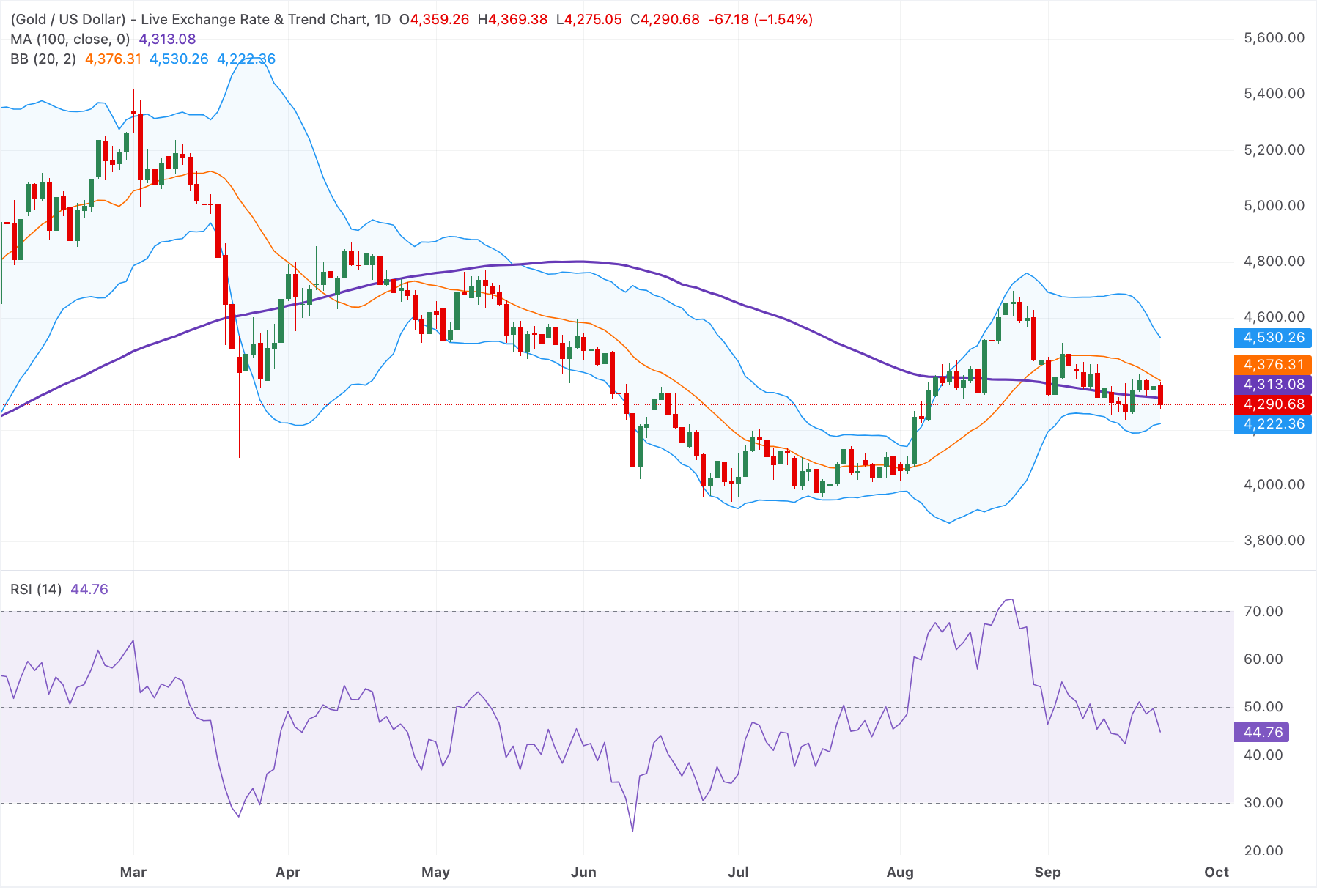
Technical Analysis: Gold keeps a bearish vibe under the 100-day SMA
In the daily chart, XAU/USD holds below the 100-day simple moving average (SMA) and the Bollinger Bands 20-day SMA, which keeps the near-term bias bearish. Price is trapped in the upper half of the Bollinger envelope, with the lower band offering underlying demand, while the Relative Strength Index (14) around 45 suggests subdued, consolidative momentum rather than directional strength.
On the topside, initial resistance aligns at the 100-day SMA ahead of a denser cap at the Bollinger midline around $4,375 and then the upper band near $4,530. On the downside, the Bollinger lower band at $4,222 marks the next notable support, and a daily close below this level would open the door to a deeper corrective slide despite the current sideways tone in momentum.

Comments
Log in or sign up to join the conversation.