


Gold (XAUUSD) remains under pressure as tighter US monetary policy and a stronger dollar continue to weigh on prices. Downside momentum remains firm as markets price a higher probability of further rate hikes, reducing demand for non-yielding assets. Meanwhile, easing inflation concerns and mixed geopolitical signals limit safe-haven demand, keeping sentiment tilted to the downside.
Gold Declines as Hawkish Fed Expectations and Strong Dollar Drive Pressure
Gold continues to react to expectations of tighter US monetary policy while moving lower and extending its decline. The price is trending downward as selling pressure remains dominant. Investors are pricing a higher probability of further rate hikes in the coming period. This reduces demand for non-yielding assets like gold. At the same time, stronger US currency demand adds additional pressure on gold.
Meanwhile, inflation dynamics are also influencing sentiment. Recent declines in energy costs have reduced inflation concerns. This has not supported gold, as markets shift focus from inflation protection to policy tightening. As a result, safe-haven demand remains limited in the current environment, keeping price reactions muted even during periods of macroeconomic uncertainty.
Geopolitical conditions continue to send mixed signals to the market outlook. Developments around US-Iran nuclear talks are showing alternating phases of progress and uncertainty. While some updates point toward diplomatic engagement, other conflicting statements from both sides continue to limit clarity. This creates uneven sentiment, with demand appearing only in short phases rather than building into lasting momentum.
Gold Falls within Descending Wedge as $4,000 Region Comes Into Focus
The gold chart below shows a large multi-year descending wedge pattern that has guided price movements over recent months. Price has continued to move within two downward sloping boundaries during this period. The lower boundary has repeatedly acted as a key support zone, while the upper boundary has limited sustained advances. This structure reflects a prolonged phase of downward compression that gradually shaped market behavior.
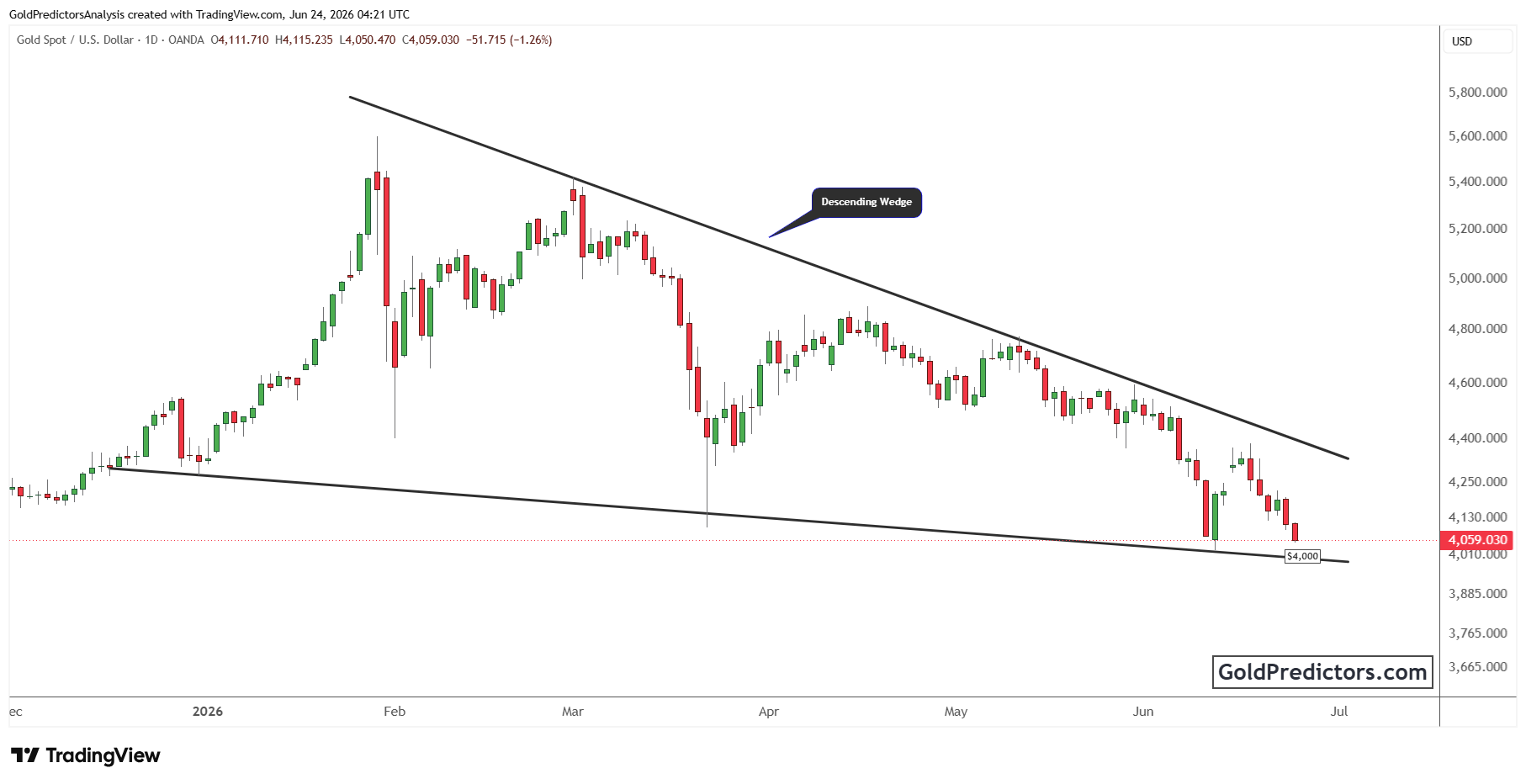
In early 2026, gold reached record levels above the $5,000 area before entering a corrective phase. Price then shifted lower and moved away from the upper boundary of the wedge structure. The move reflected fading momentum after the extended rally. Sellers gained control as price continued to drift toward the lower side of the formation.
The recent decline has brought gold back toward the $4,000 region. Price still trades inside the wedge despite the pullback. The lower boundary now plays a key role in shaping the next direction. A move below this area could open space for deeper downside pressure, while stability above it could maintain the broader structure.
Gold Outlook: Fed Policy and Dollar Strength Continue to Cap Recovery Attempts
Gold continues to move lower as Fed policy expectations and a stronger dollar shape market direction. Rate hike expectations keep demand for gold limited. Easing inflation concerns also reduce support for the metal. Meanwhile, geopolitical signals remain mixed and fail to build consistent demand. The chart shows price still inside a multi-year descending wedge. The lower boundary now becomes the key level to watch. Price action around this area may guide the next major move in the market. To receive gold and silver trading signals and premium updates, please subscribe here.


Comments
Log in or sign up to join the conversation.