

Gold (XAU/USD) is consolidating following its recent advance as markets focus on inflation developments and Federal Reserve policy expectations. Lower Oil prices have eased inflation concerns and reduced expectations for higher interest rates. US-Canada trade tensions and stronger physical demand from India also support the precious metal. Markets will now focus on US core PCE data and Federal Reserve Chair Kevin Warsh’s Jackson Hole speech for the next direction.
Gold Price Holds Firm as PCE Data and Fed Signals Drive Market Focus
Gold is consolidating after its recent advance as markets assess changing inflation expectations and await fresh signals from the Federal Reserve. Developments around the Strait of Hormuz have also pushed Oil prices lower. Lower energy prices have eased concerns about persistent inflation. This has reduced expectations that the Federal Reserve will raise interest rates at its next policy meeting. These developments continue to support gold.
Trade tensions between the United States and Canada continue to create uncertainty across financial markets. Canada has announced new tariffs on hundreds of US products in response to measures introduced by Washington. The growing trade dispute could increase concerns about the economic outlook and provide further support for gold. The US Treasury’s larger bond-buyback program also remains supportive for the precious metal. At the same time, physical demand from India has strengthened. Gold imports rose notably in July following two months of weaker activity, indicating renewed demand from the country’s domestic market.
Markets are now focused on the US core PCE Price Index for fresh clues on the inflation outlook. A softer reading could ease inflation concerns and further reduce expectations for higher interest rates. Lower Treasury yields could then provide additional support for gold. In contrast, stronger inflation could revive expectations for tighter monetary policy and weigh on the precious metal. Attention will then shift to Federal Reserve Chair Kevin Warsh’s speech at the Jackson Hole Symposium. His remarks could offer clearer signals about the direction of monetary policy.
Gold Technical Analysis: Triangle Breakout Keeps $4,800 in Focus
The gold chart below shows a large symmetrical triangle that has shaped price action over recent months. Gold reacted to both trendlines several times as the pattern gradually narrowed. The lower trendline provided important support during periods of weakness, while the upper trendline acted as resistance during stronger advances. These repeated reactions gradually pushed price into the narrowing section of the triangle.
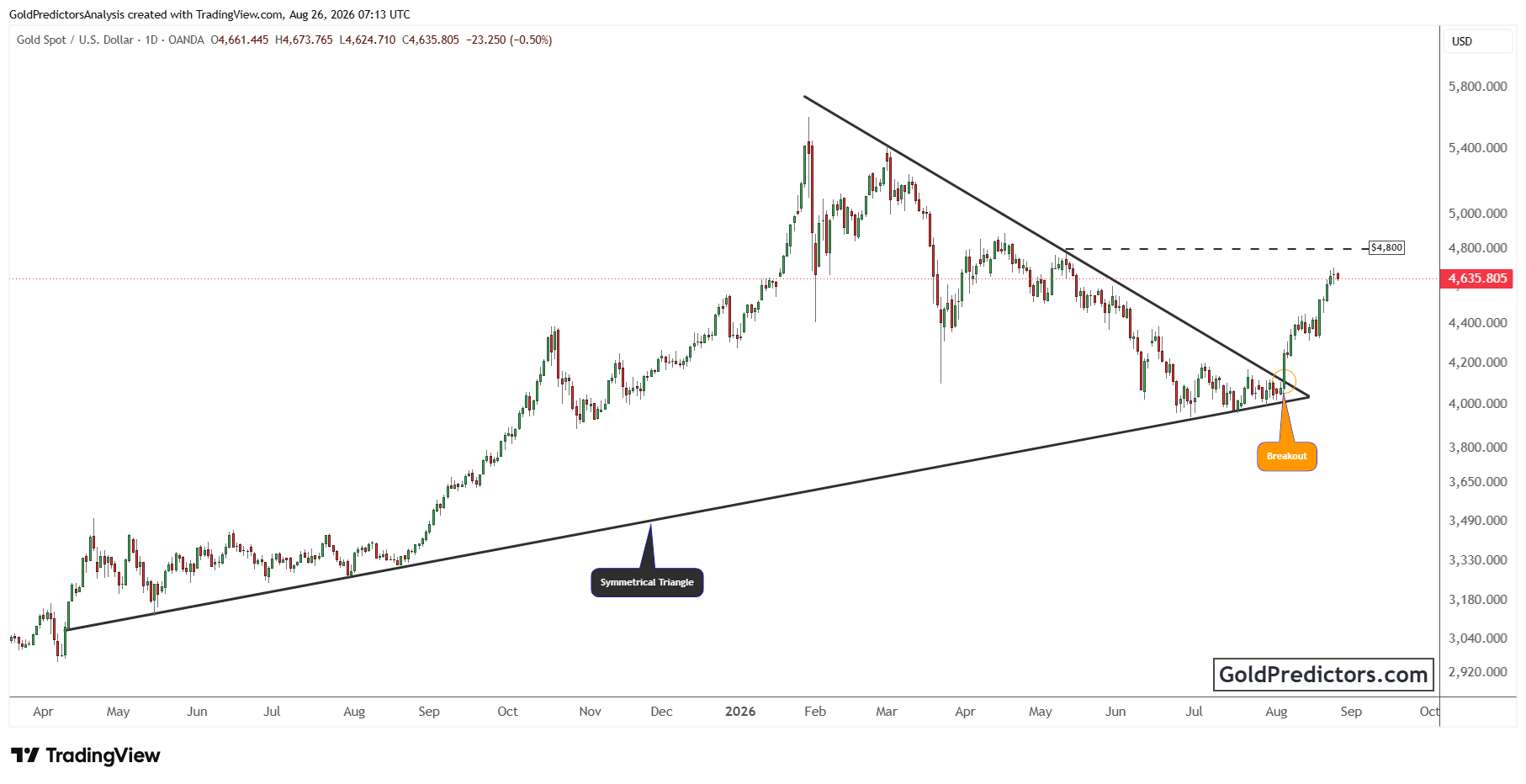
Gold eventually broke above the resistance trendline near the end of the formation. The breakout marked an important shift in the technical structure. Price gained strength above the broken trendline and advanced toward the $4,690 region before turning lower. Despite the decline, gold remains well above the former resistance trendline, keeping the triangle breakout intact.
The $4,800 region remains an important resistance area if gold regains strength from the current decline. A renewed advance toward this level could support further gains, while a break above $4,800 would strengthen the technical outlook. However, continued weakness could bring the former triangle resistance trendline back into focus as support. Holding above this trendline would keep the breakout structure intact and could support another advance.
Gold Outlook: Fed Policy and Inflation Data Drive Market Focus
Gold remains stable as falling Oil prices reduce inflation concerns and weaken expectations for higher interest rates. US-Canada trade tensions and stronger physical demand from India provide additional support. The triangle breakout also keeps the technical outlook positive despite the decline from the $4,690 region. The $4,800 area remains an important resistance level if gold regains strength. Holding above the former triangle resistance trendline could support another advance. Markets will now focus on US core PCE data and Federal Reserve signals for the next direction.



Comments
Log in or sign up to join the conversation.