


With US federal debt exceeding 120% of GDP, Moody’s stripping the United States of its last AAA credit rating in May 2025, Fitch downgrading France’s sovereign rating in September 2025, and the 10-year yield spread between French government bonds (OATs) and German Bunds exceeding 100 basis points in September 2026, sovereign risk is no longer the exclusive preserve of emerging markets or the eurozone periphery. This is the first time since 2012 that we are witnessing such a development.
At the same time, gold became the second-largest reserve asset held by central banks in 2024, overtaking the euro. This article examines the extent to which gold can serve as an “option” against sovereign risk. The evidence suggests that gold responds significantly to major changes in credit risk spreads, particularly in the eurozone, as well as to currency depreciation.
Gold: a hedge and a safe haven
A protective asset should be assessed by how it behaves when other assets fail. Baur and Lucey (2010) distinguish between a hedge – an asset that is, on average, uncorrelated with a portfolio – and a safe haven, which provides protection during market crashes.
Gold offers an additional advantage when it comes to sovereign risk: it is a real asset with no issuer and therefore no counterparty risk. It cannot be restructured or monetized. Under these conditions, gold can be viewed as a digital (or binary) option on confidence in the issuing government.
As long as sovereign risk remains contained, gold offers little beyond its carrying return, which is zero or negative. But when a threshold of distrust is crossed – through a sharp widening of credit spreads, a sovereign credit rating downgrade, or debt monetization – it delivers a discrete, nonlinear payoff.
Chart 1 compares this theoretical profile with data covering January 1999 to September 2026. The average six-month return on gold in euros rises as the yield spread between Italy and Germany widens. It increases from 1.1% when the spread narrows by more than 50 basis points to 9.6% when it widens by more than 100 basis points.
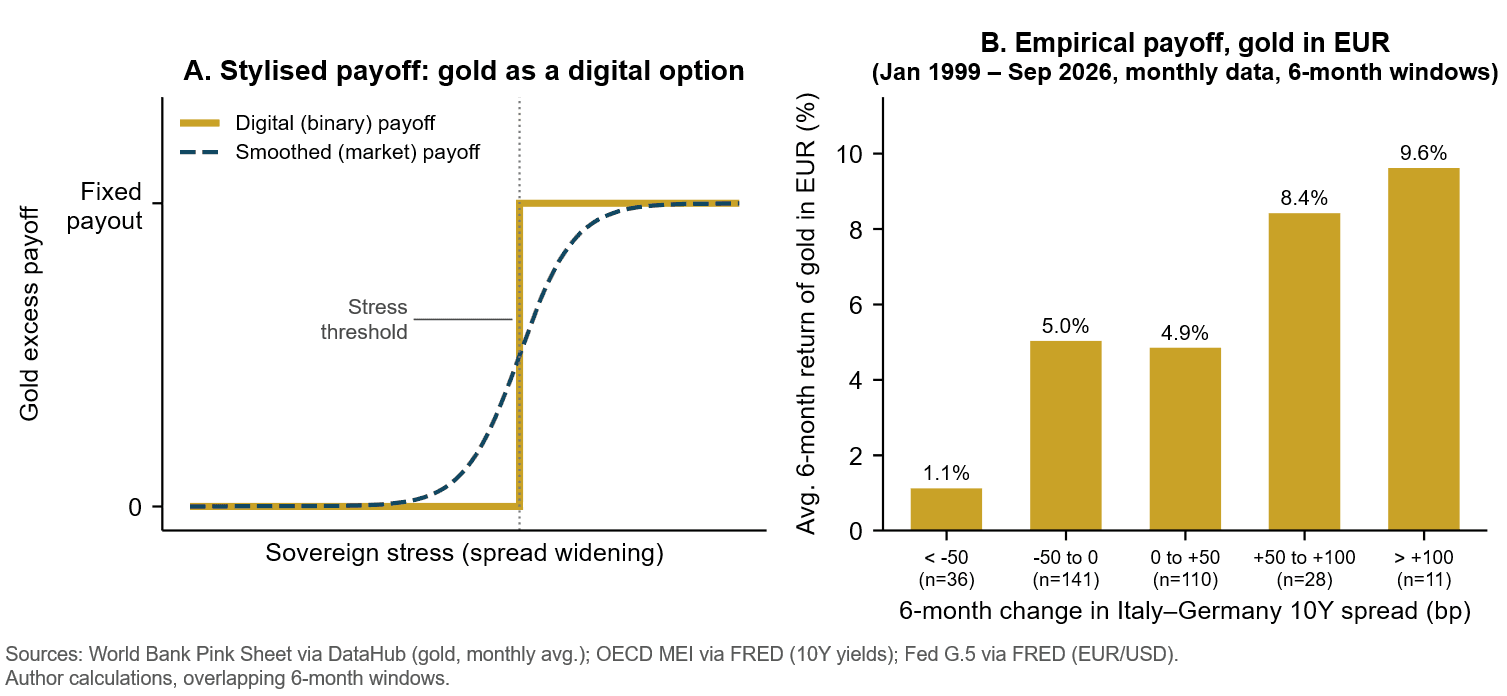
Chart 1 — Gold as a digital option on sovereign stress: theoretical payoff profile and observed returns
The analysis is conducted in euros because the yield spread between Italy and Germany reflects risk within the eurozone. This finding is consistent with Agyei-Ampomah, Gounopoulos and Mazouz (2014), who find that gold provides better protection against losses on bonds issued by financially vulnerable countries, such as Greece, Italy and Portugal – and, more recently, France – than against losses on bonds issued by stronger sovereigns. Investors tend to regard the latter as substitutes for gold.
The option is therefore most valuable when risk is poorly anticipated and nonlinear. All else being equal, the risk of default increases exponentially as interest rates rise. Conversely, the option is worth considerably less when default is expected and already priced into the market.
Concerns about public debt: how much is the “option” worth today?
To price this option, we must first estimate what gold would be worth without it. We use two reference points. The first is financial: the real price of gold tends to fall when real interest rates rise, since gold pays no coupon. A strong dollar also weighs on its price because it makes the metal more expensive for the rest of the world.
The second reference point is physical: the all-in sustaining cost (AISC) of gold production reached $1,552 per ounce in 2025, according to Metals Focus. In the years for which data are available between 2012 and 2022, gold traded at an average of approximately 1.6 times this cost, implying a price of around $2,600 per ounce today (Chart 2).
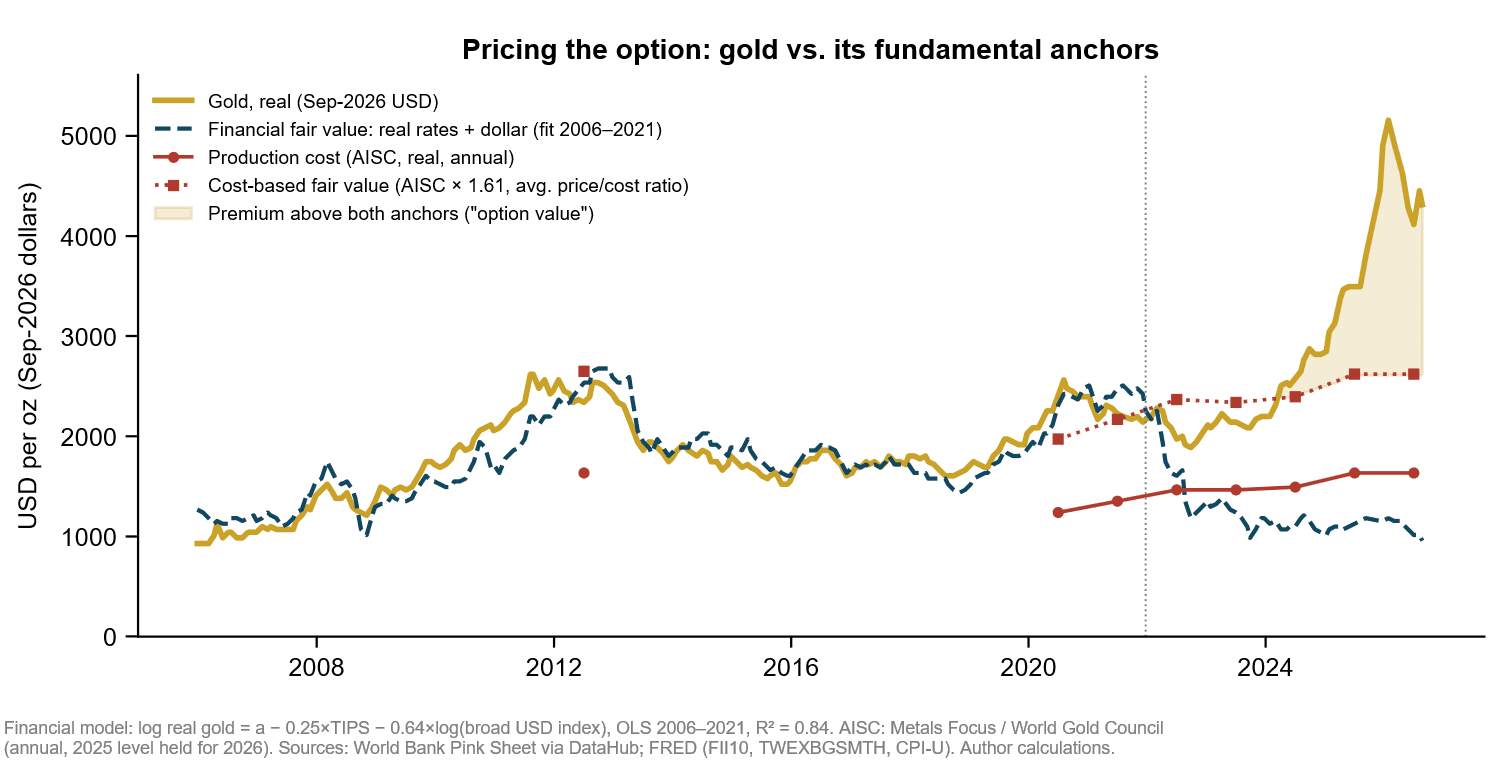
Chart 2 — Actual gold price, its financial value based on real interest rates and the dollar, and its value based on production costs
Since 2022, gold has decoupled from both reference points: real interest rates have risen sharply without triggering a decline in gold prices. At $4,147 recorded on October 15, 2026, the premium unexplained by interest rates, the dollar and production costs accounts for between 37% and 77% of the price, depending on the benchmark used. This premium can be interpreted as the price of the protection gold provides, allowing us to infer an implied probability of crisis.
Let S denote the current gold price, V its fundamental value, and C the price it would reach in the event of a sovereign crisis. If the market assigns a probability p to such a crisis, then:
S = (1 − p) × V + p × C
Rearranging gives:
p = (S − V) / (C − V)
Since C is unknown, we test several scenarios. If a crisis were to double the gold price (C ≈ $8,300), the implied probability p would range from 27% (assuming V ≈ $2,600) to 43% (assuming V ≈ $960). If a crisis were to triple the price, the implied probability would range from 16% to 28%.
These probabilities are known as risk-neutral probabilities and incorporate investors’ risk aversion. The premium also reflects central bank purchases, which exceed 1,000 tonnes a year, concerns about sanctions, and demand for protection against inflation.
All these motives nevertheless point to the same underlying concern: declining confidence in government debt and the currencies in which it is denominated. Reserve managers surveyed by the European Central Bank explicitly cite default risk as well. The option is therefore expensive. Buying gold at this price amounts to betting on the probability of a breakdown in the financial system. Yet the premium is not without justification (see our latest article).
Sovereign risk and gold performance
To measure the relationship between gold and sovereign risk more directly, we use the 10-year yield spread between France (or Italy) and Germany. This indicator helps isolate the issuer-specific risk premium within a common currency.
Over a one-month horizon, the relationship is almost nonexistent: changes in the OAT–Bund spread explain just 0.5% of the variation in gold prices in euros. Over a 12-month horizon, however, the relationship becomes statistically significant. On average, each basis-point widening in the French spread is associated with an additional 0.19% increase in the price of gold in euros (t = 3.3), equivalent to nearly 19% for a 100-basis-point shock (Chart 3).
Gold therefore appears to hedge against deteriorating public finances when uncertainty changes significantly. (In our analysis, this effect becomes apparent when the spread moves by more than ±25 basis points.)
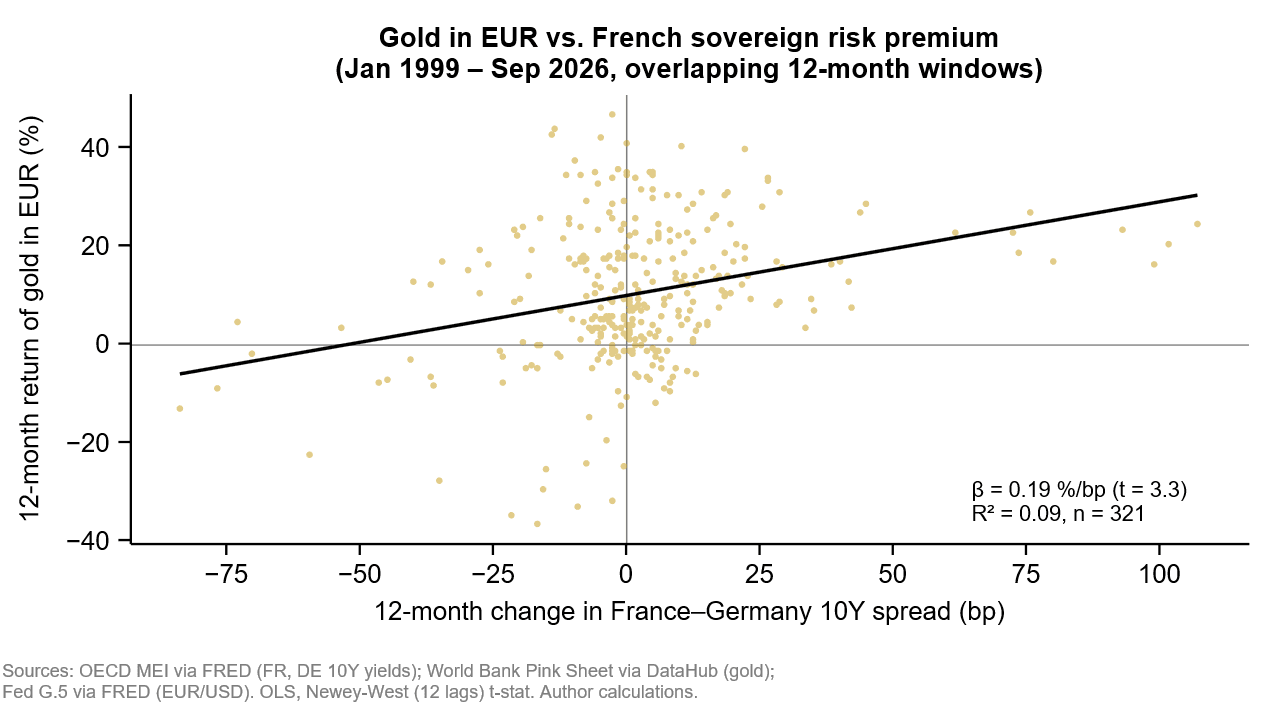
Chart 3 — Twelve-month returns on gold in euros and changes in the France–Germany yield spread
Historical comparison
At the height of the sovereign debt crisis in November 2011, the yield spread between Italy and Germany reached 518 basis points, while the French spread stood at 154 basis points. Over the same period, the average price of gold in euros rose from approximately €590 per ounce in 2008 to nearly €1,300.
Today’s stress is of a different nature. Although it is more widespread, it is particularly concentrated in France. The French spread reached 101 basis points in September 2026 and has exceeded Italy’s since late 2025. Meanwhile, gold is trading at around €3,750 per ounce, more than six times its 2008 level.
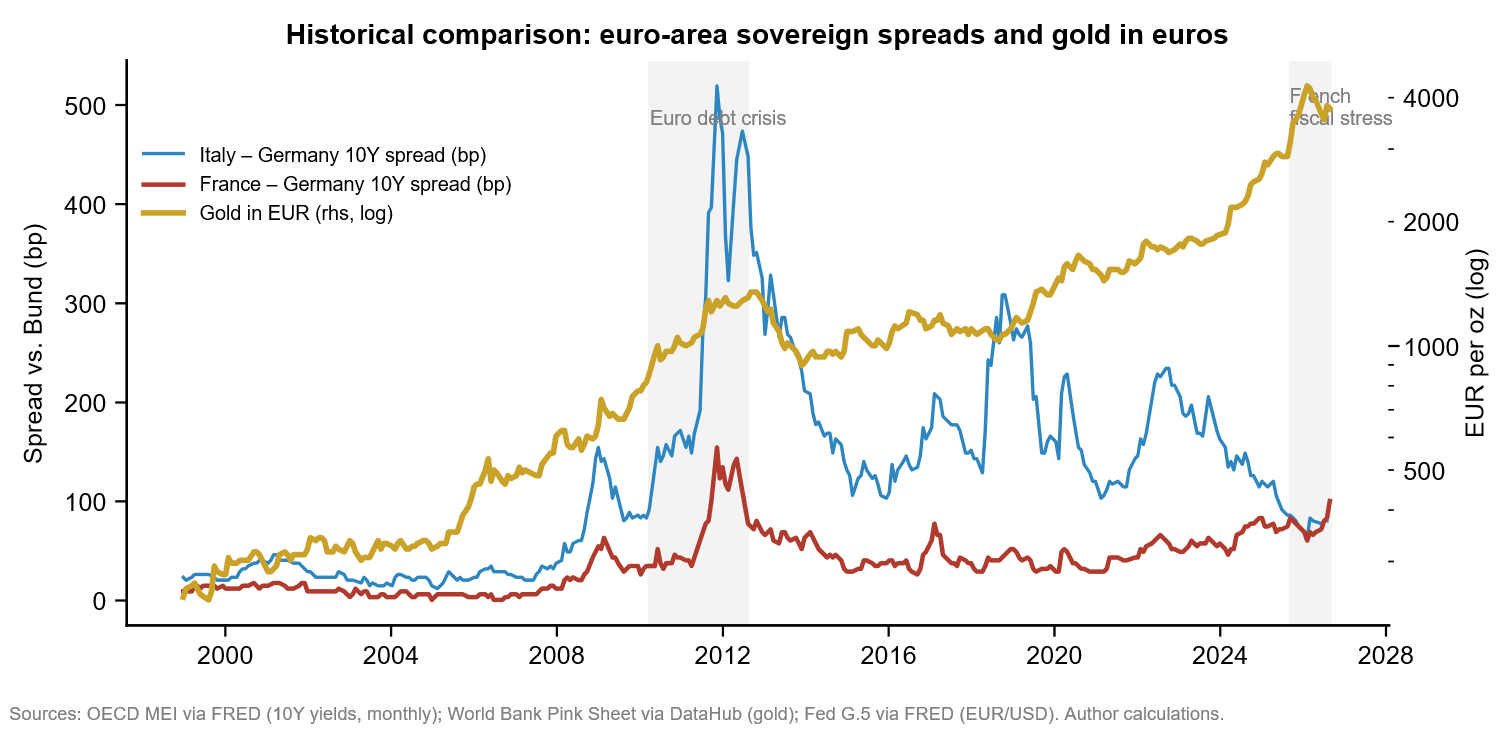
Chart 4 — Sovereign yield spreads in the eurozone and the gold price in euros, 1999–2026
The historical comparison is even more striking in the United States (Chart 5). From 1966 to 1999, the real price of gold and the federal debt-to-GDP ratio showed virtually no relationship, with a correlation of −0.04. Since 2000, however, the two have moved broadly in tandem, with a correlation of 0.90, while federal debt has risen from approximately 58% of GDP to 122.6% in the first quarter of 2026. This correlation does not establish causation, but it suggests a change in regime: gold prices may now be more closely linked to perceptions of debt sustainability than to inflation alone.
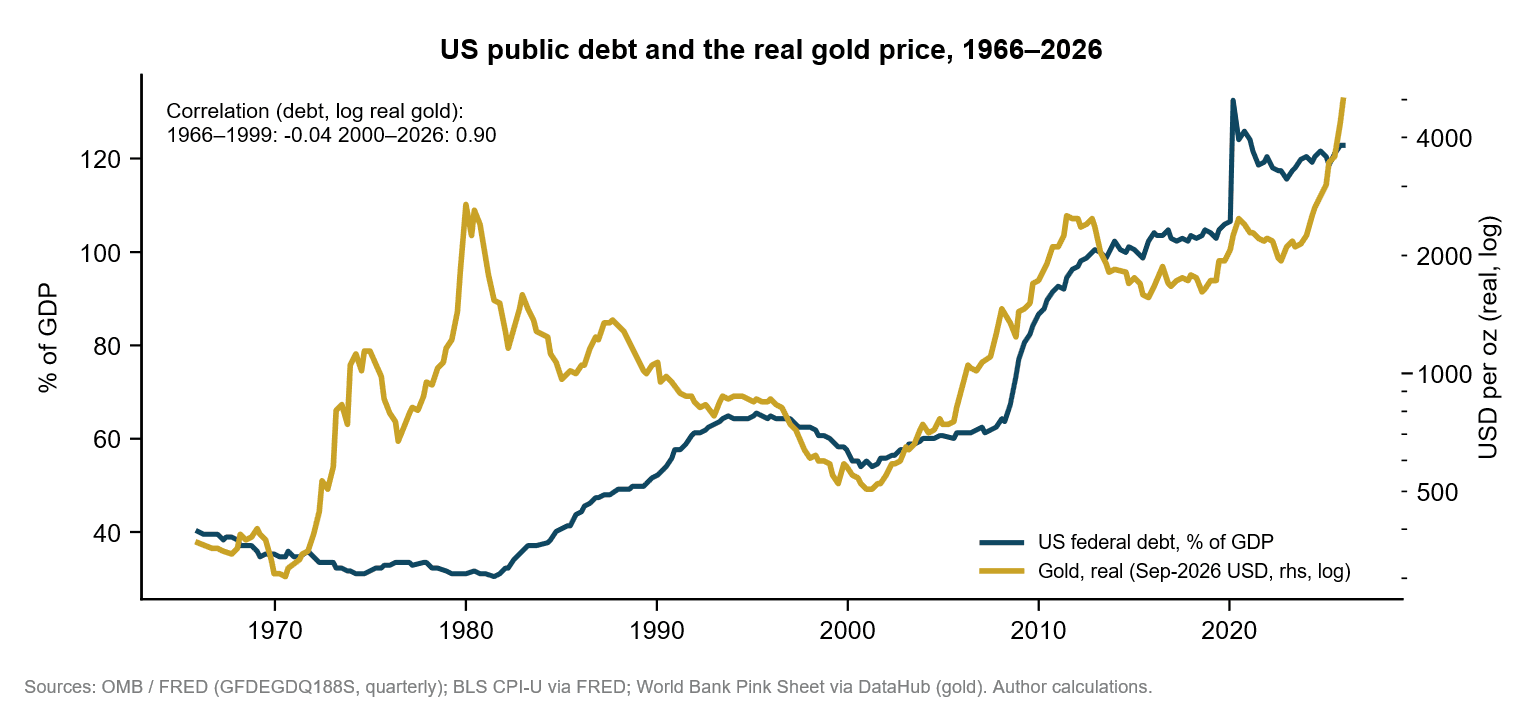
Chart 5 — US federal debt as a percentage of GDP and the real price of gold, 1966–2026
Gold, the dollar and the euro
The exchange-rate channel also matters. Over the period from 1999 to 2026, a 1% depreciation of the dollar against the euro was associated, on average, with a 0.69% increase in the price of gold in dollars. Conversely, a 1% depreciation of the euro against the dollar was associated with an average 0.31% increase in the price of gold in euros, although the explanatory power of this relationship is considerably weaker (Chart 6).
Gold therefore behaves primarily as an “anti-dollar” asset: it provides a greater cushion against depreciation in the world’s reserve currency than against depreciation in the euro. For European investors, gold priced in euros thus offers a dual layer of protection: against a widening of their own government’s yield spread and, to some extent, against weakness in their currency.
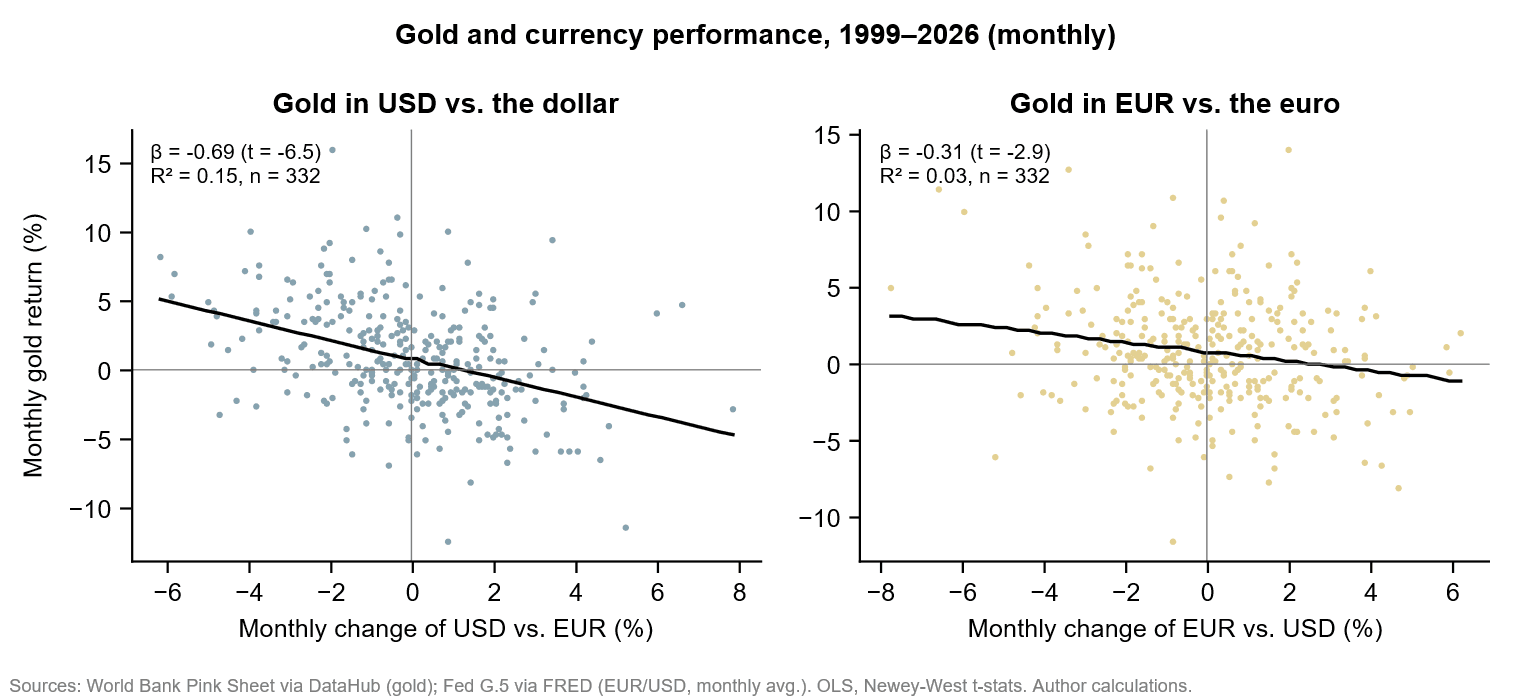
Chart 6 — Monthly gold returns and changes in the dollar (left) and the euro (right)
The three functions of money are increasingly disconnected
Since Aristotle, money has traditionally been understood to serve three functions. Yet it is increasingly clear that conventional currencies have failed to retain their monopoly over all three, particularly since the dollar ceased to be convertible into gold in 1971.
These functions are:
Unit of account: the ability to express prices using a common standard that economic agents can rely on.
Store of value: the ability to transfer purchasing power over time, thereby underpinning economic confidence.
Medium of exchange: the ability to facilitate transactions reliably, securely and with minimal friction.
These functions are becoming increasingly separated (Diagram 1). Conventional currencies remain best suited to serving as units of account, but they are not necessarily the most effective means of preserving value or facilitating transactions.
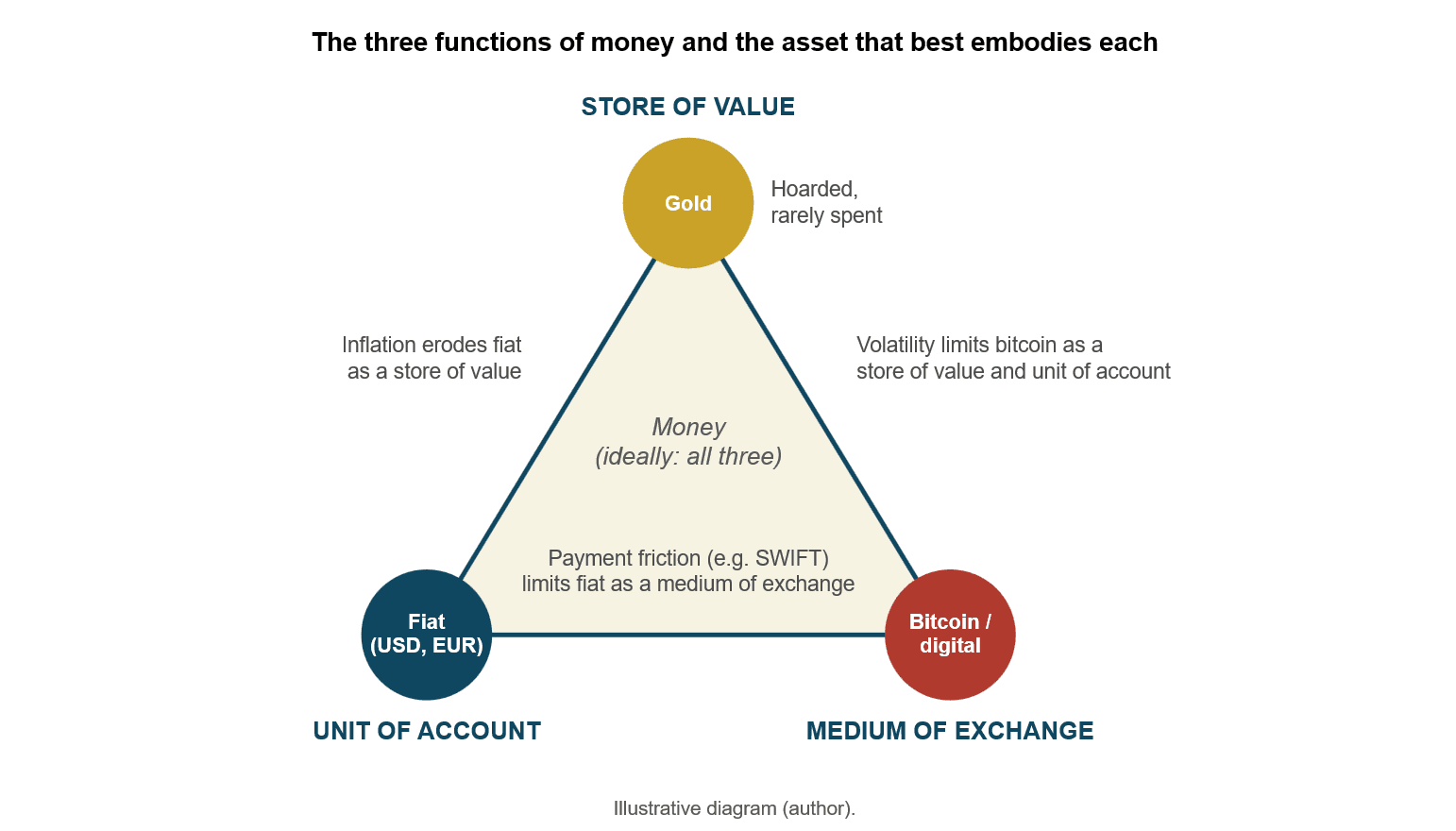
Diagram 1 — The three functions of money and the asset best suited to each
As a store of value, gold and other assets with universally recognized and accepted value clearly offer substantial protection against the depreciation of their holders’ domestic currencies.
As a medium of exchange, cryptocurrencies – particularly Bitcoin – offer greater digital flexibility than traditional payment systems. History also shows that forms of money continually adapt to technological advances: coins emerged with developments in metallurgy, banknotes with the advent of printing, and deposit money with the expansion of banking.
However, because these functions cannot be completely separated, the dominance of one tends to undermine the other two. A currency used solely to preserve value circulates little and is therefore poorly suited to serving as a unit of account. From this perspective, gold belongs primarily in vaults, beginning with those of central banks.
Conversely, when inflation becomes entrenched, the unit of account loses its stability, directly threatening the efficiency of transactions and money’s ability to preserve value. Finally, a currency that is perfectly transferable but highly volatile cannot reliably serve either as a unit of account or as a store of value.
Conclusion
Gold is not perfect insurance against sovereign risk. It generates little return when confidence prevails, responds with a lag, and offers protection primarily in the currency under threat. Nevertheless, it exhibits the characteristics of a digital option, whose payoff becomes nonlinear when distrust of a government – particularly one that issues a reserve currency – crosses a critical threshold.
This protection comes at a price. The premium unexplained by real interest rates, the dollar and production costs currently accounts for between one-third and three-quarters of the price of an ounce of gold.
Ultimately, gold emerges as a robust instrument for protecting against a debt crisis, which typically brings currency depreciation, weaker economic growth and heightened financial uncertainty.
Note: Unless otherwise stated, the data are monthly. Gold price data are from the World Bank; data on sovereign debt, interest rates and related economic variables are from the OECD, the Federal Reserve and the Bureau of Labor Statistics via FRED; production-cost data are from Metals Focus. All calculations are the author’s own.
See also:
Agyei-Ampomah, S., Gounopoulos, D. and Mazouz, K. (2014), “Does Gold Offer a Better Protection Against Losses in Sovereign Debt Bonds Than Other Metals?”, Journal of Banking & Finance, 40, pp. 507–520.
Baur, D. G. and Lucey, B. M. (2010), “Is Gold a Hedge or a Safe Haven? An Analysis of Stocks, Bonds and Gold”, The Financial Review, 45(2), pp. 217–229.
Baur, D. G. and McDermott, T. K. (2010), “Is Gold a Safe Haven? International Evidence”, Journal of Banking & Finance, 34(8), pp. 1886–1898.


Comments
Log in or sign up to join the conversation.