

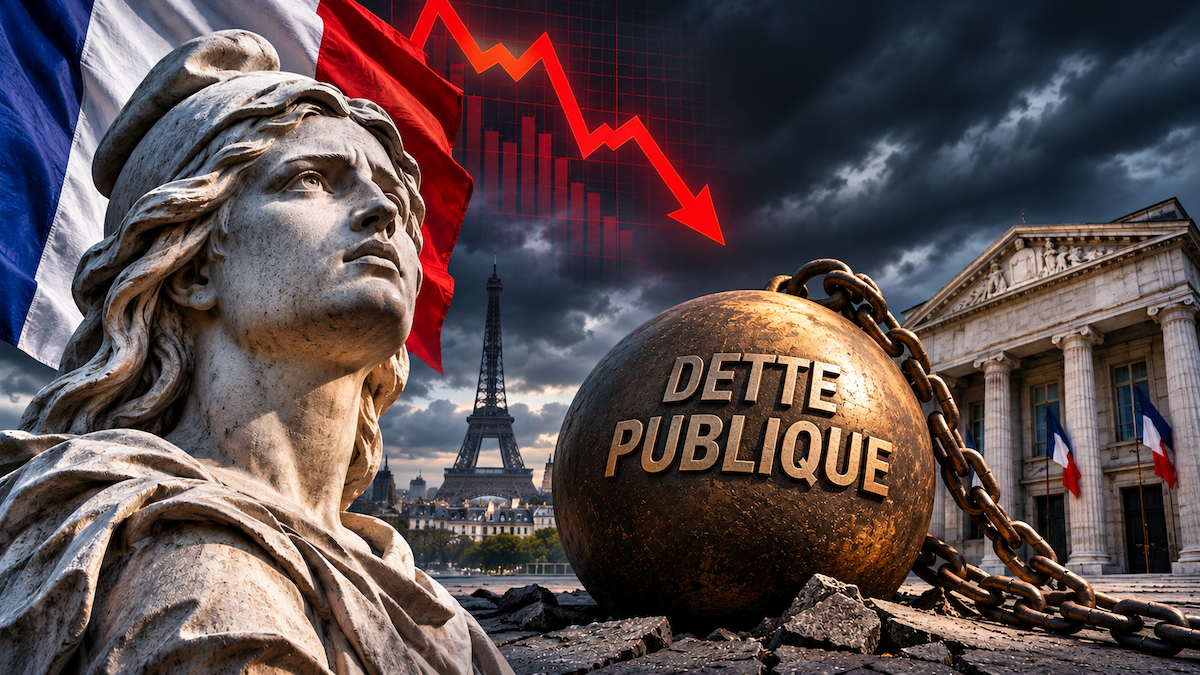
France is sinking deeper into a crisis whose economic consequences are only just beginning to show up in the statistics. Until now, the markets had focused primarily on political instability, difficulties in passing a budget, and a series of warnings from credit rating agencies. But the latest figures show that this institutional crisis is now beginning to have a direct impact on the real economy, just as the government’s financing needs are reaching historic levels and the growing debt burden is gradually reducing fiscal flexibility.
France is entering a phase in which the budget crisis is fueling the economic crisis, which in turn is exacerbating the budget crisis.
France’s economic slowdown is becoming impossible to ignore
The latest business surveys released on Wednesday, November 4, send a particularly troubling signal. The French services PMI fell to 46.2 in October, down from 51.2 in September—a sharp drop that signals a reversal in activity within a sector accounting for nearly three-quarters of the French economy’s value added. The composite index, which combines manufacturing and services, also fell to 46.6, confirming that the slowdown is no longer limited to a few industrial sectors traditionally sensitive to economic conditions.
It is important to note that a PMI below 50 indicates a contraction in business activity among the companies surveyed. At 46.2, we are therefore no longer experiencing a mere slowdown in growth, but rather a phase in which companies are reporting an actual decline in their business activity, weak new orders, and growing caution in their hiring and investment decisions.
This deterioration is also reflected in the national accounts. According to the preliminary estimate published by INSEE, French GDP contracted by 0.1% in the third quarter of 2026, following stagnation in the second quarter and a 0.2% decline in the first. France has therefore not recorded a single quarter of positive growth since the beginning of the year, a situation that is all the more concerning given that it is occurring in a European context that does not show the same signs of widespread contraction.
The breakdown of this decline in GDP is particularly revealing. Investment fell by 0.6% in the third quarter, following several already difficult quarters, while manufacturing output contracted by 1.4% and exports declined by 1.7%. Household consumption continues to grow modestly, but it is no longer sufficient to offset weak investment and the deterioration in foreign trade.
It is likely this last point that represents one of the main vulnerabilities of the French economy. When a country experiences a temporary slowdown in consumption, it can hope for a rebound once financial conditions improve. But when companies begin to postpone their investments for an extended period, reduce their production capacity, and delay their development projects, future growth is gradually compromised.
Yet this is precisely what seems to be happening today. Political uncertainty, the fiscal outlook, and rising financing costs are leading companies to adopt a wait-and-see approach, while social unrest adds yet another challenge to an already fragile economic environment. The French political crisis is thus beginning to have economic repercussions that could persist well beyond its institutional resolution.
An increasingly dramatic divergence from the rest of Europe
What makes the situation in France particularly concerning is that it can no longer be explained solely by a general slowdown in the European economy. On the contrary, the latest figures show that several of our major partners are experiencing significantly more favorable conditions, despite their exposure to the same energy, geopolitical, and trade tensions.
In Germany, the services PMI reached 52.5 in October, confirming an expansion of economic activity in a country that is now emerging from several years of industrial difficulties. In Italy, the index stood at 52.0, while Spain continues to show particularly strong momentum, with a services PMI of 57.2. Across the eurozone as a whole, the index stood at 51.4, indicating that services activity continues to grow overall.
France thus appears to be the only one of the four major eurozone economies whose services sector is contracting, and the gap with its neighbors is becoming large enough that it is difficult to attribute it to mere statistical fluctuations.
Third-quarter GDP figures confirm this divergence. While France recorded a 0.1% contraction, Germany grew by 0.2%, Spain by 0.6%, and the eurozone as a whole by 0.4%. Italy remained flat but avoided the contraction seen in France.
This comparison is worth highlighting, as it partly reverses the perception that still prevailed just a few quarters ago. At that time, Germany was portrayed as Europe’s ailing economy, hampered by difficulties in its automotive industry, high energy costs, and the weakening of its export-driven model. These problems have obviously not disappeared, but the German economy appears to be regaining some stability just as France is beginning to fall behind.
Spain, for its part, continues to enjoy sustained growth, while Italy, despite historically high public debt, is not experiencing the same accumulation of political, fiscal, and economic tensions.
France is now facing a crisis with a distinctly national dimension, the effects of which are beginning to set it apart unfavorably from its main European partners.
This divergence is particularly problematic within a monetary union. France has the same key interest rates as Germany, Spain, and Italy, but it must finance a substantial public debt with an economy that is now struggling to generate growth. It has neither the ability to devalue its currency to restore its competitiveness nor the ability to pursue a monetary policy tailored to its specific challenges.
The budget deficit is becoming increasingly difficult to control
It is against this backdrop of near-recession that the government is attempting to restore public finances, with targets that appear increasingly difficult to meet.
The budget proposal presented in early October now projects a public deficit of 5.4% of GDP in 2026, with the goal of reducing it to 5% in 2027. To achieve this relatively modest goal, the government is planning approximately €43 billion in recovery measures, combining budget cuts and tax adjustments.
But these projections are based on growth assumptions that are becoming particularly fragile as economic indicators deteriorate. The government’s scenario projected GDP growth of 0.5% in 2026 and 1% in 2027, even though none of the first three quarters of the year recorded positive growth.
The risk, therefore, is that the budget will once again spiral out of control—not necessarily because public spending would surge sharply, but because tax revenues could fall short of expectations. A stagnant economy generates less VAT revenue, fewer taxable profits for businesses, and, ultimately, fewer employment-related taxes and contributions.
At the same time, certain social spending items may rise automatically when economic activity slows, further reducing the government’s ability to contain the deficit.
France thus finds itself facing a classic problem, but one that is particularly difficult to solve: fiscal consolidation measures risk weighing on an already weakened economy, while a lack of consolidation would allow a debt trajectory to continue that investors might deem unsustainable.
The danger is all the greater given that France’s public debt is now approaching 120% of GDP. Government projections put it at 119.3% in 2026, then at 121.7% in 2027, meaning that debt would continue to rise despite the announced fiscal efforts.
In other words, even if the government managed to reduce the deficit to 5% of GDP next year, debt would continue to grow significantly faster than the wealth produced by the French economy.
The refinancing wall is drawing near
The issue of financing this debt is slowly becoming one of Europe’s main macroeconomic risks.
According to forecasts by Agence France Trésor, the government’s financing needs will reach €339.7 billion in 2027, up from €311.7 billion in 2026. Issuance of medium- and long-term debt, net of redemptions, is expected to total €340 billion, up from €310 billion this year.
These amounts are substantial, but they must above all be analyzed in terms of their dynamics. The French government must not only borrow to finance its current deficits; it must also refinance maturing bonds, some of which were issued during years when interest rates were near zero or even negative.
The French bond market is beginning to send a particularly worrying signal. The yield on the 10-year OAT has just sharply broken through the upper boundary of its upward channel, approaching the symbolic threshold of 5%, a level not seen since the late 1990s.
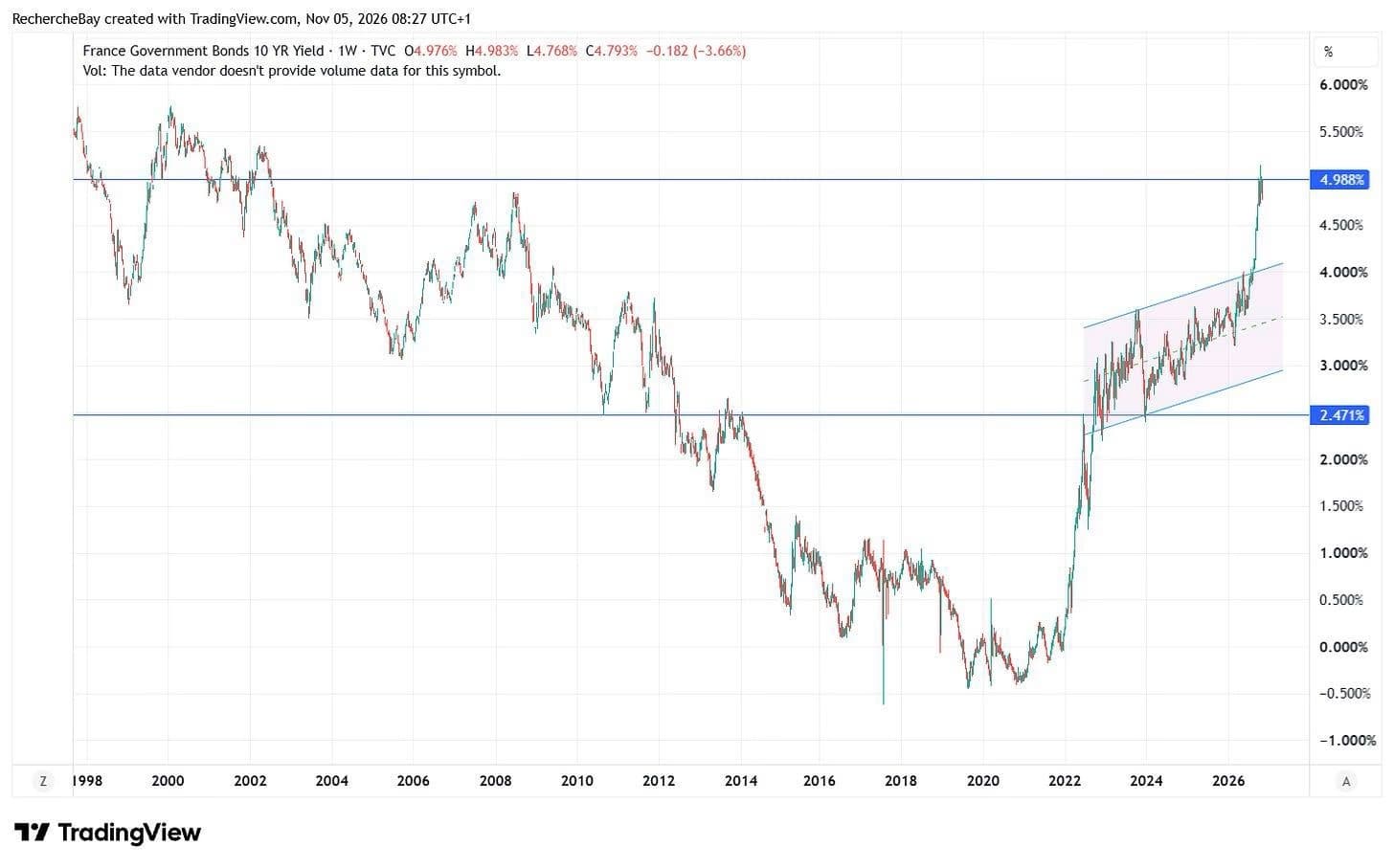
This acceleration is occurring precisely as French growth slips into negative territory and the government’s financing needs reach record levels.
It is this dynamic that makes the situation particularly delicate. For more than a decade, France was able to accumulate significant deficits without immediately feeling the impact on its interest burden, thanks to steadily falling interest rates and interventions by the ECB. That period is now over, and each new debt issuance is gradually replacing historically cheap financing with more expensive borrowing.
Interest payments are thus projected to reach €79.2 billion in 2026, then €91.2 billion in 2027 — an increase of €12 billion in a single year. This increase is occurring even before the entire debt stock has been refinanced at current market conditions, which means that the effects of rising interest rates will continue to impact public finances for several years.
We must assess the significance of such an increase. An annual rise of €12 billion in interest payments can absorb a significant portion of the budget savings achieved across several ministries, without funding any additional public services, productive investments, or infrastructure improvements.
The government is thus devoting an increasing share of its resources to repaying creditors who financed past deficits, at the expense of spending that could support future growth.
The risk is that of a fiscal squeeze, in which debt interest payments gradually replace spending on investment, research, education, or the modernization of the productive sector.
And this trend could accelerate even further if investors demanded a higher risk premium to continue financing the French government.
This time, the ECB does not seem willing to come to France's aid immediately
This is likely one of the most significant developments of the past few hours — and one that could shift the perception of French risk in the bond markets.
Two influential members of the European Central Bank’s Governing Council have just reiterated, in particularly explicit terms, that resolving France’s fiscal difficulties is primarily the responsibility of national political authorities.
Olaf Sleijpen, president of the Dutch central bank, stated that France’s problems must be resolved in Paris. Joachim Nagel, president of the Bundesbank, made a similar point, emphasizing that the French budget issue is not a matter for monetary policy.
These statements are significant because they come at a time when investors might be tempted to assume that renewed pressure on French bonds would automatically trigger an intervention by the ECB.
This assumption now deserves to be seriously questioned.
Since the eurozone crisis, markets have grown accustomed to the idea that the European Central Bank has the necessary tools to prevent a sovereign debt crisis from spiraling out of control. Asset purchase programs, exceptional interventions, and, more recently, the Transmission Protection Instrument (TPI) have helped cement the belief that Frankfurt would always eventually intervene in the event of significant tensions in the bond markets.
But this protection is neither automatic nor unconditional.
The ECB may intervene when it believes that disorderly market movements threaten the transmission of its monetary policy. However, it is not intended to provide long-term financing for a member state’s deficits or to offset the consequences of a fiscal path deemed insufficiently credible.
This distinction is essential. If French bond yields rise because investors believe that the fiscal outlook is deteriorating, the ECB might conclude that this rise reflects a legitimate reassessment of sovereign risk, rather than a market dysfunction requiring intervention.
Of course, this does not mean that the European Central Bank would stand idly by and allow a systemic crisis threatening the entire eurozone to unfold. But between the initial tensions surrounding French OATs and a possible intervention by Frankfurt, the markets could face a particularly uncomfortable period.
France may therefore have to contend with a significant increase in its financing costs before the ECB determines that the conditions for intervention have been met.
And the European monetary environment further complicates this outlook. While the ECB continues to face inflationary pressures — particularly in the energy sector — several of its officials have raised the possibility of further rate hikes. European monetary policy could therefore remain restrictive precisely at a time when the French economy needs more accommodative financial conditions.
This is a very different situation from the one that prevailed during the years of negative interest rates, when monetary policy helped reduce the cost of government borrowing despite mounting deficits.
France faces a dilemma that has become nearly impossible to resolve politically
This is likely where the true uniqueness of the French crisis lies.
From an economic standpoint, the mechanisms needed to stabilize the debt are relatively well understood: improving potential growth, sustainably controlling the rise in spending, restoring fiscal credibility, and ensuring that the average cost of financing does not exceed nominal growth for too long.
But implementing them requires a capacity for political decision-making that appears particularly weakened today.
Parliamentary fragmentation complicates the adoption of ambitious fiscal measures, while social tensions limit the room for maneuver of successive governments. Trade-offs become all the more difficult as growth slows, since every additional effort risks producing immediately noticeable economic and social effects.
The government thus finds itself facing a fundamental contradiction: it must convince investors of its ability to reduce deficits, while avoiding triggering a further economic contraction that would make these very objectives more difficult to achieve.
Too abrupt fiscal consolidation could exacerbate the slowdown, while a lack of sufficiently credible measures could lead to a further rise in the sovereign risk premium.
This situation does not mean that France is doomed to a financial crisis. It does, however, mean that the time available to correct these imbalances could shrink if markets begin to doubt policymakers’ ability to produce a coherent fiscal path.
For a long time, low interest rates made it possible to postpone these trade-offs. Nominal growth and inflation then temporarily helped to ease the relative burden of debt.
But this combination is now becoming much less favorable.
France must finance persistent deficits in an environment of higher interest rates, with an economy that is barely growing and political institutions whose ability to implement structural reforms appears limited.
France’s problem, therefore, is not merely one of excessive debt. It is that of a country whose political capacity to stabilize this debt appears to be deteriorating at the very moment when economic conditions are making such an adjustment increasingly necessary.
Gold in euros is regaining its role as a safe-haven asset
In this context, it is probably no coincidence that gold priced in euros is regaining momentum. The deterioration of France’s public finances serves as a reminder to investors that sovereign bonds — long considered the safest assets — are not without risk, particularly when governments must refinance substantial debts in an environment of near-zero growth.
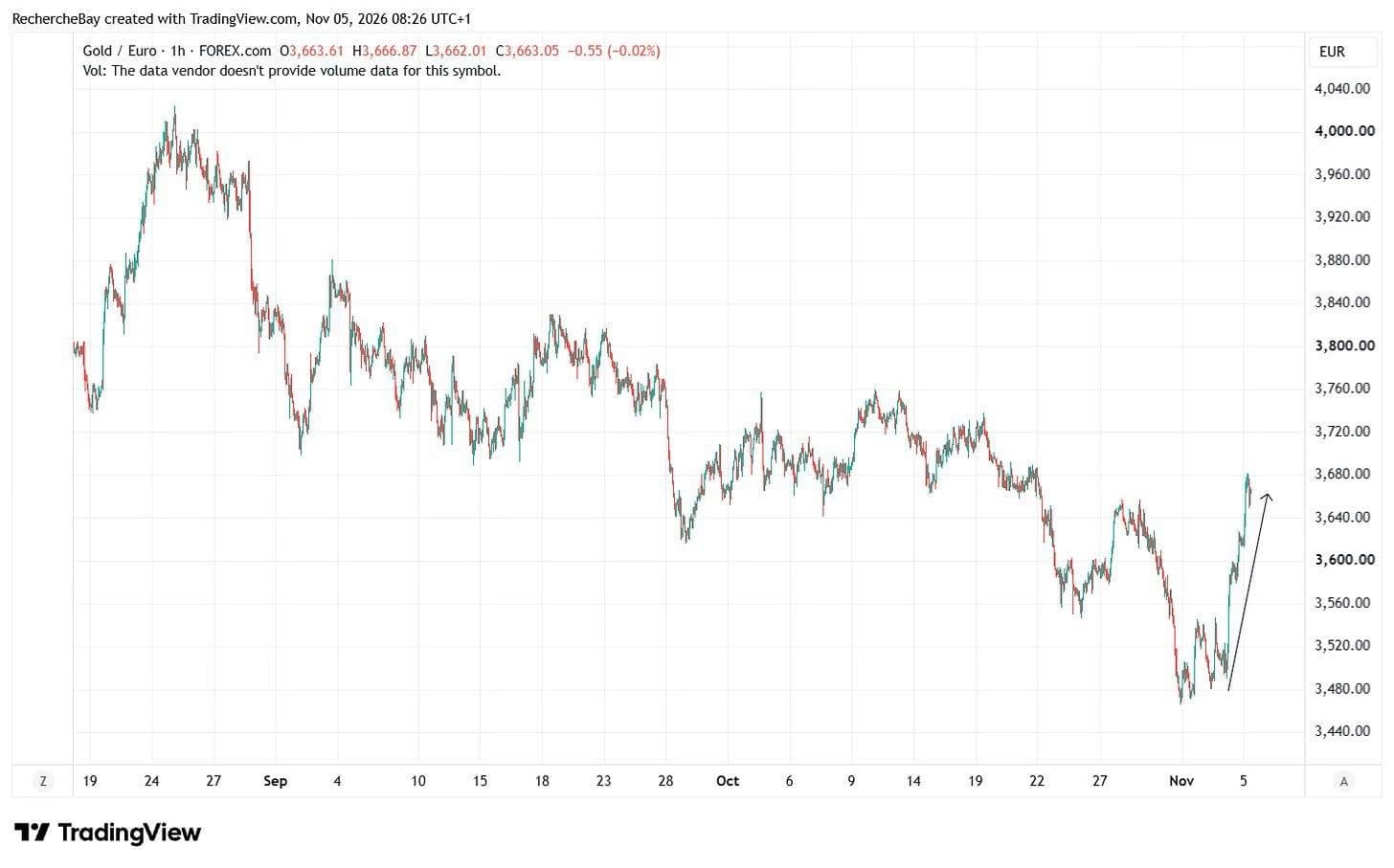
Gold thus regains an essential function: that of an asset that depends neither on a government’s creditworthiness nor on the credibility of its fiscal policy. And for European investors, any potential weakening of the euro against the dollar could further enhance this protection, since gold is priced internationally in dollars.
The paradox is that both possible outcomes of this crisis could support gold in the medium term. If the ECB maintains tight monetary conditions, it risks exacerbating tensions over sovereign debt. If it ends up intervening on a massive scale to contain these tensions, it could reignite questions about the currency’s future value. A rise in real interest rates could, however, temporarily weigh on the metal.
Gold’s rebound in euros may reflect a deeper shift: investors are beginning to realize that the main risk is no longer just inflation, but the ability of governments to sustainably maintain the credibility of their financial commitments. And in a world where public debt continues to accumulate, gold retains a fundamental advantage: it is not anyone’s debt.



Comments
Log in or sign up to join the conversation.