

Global Euphoria
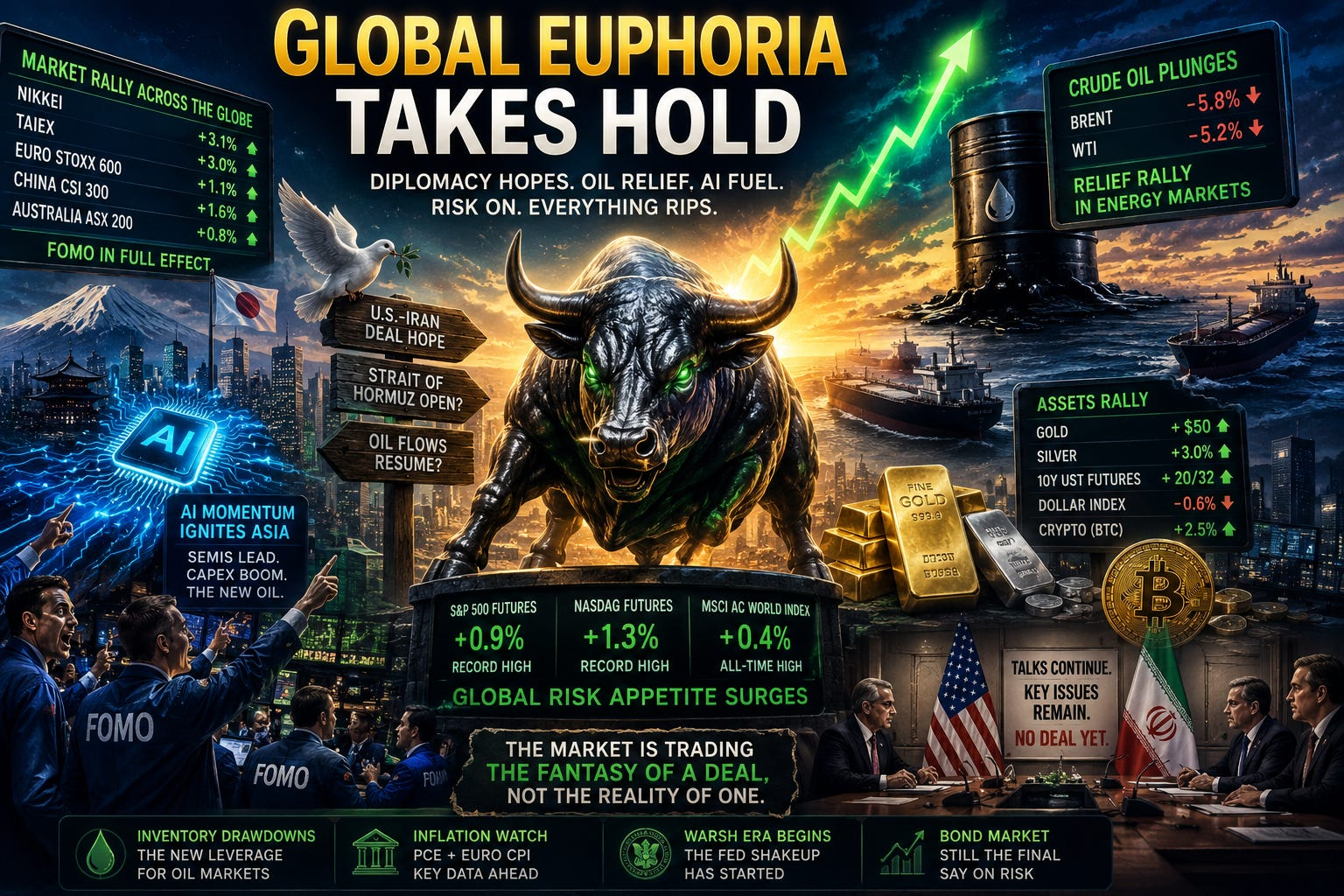
Global markets have once again strapped themselves to the same rocket fueled by diplomacy headlines, AI mania, and the relentless fear of missing the next melt higher. Equity futures exploded upward overnight as traders rushed back into risk assets on renewed signals that Washington and Tehran are inching closer toward reopening the Strait of Hormuz and restoring oil flows through the most critical energy artery on earth. S&P 500 (SPY) futures surged nearly 1% while Nasdaq (QQQ) futures ripped more than 1.3% higher into fresh record territory, extending exactly the kind of squeeze dynamic building underneath the surface that we flagged in yesterday’s note. This no longer feels like a market climbing a wall of worry. It feels more like a crowded casino where every gambler suddenly believes the house has started handing out free chips. The Nikkei (EWJ) exploded more than 3% into record highs, Taiwan equities surged alongside semiconductors, the MSCI All Country World Index (ACWI) printed another all-time high, and Europe pushed toward its strongest levels since before the Iran conflict erupted. Meanwhile, crude oil collapsed more than 5%, with Brent sliding back below $100 and WTI falling toward $91 as traders aggressively unwound geopolitical hedges built during the Hormuz panic. Gold rebounded more than $50, silver ripped 3% higher, bond futures rallied, and the dollar weakened against every major peer as markets collectively stampeded back toward risk. In short, global euphoria has fully returned to the tape.
The market’s reaction remains almost mechanical at this point. Every incremental diplomatic headline involving Iran gets treated like another liquidity injection directly into risk appetite. Yet beneath the surface, the actual negotiations still resemble two traders standing on opposite sides of the pit pretending the spread has narrowed while the hardest legs of the trade remain unresolved. Washington continues to signal optimism, while Tehran insists no agreement is imminent. President Donald Trump says he will not rush a deal. Secretary of State Marco Rubio insists diplomacy will be given every chance to succeed. Iran’s foreign ministry acknowledges a framework exists, but openly concedes major sticking points remain unresolved. Even the latest commentary around Hormuz avoids clarity. Tehran says there will be no formal tolls yet simultaneously suggests maritime environmental services would require payment structures. In other words, the market is once again trading the fantasy of a completed transaction long before the signatures have actually hit the paper.
That disconnect matters because positioning has already moved well beyond cautious optimism and into outright performance panic. FOMO has become the dominant cross-asset driver. For those traders who spent the past several weeks hiding behind oil hedges, volatility protection, and defensive positioning, volatility protection and defensive positioning are now being dragged back into equities at progressively worse levels simply to avoid career risk. The tape increasingly resembles a giant momentum-driven short-gamma machine, where every new high mechanically forces reluctant capital back into risk assets. SocGen (SCGLY) described it as muscle memory from previous crises, teaching investors to buy every dip, while Bank of America (BAC) summed up London’s buyside as “long and paranoid”. That combination is combustible because it creates a market structure in which no one fully trusts the rally, yet everyone feels compelled to participate anyway.
Now, for the bad news: as we hinted in our weekend note (Middle East Breakthrough or Rough Patch?), after the initial market FOMO squeeze, the most likely outcome increasingly feels pre-priced into the tape. Once an actual agreement is formally signed and rolled out, markets may suddenly discover that much of the emotional upside was already consumed weeks earlier. The greater risk from here is not missing the rally but arriving late to a trade where the champagne has already been uncorked, positioning has become overcrowded, and some of the smarter macro money is quietly drifting toward the exits. That is why I would still refrain from adding larger clips of equity index exposure until bond markets begin validating the optimism with lower yield curves and a hint of dovish repricing in the Fed rate-cut probability curve. The real issue for equities is not diplomacy itself. It is that traders have already aggressively discounted a near-perfect geopolitical outcome while the underlying cost of capital remains stubbornly restrictive beneath the surface.
At the same time, the oil market itself may be far tighter underneath the surface than current price action implies. Using our analysis alongside UBS (UBS) research (UBS Flags Crude “Danger Zone”) showing massive SPR and commercial inventory drawdowns, we find that leverage has actually shifted over time. Initially, the West held leverage because Iran faced economic pain from shut-in production and restricted flows. But with every passing day, global inventories continue falling while spare buffers disappear. In other words, the unprecedented pace of the drawdown in US crude inventories increasingly underscores how critical it is for negotiations between Washington and Tehran to ultimately succeed. This is where the market may be dangerously underestimating the structural fragility underneath the current relief rally. The longer inventories drain, the less room exists for policy error. Energy markets are no longer trading off theoretical spare capacity. They are trading off the number of usable molecules remaining in the physical inventory system.
That dynamic also explains why inflation remains glued to the center of the macro conversation even as oil prices tumble overnight. Traders have already fully priced in another Federal Reserve rate hike by year's end, despite the arrival of Kevin Warsh as the new Fed chairman. Markets are simultaneously trying to price falling oil, sticky inflation, slowing inventories, and a potentially more activist Federal Reserve all at once. It is the macro equivalent of traders trying to run four conflicting algos through the same execution engine. Warsh enters office promising the biggest shakeup at the Fed in decades while President Donald Trump attempts to reassure markets that policy independence will remain intact. Yet the debate has already shifted toward whether Warsh might actually have enough cover to cut rates rather than hike them if growth conditions soften beneath the surface. BlackRock (BLK) openly floated that possibility over the weekend. This week’s US PCE inflation data, alongside European inflation readings, now carry outsized importance because they will determine whether falling oil can psychologically offset the inflationary residue already embedded throughout the system.
Meanwhile, Asia continues operating as the global epicentre of AI liquidity gravity. Taiwan and Japan once again led the charge as semiconductor optimism combined with easing geopolitical fears to create a powerful risk cocktail across regional markets. TSMC (TSM), MediaTek, Delta Electronics, and Japanese component makers surged as investors doubled down on the AI revenue super cycle. The information technology sub-index across Asia Pacific pushed to fresh records as the market increasingly behaves like AI has become less of a sector theme and more of an entirely separate monetary system capable of absorbing infinite liquidity. Even Chinese semiconductor names rallied after Huawei hinted at another potential breakthrough in advanced chip manufacturing. The market’s obsession with artificial intelligence has created a strange gravitational distortion in which capital continues to cluster around a handful of perceived winners, regardless of broader macro instability. The trade increasingly resembles a modern-day resource boom, in which semiconductors serve as the new oil fields, and GPUs have become the digital equivalent of strategic reserves.
China, meanwhile, is quietly trying to seal cracks in its own financial plumbing. Beijing launched an unprecedented crackdown on illegal cross-border trading to stem capital outflows, threatening severe penalties against brokers and ordering non-compliant offshore accounts to liquidate. Citic (CTPCY) estimates the measures could affect up to $32 billion in Hong Kong-linked trading activity. Yet, ironically, domestic Chinese equities rallied anyway, as investors interpreted the measures as supportive of mainland markets by trapping liquidity onshore. It is another reminder that modern markets increasingly trade less on classical fundamentals and more on where policymakers force liquidity to reside.
Back in Europe, light holiday trading volumes only amplified the upside squeeze. With London, Norway, Denmark, and several other markets closed, relatively thin liquidity allowed futures to levitate even faster as falling oil boosted airlines and travel stocks while energy shares collapsed. Individual names added their own fuel to the momentum fire. Delivery Hero surged after Uber (UBER) floated a takeover proposal. Nexi rallied after Italy’s state lender increased its grip on the payments company. Kinnevik, Hexagon (HXGBY), and Kambi all joined the upside chase as investors continued to treat corporate activity as confirmation that global animal spirits remain fully alive.
The irony is that underneath all the celebration, the market is still effectively trading a conditional fantasy. The geopolitical risk premium is being dismantled before the actual geopolitical architecture has been rebuilt. Traders are cancelling insurance policies while smoke still drifts over the hills. For now, the squeeze remains real because positioning, liquidity, and AI-driven momentum continue overwhelming caution. But increasingly, this feels less like a clean macro expansion and more like a giant synchronized reach for performance, occurring in an environment where inventories remain depleted, inflation remains unresolved, and the bond market still has not fully signed off on the celebration.
The Real Wall of Worry
Markets continue behaving as though every problem can be solved with another AI earnings beat, another diplomacy headline, or another momentum squeeze higher in equities. But underneath the surface, the real machinery driving global financial conditions has quietly shifted into something far more dangerous. The latest move higher in global bond yields is no longer being driven by inflation panic. It is increasingly being driven by rising real yields, which is a completely different animal altogether. That distinction matters because inflation-driven selloffs often sow the seeds of eventual reflation and optimism about nominal growth. Real yield-driven tightening does not. Real yields are the financial system’s gravity setting. When they rise aggressively while inflation expectations remain contained, liquidity conditions tighten mechanically across almost every major asset class, regardless of how euphoric the equity tape may temporarily appear.
That is precisely the regime beginning to emerge across the United States, Europe, and parts of emerging markets. Nominal yields continue grinding higher, but breakevens remain relatively anchored near long-term inflation expectations. In simple terms, markets are no longer repricing runaway inflation. They are repricing the actual cost of money itself. The entire discount rate structure beneath global markets is slowly being lifted, like a hydraulic platform rising beneath a crowded dance floor. Traders still hear the music playing overhead, but the ceiling is moving closer with every passing session.
The dangerous irony is that parts of the market initially celebrated falling breakevens last week as evidence that inflation fears were easing following the collapse in oil prices tied to renewed Iran diplomacy. But lower breakevens without a fall in real yields can actually tighten financial conditions even further. That is the part that many momentum-driven equity traders are still struggling to grasp. Falling inflation expectations do not help risk assets if the real cost of capital keeps climbing underneath the surface. In that environment, markets lose the cushion of reflation optimism while still absorbing the pain of tighter liquidity conditions. It becomes tight without growth rescue.
This is why the entire market increasingly hinges on the direction of real yields rather than crude oil headlines alone. If real rates continue to push higher while breakevens remain anchored, the current melt-up in equities could slowly begin to morph from a healthy cyclical rally into something more structurally unstable. Right now, markets are still interpreting the simultaneous rise in equities and yields as evidence of stronger growth expectations. The labour market remains resilient. AI investment continues pulling massive amounts of capital into semiconductors, data centers, and infrastructure buildouts. In many ways, the market is treating AI spending like a wartime industrial mobilization cycle, in which investment demand itself becomes large enough to alter the entire neutral rate structure of the global economy.
That may partially explain why real yields continue climbing without immediately detonating risk appetite. As long as investors believe higher real yields are being driven primarily by productive growth, capital expenditure, and genuine investment demand, markets can temporarily absorb the tightening. Under that scenario, higher real rates act more like a speed governor on speculative excess rather than an outright wrecking ball for risk assets. The problem begins if markets stop believing the rise in yields reflects healthy growth and start believing it reflects fiscal stress, endless sovereign supply, deteriorating debt dynamics, or the possibility of meaningfully tighter central bank policy.
That is the true wall of worry now forming underneath the market’s feet.
The comparison that increasingly matters is not inflation panics from 2022 but the summer of 2023, when long-end yields suddenly repriced higher and financial conditions tightened aggressively despite relatively stable inflation expectations. If markets drift back toward that type of regime, the implications broaden rapidly. Carry trades begin losing altitude. Emerging markets that have so far weathered the storm remarkably well suddenly come under pressure as dollar funding conditions tighten. Long-duration equities, especially the same AI-driven megacap names currently driving the entire market higher, become increasingly vulnerable to valuation compression. Housing weakens. Consumer cyclicals lose oxygen. The higher the real yield structure climbs, the more every asset class eventually gets forced to reprice against a harsher financial reality.
The foreign exchange market may ultimately become the cleanest pressure valve for this entire adjustment process. Rising yields have been global, which complicates the directional signal for currencies in the short run. But if real yields continue to climb primarily in the United States while growth resilience remains intact, the dollar could begin strengthening again, particularly against lower-yielding currencies such as the yen and in parts of emerging markets. The irony is that many traders spent the past several months preparing for a structurally weaker dollar regime tied to fiscal deterioration and eventual Fed easing. Instead, the market may temporarily find itself trapped inside the exact opposite environment where tighter real financial conditions mechanically reinforce dollar demand.
Everything now comes back to the Federal Reserve and the shape of the yield curve. If Chairman Kevin Warsh begins openly entertaining further tightening rhetoric, front-end real yields could rise, helping to stabilize long-end inflation fears. But if the Fed appears hesitant while fiscal concerns and supply pressures continue to build, the burden of tightening may shift increasingly toward the long end of the curve itself. That is the more dangerous scenario because steepening curves, driven by rising real yields at the back end, tend to behave like slow-moving financial avalanches. They do not destroy confidence instantly. They simply tighten conditions incrementally until leverage cracks begin appearing in the weakest corners of the system.
For now, markets still appear unusually relaxed about the entire process. Equities continue to levitate higher alongside yields, as though the system can absorb both indefinitely. But history suggests there comes a point when rising real yields stop acting as a background macro variable and become the dominant market narrative. When that transition happens, liquidity no longer behaves like an endless tide lifting all boats. It starts behaving more like gravity, slowly returning to a market that had briefly forgotten it existed.

Comments
Log in or sign up to join the conversation.