


The GBP/USD pair trades in positive territory around 1.3380 during the early European trading hours on Friday. The British Pound (GBP) strengthens against the US Dollar (USD), while markets digest the UK Autumn Budget and look ahead to upcoming Bank of England (BoE) decisions.
The United Kingdom (UK) set out a target date for defense spending to rise to 3% of Gross Domestic Product (GDP), as the Finance Minister John Healey announced billions in aid for Ukraine in a “clear message to Moscow.” Healey on Wednesday set a target date of 2030 for the 3% figure while reaffirming its NATO commitment to reach 3.5% by 2035.
Data released by the Commerce Department’s Bureau of Economic Analysis on Thursday showed that the US Personal Consumption Expenditures (PCE) Price Index climbed 0.5% in September, versus a 0.3% rise prior. This figure came in line with market expectations.
The Federal Open Market Committee (FOMC) voted 10-2 to hold its benchmark federal funds rate steady in a range of 3.75% to 4% at its October policy meeting on Wednesday. Federal Reserve (Fed) officials said they hoped incoming data would help inform their next decision.
Markets are now pricing in about 74.9% odds of a US rate hike in December, according to the CME FedWatch tool. Higher interest rates increase the opportunity cost of holding non-yielding gold.
UK budget seen as neutral for Pound and gilts as modest fiscal drag leaves BoE path intact
Analysts at Brown Brothers Harriman judge that the UK October 2026 Budget is “neutral for GBP and gilts,” noting that the government has “modestly increased fiscal tightening but plans to issue slightly more debt.” They highlight that the “cyclically adjusted primary balance, which excludes interest costs and adjusts for the economic cycle, is projected to improve from a deficit of -0.3% of GDP in 2026/27 to a surplus of +0.5% in 2027/28.” This shift implies “a fiscal drag of 0.8% of GDP, up from 0.6% projected in March,” but BBH cautions that “the additional fiscal restraint is probably too modest to materially curb the nearly 125bps of BoE rate hikes implied over the next twelve months.” On the funding side, they note that “£250.6 billion of total gilt sales are planned for 2026/27,” which is “roughly in line with expectations (around £249.6bn) and up £4.4bn from the £246.2bn planned in April.”
Greene flags stalled wage disinflation, keeping GBP rate-cut hopes in check
Greene’s 7.4/10 FXS Speechtracker score matches the historic average, signaling a steady but firmly hawkish stance rather than an escalation. Emphasis that wage disinflation has stalled above levels consistent with 2% inflation, alongside stronger-than-expected economic resilience and a possible peak in labor market slack, reinforces caution on loosening policy and supports GBP on the margins.
The call to “proactively lean against” second-round inflation effects, and the admission that these risks are greater than previously thought, underline resistance to near-term rate cuts. Forward-looking data pointing to pay growth closer to 3.5% backs the view that inflation pressures remain sticky, keeping the Bank of England biased toward a higher-for-longer stance that limits downside for GBP.
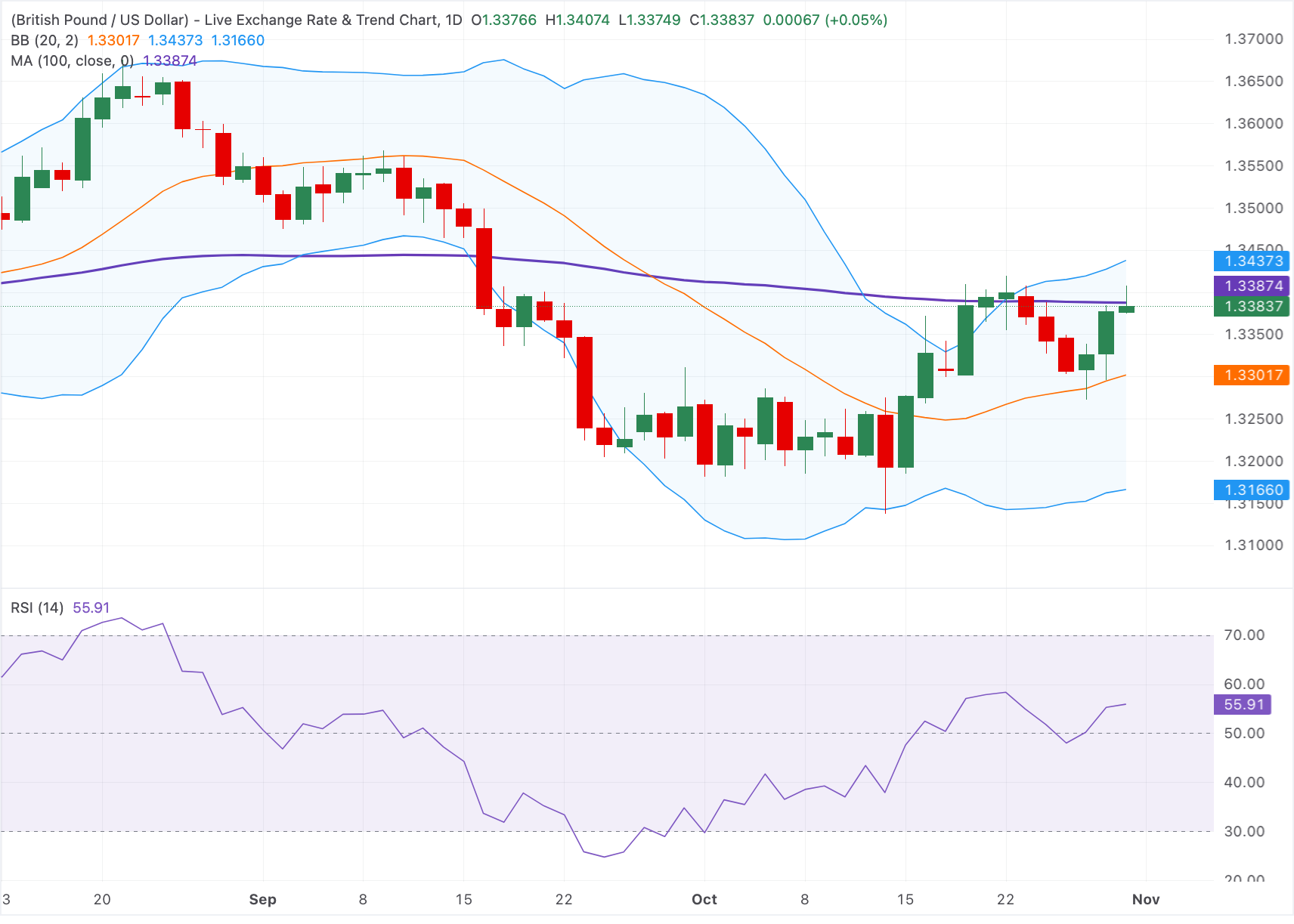
Technical Analysis: GBP/USD retains a bearish tone in the near term
In the daily chart, GBP/USD holds just beneath the 100-day simple moving average (SMA), which caps the topside and keeps the near-term bias cautiously bearish. Price remains above the 20-day Bollinger middle band, suggesting underlying demand on dips, while the Relative Strength Index (RSI) at 55.9 points to steady but moderate bullish momentum that has yet to overcome the immediate overhead supply.
On the topside, the initial resistance level aligns in the 1.3390-1.3400 zone, representing the 100-day SMA and the psychological level. A decisive break above this level could pave the way to the upper boundary of the Bollinger band near 1.3435, where a sustained break would be needed to ease downside pressure.
On the downside, the 20-day Bollinger middle band at 1.3300 acts as first support ahead of the October 27 low of 1.3272. The next contention level is located at the lower limit of the Bollinger band near 1.3165, where a deeper slide would expose a more pronounced corrective phase.



Comments
Log in or sign up to join the conversation.