


The EUR/USD pair attracts some sellers to near 1.0980 during the early European trading hours on Wednesday. Stronger-than-expected US inflation reports and hawkish comments from Federal Reserve (Fed) officials boost expectations for a December interest rate hike, supporting the US Dollar (USD) against the Euro (EUR). All eyes will be on the FOMC Minutes, which will be released later in the day.
Data released by the US Census Bureau on Tuesday showed that US Retail Sales increased 0.2% MoM in October, versus a rise of 0.8% prior. This figure came in line with market expectations.
St. Louis Fed President Alberto Musalem said on Tuesday that the central bank may need several rate hikes to bring high inflation under control and should act soon to ensure the problem doesn't get worse.
Markets are now pricing in nearly a 95.7% chance of a 25 basis points (bps) rate hike in December, according to the CME FedWatch tool. The odds of a larger 50 bps increase stand at 4.3%.
"The USD rally may look stretched in the near term as tightening by other major central banks limits policy divergence with the Fed," said Elias Haddad, global head of markets strategy in the forex team at Brown Brothers Harriman. "Nonetheless, robust US growth, favorable labor market conditions and sticky underlying inflation keep USD bias tilted higher," Haddad added.
Across the pond, the European Central Bank (ECB) is likely to deliver a final rate hike in December, but inflation risks keep the door open for one more. Markets are currently pricing in two to three hikes by the end of next year.
ECB policymaker Boris Vujcic said that market wagers on the tightening monetary policy in 2027 may prove accurate. “I’m not sure that December’s hike alone would be enough,” said Vujcic. “Further tightening next year might be necessary, depending on the inflation outlook and strength of policy transmission,” he added.
Euro softens as Eurozone sovereign yields grind higher
Strategists at Deutsche Bank highlight that Eurozone government debt came under renewed pressure, with “sovereign bonds los[ing] ground across the board, with yields on 10yr bunds (+1.2bps), OATs (+3.7bps) and BTPs (+2.7bps) all moving higher.” They add that this was accompanied by further currency weakness, as “the Euro itself continued to weaken, falling beneath $1.10 for the first time since April 2025 and closing at $1.0997,” with “EUR/USD^ @ 1.101 // -0.13%” into the close.
Fed’s Musalem leans more hawkish as persistent inflation risks keep DOLLAR bid
Fed’s Musalem delivered a distinctly hawkish message, with an FXS Speechtracker score of 8.1/10, notably above the 7.2/10 historical average, underscoring a stronger-than-usual tightening bias. The emphasis on “meaningful risk” that high inflation will persist, the need for “several” rate hikes before spring, and a roughly 1 percentage point rise in the real policy rate, alongside optimism on above-trend GDP and a stable, near-full-employment labor market, signal confidence in the economy’s capacity to absorb further tightening. Warnings that bond yields could rise if the public doubts the Fed’s resolve reinforce a message designed to keep financial conditions from easing prematurely, a configuration typically supportive for the DOLLAR and a headwind for risk-sensitive currencies.
The FXS Fed Sentiment Index rose by 0.74 points to 148.09, confirming that the speech pushed the already hawkish stance further into restrictive territory. With the index far above the neutral 100 mark and the FXS Speechtracker score elevated relative to the historical average, markets are likely to price in a higher probability of additional rate hikes, underpinning the DOLLAR while pressuring the EURO, YEN, and other high-beta FX.
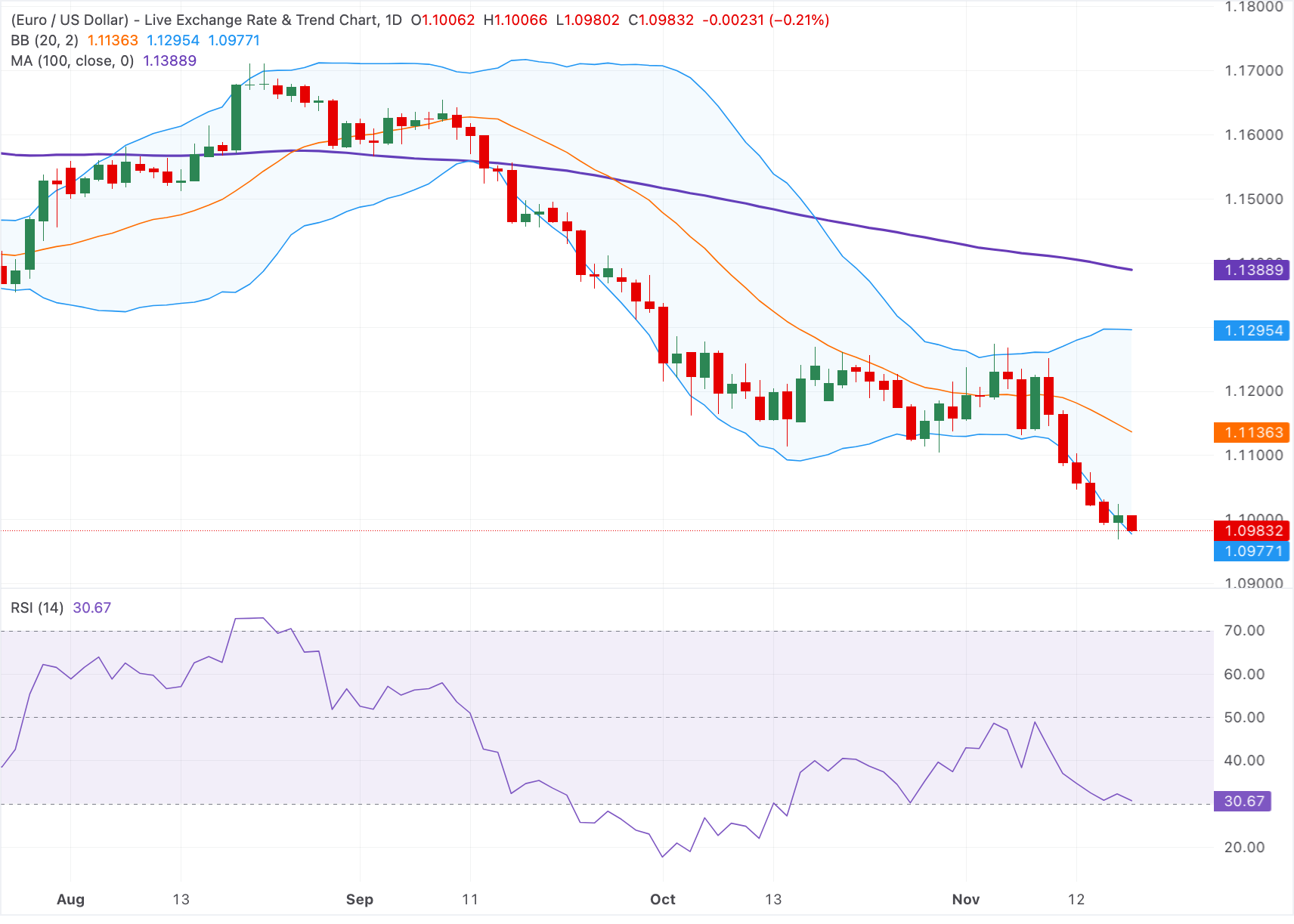
Technical Analysis: Negative outlook of EUR/USD prevails under the 100-day SMA
In the daily chart, EUR/USD maintains a bearish near-term bias as spot holds below the 20-day Bollinger simple moving average and well under the 100-day moving average. Price is hovering just above the lower Bollinger band support, underscoring persistent downside pressure, while the Relative Strength Index (14) at roughly 30.7 flirts with oversold territory, hinting that while bears remain in control, the pace of the decline could start to moderate.
On the downside, immediate support is aligned with the lower Bollinger band at 1.1000; a clear break lower would expose further weakness toward fresh lows beyond the current dataset. On the topside, initial resistance is seen at the 20-day Bollinger simple moving average near 1.1135, with the upper Bollinger band around 1.1295 next in line, ahead of the more distant 100-day moving average at 1.1390, which reinforces the broader bearish structure while price remains capped beneath it.



Comments
Log in or sign up to join the conversation.