


Gold price (XAU/USD) remains under selling pressure near $3,735 during the early Asian session on Thursday. The precious metal falls to its lowest level since September 2025 as hawkish Federal Reserve (Fed) signals raised expectations of higher interest rates.
According to Fed meeting minutes released Wednesday, officials said in October that additional interest rate increases would be needed to combat inflation, but decided to hold off while gathering more data.
The Federal Open Market Committee (FOMC) held the Federal Funds Rate steady at 3.75%–4.00% at its October policy meeting in a 10–2 vote. This followed a 25 basis points (bps) rate hike in September.
Fed Governor Christopher Waller reiterated his belief that the FOMC should consider a half-point hike in December. Meanwhile, Fed officials John Williams and Alberto Musalem also signaled further rate hikes may be needed to curb inflation.
"Gold won't find much relief from the Fed minutes as the overwhelming majority sees further hikes, with a couple broaching a 50bps move if inflation disappoints. Fed will hike until inflation turns, but it's not an emergency. Barring a quick reversal, today's damage suggests a probe of 3350-3450 in the coming weeks," independent analyst Tai Wong said.
Markets are now pricing in nearly a 90% chance of a 25-basis-point Fed rate hike in December, while there's a 10% odds of a larger 50-basis-point increase, according to the CME FedWatch tool. Higher rates are typically negative for gold, which doesn’t pay interest.
Mixed US data keep growth expectations broadly intact
According to Deutsche Bank, the latest run of US data “painted a mixed picture of economic performance.” On the positive side, the bank highlights that “retail sales grew by +0.2% in October (vs. +0.1% expected),” suggesting consumer demand remains resilient. However, this was offset by softer activity indicators, with “industrial production unexpectedly fell -0.4% (vs. +0.1% expected), whilst the NAHB’s housing market index also fell unexpectedly to 25 in November (vs. 29 expected).” Deutsche Bank underscores that this housing gauge marked “the lowest print for the housing market index since 2012, when the economy was still recovering from the aftermath of the GFC.” Even so, they note that “with all that in hand, the Atlanta Fed’s GDPNow estimate was little changed, with the Q4 estimate moving down very slightly from an annualised 3.5% to 3.4%,” indicating that near-term growth expectations remain broadly stable despite the mixed signals.
Kashkari flags inflation miss and resilient demand, keeping DOLLAR bias cautiously supported
Kashkari’s latest remarks score 7/10 on the FXS Speechtracker, only marginally above the 6.8/10 historical average, signaling a tone broadly in line with the established baseline but with a slightly firmer policy edge. By stressing that interest rates “absolutely can impact investment levels” while acknowledging that elevated inflation stems from supply shocks yet still requires the FED to keep expectations anchored, the speech leans cautiously hawkish, especially as strong demand and a resilient job market are highlighted alongside the admission that the FED is “clearly missing on [the] inflation side” of the mandate. The observation that markets expect more hikes than officials currently project, combined with AI being cited as a key growth engine, reinforces a narrative of persistent underlying strength that tends to underpin the DOLLAR on dips.
The FXS Fed Sentiment Index slipped by 0.11 points to 150.62, signaling a minor pullback in perceived hawkishness even as the gauge remains firmly above the neutral 100 mark. This configuration suggests that, despite a slight moderation in tone, the overall policy backdrop is still clearly hawkish in the FXS Fed Sentiment Index framework, consistent with the modestly elevated FXS Speechtracker score and supportive of the DOLLAR against lower-yielding peers.
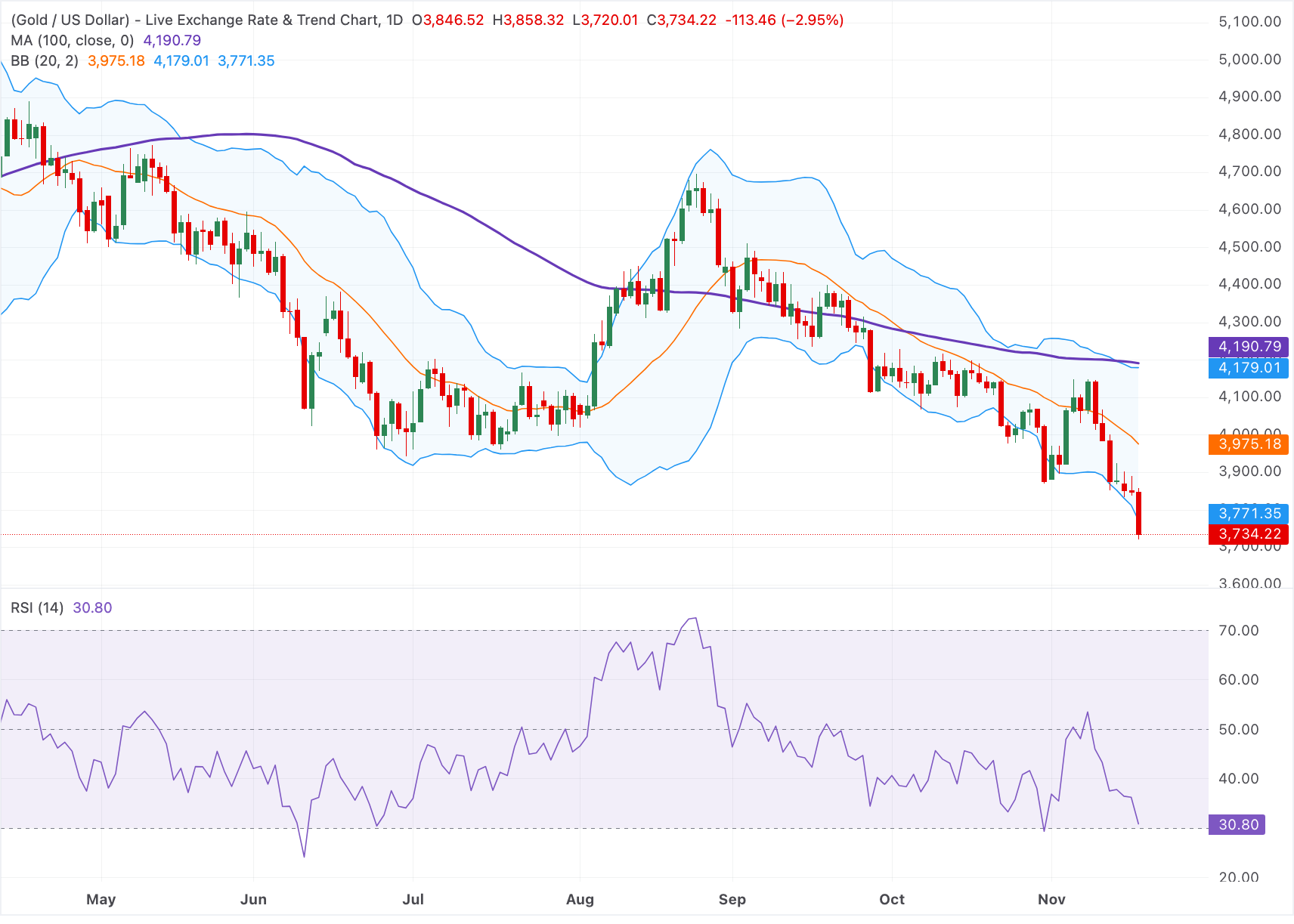
Technical Analysis: Gold retains a bearish tone under the 100-day SMA
In the daily chart, XAU/USD remains under clear bearish pressure, trading below the entire Bollinger Bands envelope, as even the lower band comes in higher. The 20-period simple moving average from the Bollinger setup and the 100-day moving average both sit well above spot, reinforcing a dominant topside cap. The Relative Strength Index (14) hovers around 31, flirting with oversold territory and hinting that while downside momentum is still in play, fresh selling could slow as conditions become increasingly stretched.
On the topside, initial resistance is located at the Bollinger lower band near $3,770, with the Bollinger mid-line around $3,975 acting as the next notable hurdle on any corrective rebound. Further up, the Bollinger upper band at about $4,180 and the 100-day moving average near $4,190 form a broader resistance area that would need to be reclaimed to ease the current bearish outlook. With no clear support levels defined by the studied indicators below the market, the metal remains vulnerable to additional downside until price can at least recover back inside the Bollinger envelope.



Comments
Log in or sign up to join the conversation.