

FX markets remain calm despite energy prices nudging higher and some weakness in semiconductor stocks. Expect further consolidation ahead of tonight's release of the July FOMC meeting minutes. Elsewhere, this quarter's turnaround in the Korean won continues – a testament to the benefits of domestic growth and some structural measures.
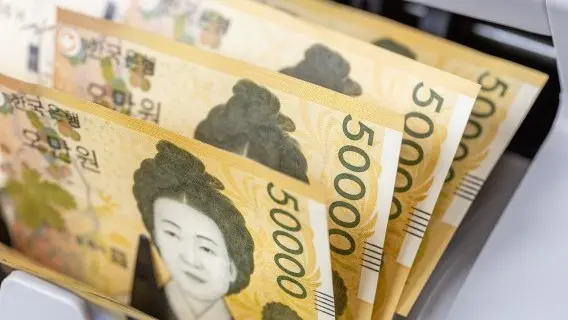
The Korean won's recovery continues, helped by the domestic growth story.
USD: Waiting on the minutes
The unresolved conflict in the Middle East is keeping energy prices bid and partially contributing to the rise in long-end yields. Longer-dated US Treasuries actually found a little demand on yields above 5.30% yesterday, but risks still look skewed to the upside here. Please see the latest update from the ING Rates team here. Higher rates have taken a little steam out of the growth stocks, but a 5% drop in the Philadelphia Semiconductor index yesterday looks small beer in comparison to daily swings seen so far this year. As yet, we see no grounds for a fundamental shift in the low volatility environment which favours the carry trade.
For today, the focus will be on tonight's release of the FOMC minutes for the July meeting. Recall that the vote was 9-3 for unchanged rates and the event proved a dovish one for the short end of the US curve and the dollar, while the long end sold off. The suspicion is that the 12-member FOMC is less hawkish than the participants whose projections delivered forecasts of a 9:9 split for a hike in the June set of Dot Plots. So while there may be a few hawkish references in tonight's minutes that could nudge the dollar and short-dated rates a little firmer, we do not see the minutes as a game changer. Instead, another batch of CPI and jobs data, plus the end-of-month Jackson Hole symposium, will have a bigger say in whether the Federal Reserve hikes in September. Our base case is that it does not, and the dollar softens a little.
Expect more narrow range trading in DXY – perhaps in a 99.40-99.80 range. One-day FX option straddles in USD/JPY price just a 28 USD pip range for the next 24 hours.
EUR: Natural gas prices inch higher
European natural gas prices are now inching up towards their highs of the year. This is bad news for Europe and leaves manufacturers at a comparative disadvantage relative to the US. High energy prices also maintain the hawkish undercurrent at the European Central Bank, where Chief Economist Philip Lane yesterday warned of eurozone inflation staying at 3.0% all year and perhaps staying high next year as well, on the El Niño weather event driving food inflation globally.
For today's session, we see the final release of July eurozone CPI – expected at 2.9% – and June current account data. That data includes portfolio flows, which recently have been showing sustained foreign interest in eurozone debt and equity securities.
Event risk from the FOMC minutes and higher natural gas prices warn against chasing EUR/USD above 1.1600/1620 today.
GBP: July CPI can keep BoE hawks in check
EUR/GBP has barely budged on today's release of the UK July CPI data. The rise in headline inflation was widely expected, though food inflation – which the Bank of England tracks closely – remains quite benign. ING's UK economist, James Smith, notes that the BoE's core services measure of inflation has picked up a little to 3.8% year-on-year, but probably not enough to trouble the Bank.
Our call is that the BoE does not need to hike again, but that the realisation of that may not weigh on sterling until later in the year. In a low volatility environment, sterling is probably still enjoying some carry demand given it is one of the highest, volatility-adjusted currencies in G10. EUR/GBP can probably hang around these 0.8550 levels for the time being.
KRW: Domestic growth has been a big driver
For much of this year, Korea has struggled with massive portfolio outflows and a weaker Korean won, which sent USD/KRW as high as 1560 in June. Those portfolio flows were stemming from foreign selling of Korean equities ($100bn sold year-to-date) and domestic residents putting money offshore. Korea's huge current account surplus on the back of the semiconductor boom did not seem to matter. Korean authorities have tried various measures to support the won, including changing the FX hedging strategy for Korea's huge National Pension Service (NPS) and also allowing the NPS to access FX liquidity through a swap line with the Bank of Korea rather than in the open market.
Yet the turnaround in the won, with USD/KRW now trading under 1400, looks to have been driven by the Korean growth story. The AI investment and export boom has filtered into broader parts of the economy and delivered another strong 2Q GDP print of 0.6% quarter-on-quarter – helping the Bank of Korea to hike 25bp to 2.75% in July. It now seems exporters have greater confidence to repatriate more of their foreign earnings, where the current account surplus can run as high as $50bn on a monthly basis. Hynix issuing a $20bn American Depositary Receipt and bringing that money home has been helpful too.
The turnaround in the won is a reminder of the need for an attractive investment environment at home. We highlight a recent BoK research paper on the subject in a recent opinion piece. It is not clear that USD/KRW needs to go a lot lower than 1400 just yet. After all, foreigners still seem to be selling Korean equities. But the turnaround in Korea may be a useful lesson for Japanese authorities. Creating an attractive domestic investment environment at home – both through growth and higher interest rates – is an effective route to strengthen the domestic currency.



Comments
Log in or sign up to join the conversation.