

Today’s Bank of Canada meeting is unlikely to generate many surprises but the contents of the monetary policy report and the extent to which growth forecasts are revised are likely to drive the currency moves.
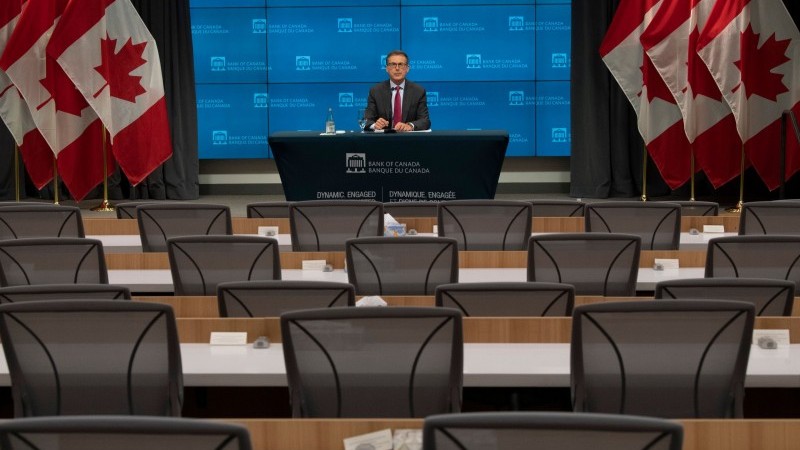
Bank of Canada Governor Tiff Macklem takes questions from reporters on the phone as he participates in a news conference at the Bank of Canada
USD: Rising implied volatility around election day
Rising infections and stricter containment measures appear to be partly priced in at this stage and risk assets are enjoying some stabilization after a turbulent start to the week.
With less than a week before the US elections, market expectations around the most risk-friendly scenario - an uncontested Joe Biden victory have partly been scaled down and investors now appear to be pricing in somewhat higher uncertainty. A rise in USD/JPY implied volatility on the election date tenor appears to be a testament of this. (UUP, FXY)
Overall, G10 FX is trading in relatively narrow ranges and today’s quiet calendar will not offer any key catalyst, with month-end rebalancing flows possibly driving most FX moves.
EUR: France’s expected lockdown suggests other may follow
France is reportedly set to announce a full, one-month lockdown today.
Despite stringent measures hardly surprising markets, the fact that Europe is once again at the forefront compared to other developed regions in imposing hard lockdowns is further feeding the process of de-rating of European growth expectations and taking a toll on the euro.
Italy has also recorded the highest number of daily deaths since May, suggesting it may follow France, along with other highly affected EU countries. (FXE)
GBP: Holding pattern
A temporary softening in the Brexit-related news flow and an empty data calendar will likely keep GBP as a bystander in global FX dynamics.
EUR/GBP to test 0.9000 if EUR shows more lockdowns-related idiosyncratic weakness. (FXB)
CAD: Short-lived impact from BoC’s cautious dovishness
Today’s Bank of Canada meeting is unlikely to generate many surprises.
The Bank’s current policy mix of low rates and quantitative easing is arguably providing just the adequate amount of support to the economic recovery and with provincial spreads under control, we see no need for the central bank to add more stimulus for now.
Governor Tiff Macklem will probably prefer to err on the side of caution and maintain a rather dovish tone which should take the form of a pledge to keep rates lower for longer. This should partly be expected by markets and we doubt it will have a substantial impact on CAD. What is likely to drive most currency moves will be the content of the Monetary Policy Report and the extent to which growth forecasts are revised. Also, we don’t completely rule out any mention of negative rates as a hypothetical tool – although we think negative rates are highly unlikely in Canada – which could have a magnified currency impact.
Overall, the balance of risks for CAD seems slightly tilted to the downside but the impact should be rather short-lived (FXC).



Comments
Log in or sign up to join the conversation.