


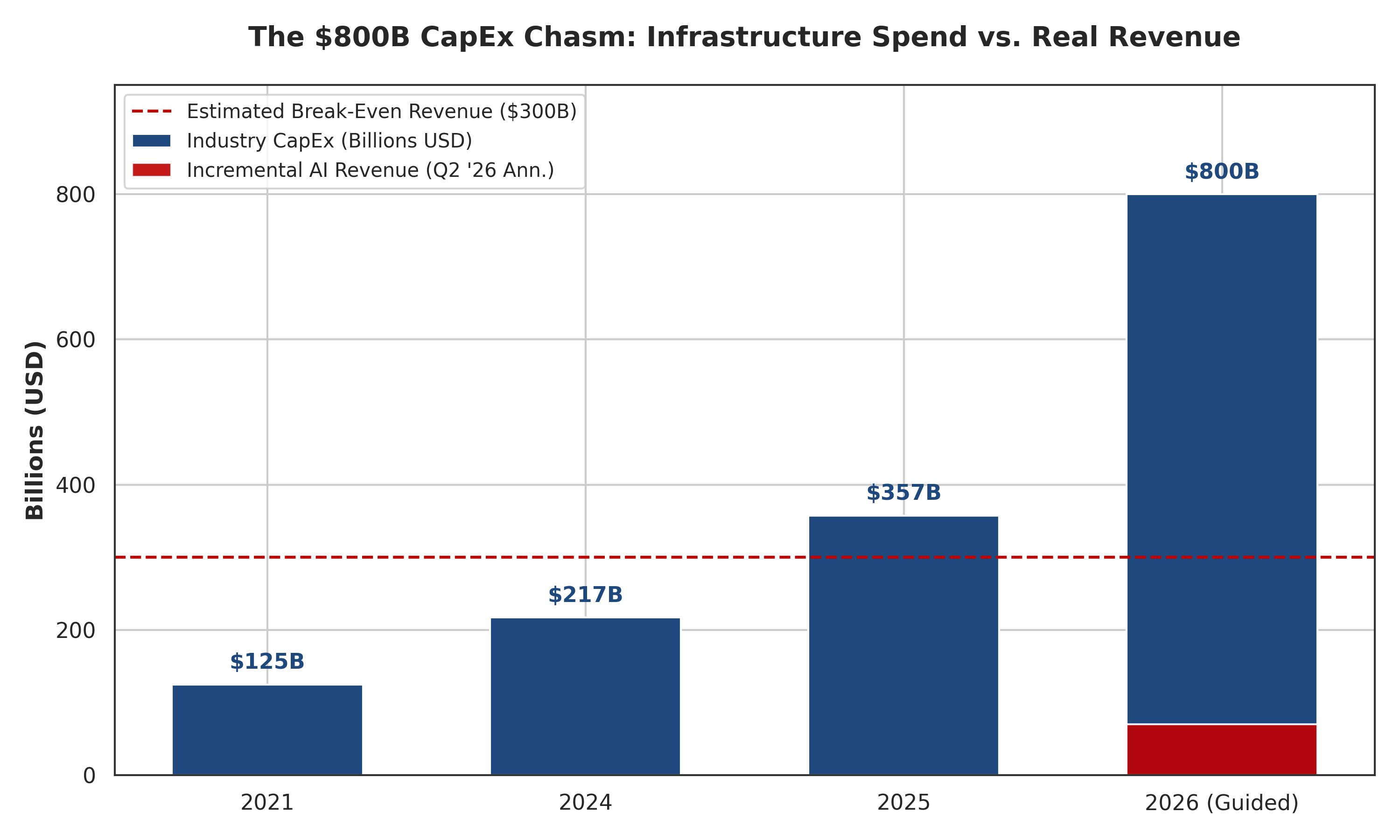
Right now, the generative AI ecosystem is operating under a structural illusion. Look at the capital expenditures for the top four U.S. hyperscalers—Amazon (AMZN), Alphabet (GOOGL), Microsoft (MSFT), and Meta (META). Back in FY2021, annual CapEx was $125 billion. For calendar 2026, guidance indicates $720 to $745 billion. Add Oracle (ORCL), and the baseline approaches $800 billion.
Compare that to actual returns. Incremental cloud revenue is running at about $70 billion annualized. The industry needs over $300 billion in net new end-user revenue just to break even. A standard 10% to 20% return on capital? That requires half a trillion. The math does not work. This isn't organic product-market fit. It is a capital misallocation driven by venture-funded panic and forced distribution.
Google’s Search Cannibalization
Alphabet’s balance sheet shows exactly where the AI market stands today. In Q3 2026, Google Services generated $39.16 billion in operating income. That represents 96.5% of Alphabet’s consolidated operating income. Despite this, management is actively cannibalizing their own monopoly out of a fear of obsolescence.
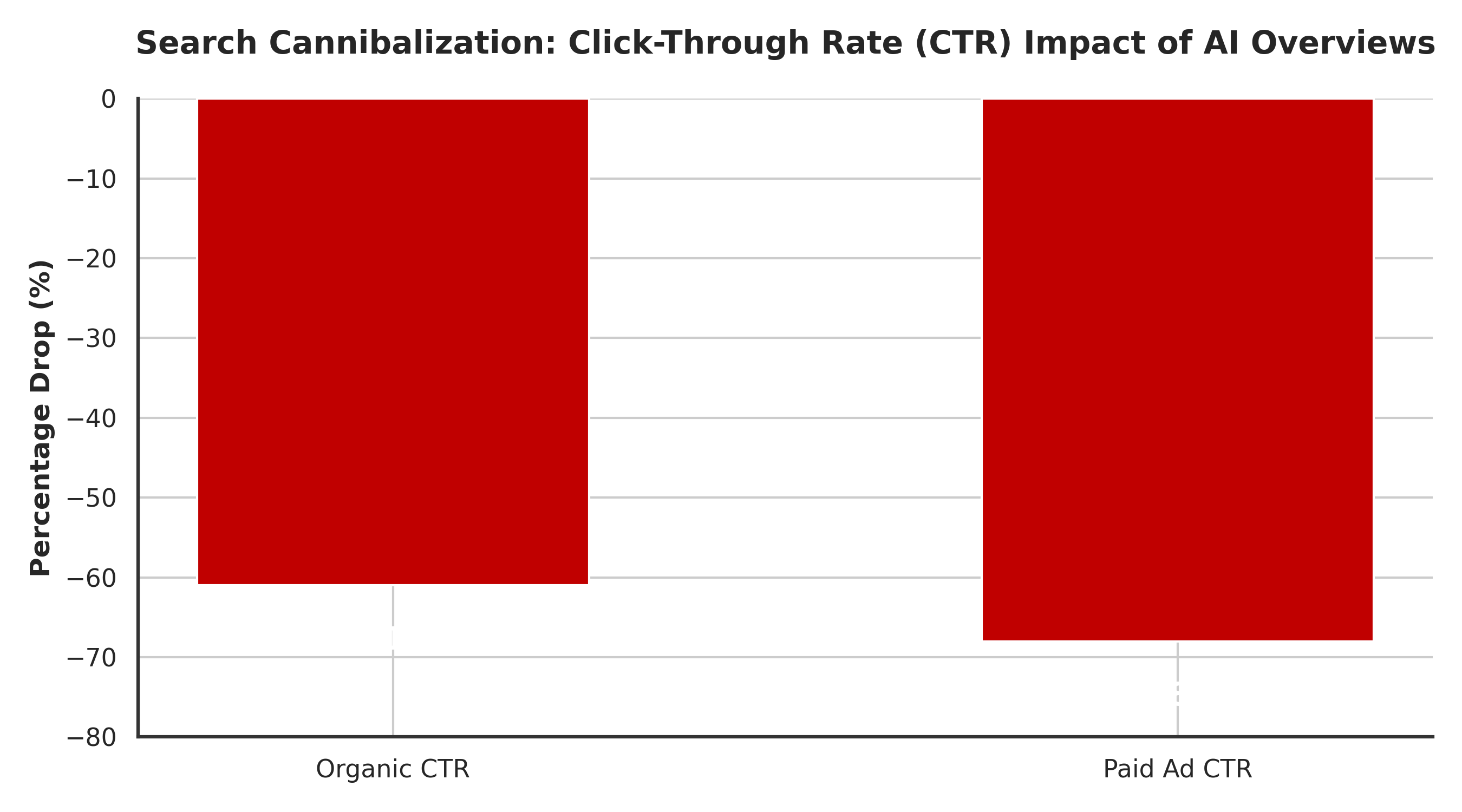
AI Overviews pushed U.S. all-device zero-click rates to 68, up from 60.45% in 2024. When an AI Overview triggers, organic click-through rates drop by as much as 61%. Paid ad CTR falls 68%. This is a severe issue for a business still relying on Search and ads for nearly half its total revenue—$63.35 billion out of $127.58 billion in Q3 2026.
Alphabet management has already admitted AI Mode queries monetize worse than classic search. The market reacted, contributing to a $500 billion single-day drop in market value late last October.
Google is paying a steep compute premium just to reduce its own outbound click volume.
A classic web search uses 0.3 to 1.0 Wh per query. Generating an unoptimized frontier LLM response requires 3 to 5 Wh. That is a 10x to 20x energy penalty. Even if serving costs are aggressively reduced, competitive pressure will likely force 80% of Google's 5 trillion annual queries into heavy-reasoning AI Mode. Assuming a proxy cost of $0.014 per query, that absorbs up to $56.0 billion in annual compute. They are spending infrastructure capital to suppress their own core ad yield.
Forced Distribution and Vanity Metrics
In August 2026, Google announced its standalone Gemini app crossed 1 billion monthly active users (MAU). Look closer, though, and it becomes clear this is a vanity metric driven by forced distribution.
Independent telemetry from Sensor Tower estimates Gemini’s actual organic MAU is roughly 662 million. That is a 27.7% global share, which lags behind ChatGPT’s 1.11 billion MAU and 46.4% share. This exposes a 238 million discrepancy in Google's internal counting. Google drove this headline growth by replacing the legacy Google Assistant on Android by default. They embedded the tool across 2 billion Apple (AAPL) devices. They also automatically bundled Gemini into Workspace tiers, all while raising prices by 16% to 22.2%.
Pushing a product onto a device is not the same as organic adoption. Real adoption requires stickiness and habit formation. Organically adopted tools like Anthropic's Claude hit 21% DAU/MAU stickiness, converting about 13% to paid users. ChatGPT commands roughly 215 minutes of average monthly time spent. Gemini sits at 20% stickiness with just 100 minutes of time spent.
The user behavior is even more telling. Exactly 69.93% of Gemini users navigate directly back to standard Google Search immediately after use. People are bouncing off the product, not retaining it. Microsoft Copilot reveals a very similar trend. Despite ubiquitous bundling across Windows and M365, it holds a mere 1.34% share of the U.S. chatbot market.
Reality of Product-Market Mismatch
The core of this disconnect is cognitive load. Traditional web search demands almost zero friction. You type a few keywords, scan the page, and click. Conversational AI forces recall. It puts an articulation barrier in front of users who really just want quick navigation.
Look at the text length. AI answers average 1,686 characters, compared to Google's 997. That creates a wall of text that completely disrupts rapid scanning. Because users know these models hallucinate, it also imposes a verification tax. Right now, 85% of consumers report they double-check AI outputs somewhere else.
The problems go deeper than just the user interface. The models themselves are bloated. As a founder running hands-on architectural benchmarks, I recently tested a leading high-tier frontier model, "Carbon," against a supposedly inferior counterpart, "Neon." Carbon repeatedly failed at deep, step-by-step logical reasoning tasks. Neon succeeded flawlessly. The industry is obsessed with parameter scale to justify high valuations to investors, ignoring that massive size does not equal architectural rigor. We are paying for compute bloat instead of actual cognitive capability.
The query data backs this up. SparkToro analyzed over 118,000 consumer ChatGPT prompts. Only 5.3% of those AI conversations involve shopping, and just 6.9% relate to commercial investigation. Google handles 16x more purchase-journey queries than ChatGPT. Users have already separated their workflows. They use AI to draft or code. When it comes to commercial navigation, they stick to classic search.
Diverging Investor Sentiment
Public sentiment has already turned. Look at the Pew Research data from June 2026. Right now, 52% of Americans are "more concerned than excited" about AI, creating a 5:1 negative-to-positive ratio. The user friction is not theoretical. It is measurable. Exactly 11% of Google AI Overview claims lack supporting citations. And a solid 77% of adults just find AI customer support frustrating.
Institutional money is reading the room much faster than retail traders. By mid-November 2026, the BofA Global Fund Manager Survey showed institutional net overweight in technology dropping from 37% to 12%. That is the fastest cut we have seen since June 2006. A record 38% of these managers have concluded that corporations are overinvesting in AI. Even more telling, 52% of them expect hyperscalers to announce CapEx cuts within the next six months.
Retail investors are doing the exact opposite. They poured a record $2.0 billion into Nvidia (NVDA) during a single week in November. That move represented over 61% of total retail net inflows. When NVDA dropped 14%, retail traders aggressively bought $111 million of the stock in the opening 30 minutes.
The divergence is obvious. Institutional portfolio managers are pricing in a severe CapEx digestion cycle and securing their exits. Retail investors are just buying the dip, leaving themselves wide open to the impending correction.
Perishable Silicon Crisis
Pure-play AI labs are deploying capital at a macroeconomic scale. The problem is they have zero viable underlying unit economics. Look at OpenAI. They posted a $21.6 billion operating loss in H1 2026 against a massive $278 billion 5-year burn plan. Then you have Anthropic. Their $81.3 billion IPO priced at 42.5x trailing twelve-month sales, even while they sit on $900.9 billion in fixed compute commitments.
Worse, over 70% of cloud AI revenue ties directly back to OpenAI and Anthropic across 23 closed-loop reciprocal deals totaling $2.3 trillion. It is a cycle of circular revenue simply propping up the numbers.
This brings us to the real danger of the current market. People compare this to the 1999-2000 Dot-com crash, but they are missing the most crucial difference: asset durability.
When the telecom bubble burst in 2000, it wiped out $5 trillion in market cap. But the fiber optic cables laid in the ground had a 25-to-30-year lifespan. That stranded capacity survived long enough to underwrite the entire Web 2.0 boom a decade later.
Today’s AI data centers do not have that luxury. Take a modern $38 billion 1-GW AI data center. Exactly 60% of that capital ($23 billion) goes straight into compute silicon like GPUs and HBM memory. This hardware depreciates economically at 20% per year, giving it a functional, competitive lifespan of just 3 to 6 years.
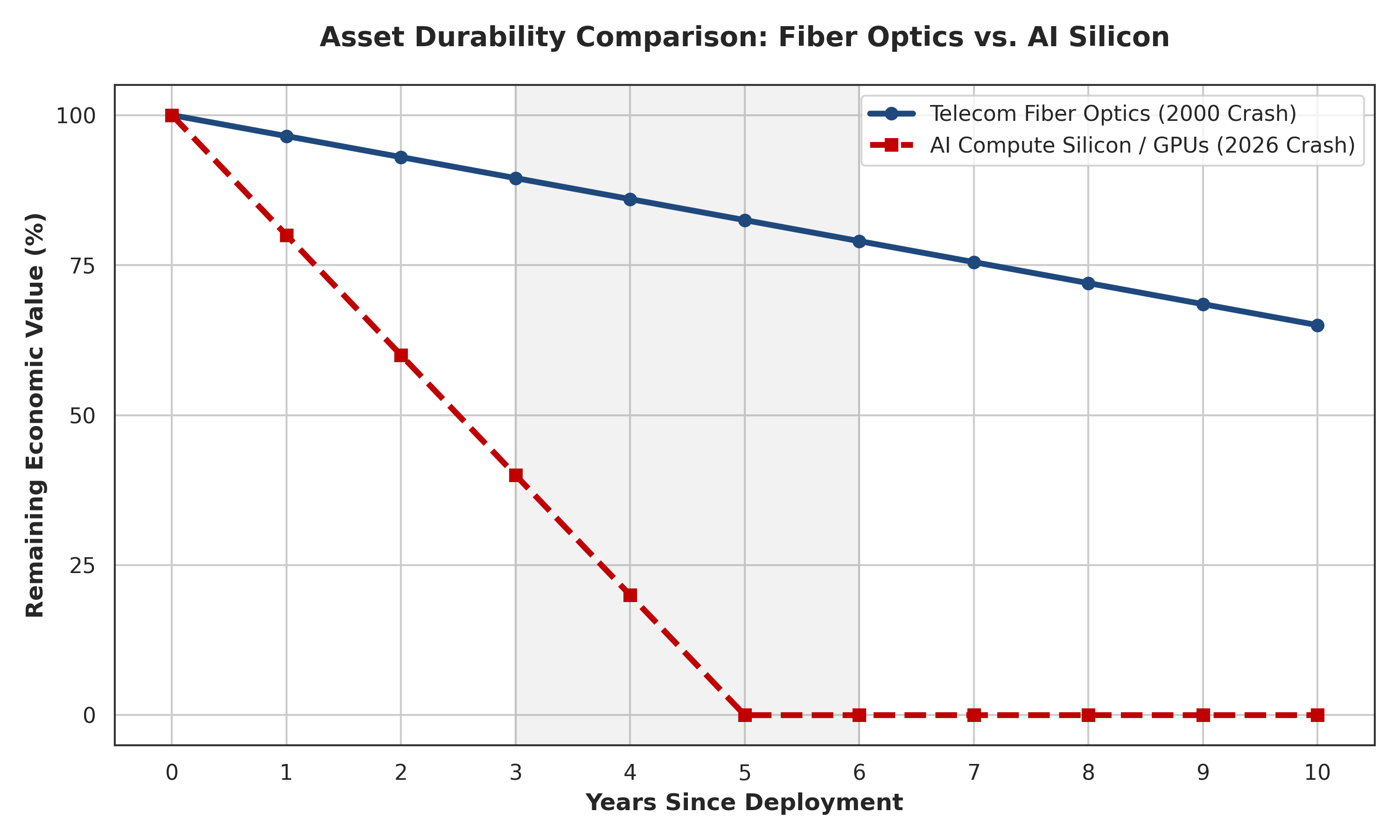
Hyperscalers have artificially boosted their net income on paper by stretching their accounting depreciation schedules from 4 to 6 years. That move alone suppresses up to $230 billion in industry depreciation through 2028.
But an accounting maneuver cannot change the physical reality of hardware obsolescence.
You cannot leave a GPU cluster sitting idle for a decade waiting for enterprise software demand to finally catch up. Idle silicon does not wait around like fiber optics. It just becomes outdated. When market conditions tighten and investors start demanding an actual return on capital, this $800 billion CapEx gap is going to be incredibly difficult to sustain. If a collapse happens, corporate executives will be safely protected by their compensation structures. Retail investors will be the ones left holding the downside of rapidly depreciating, obsolete hardware.

Comments
Log in or sign up to join the conversation.