

You don't need two decades on Wall Street to recognize when bankers are packaging garbage into gold. We all saw how it played out in 2008 with subprime mortgages—slapping AAA ratings on absolute toxic waste and offloading it to unsuspecting pension funds as "risk-free" yield. Well, the suits are back at it. They haven't changed the playbook; they just updated the vocabulary. They swapped out "Collateralized Debt Obligations" for "Real World Asset (RWA) Tokenization," and somehow, the regulators are falling for the exact same grift all over again.
Here is the harsh reality. The precise systemic rot that blew up Lehman Brothers is currently metastasizing inside the crypto ecosystem. And if you think this is strictly a blockchain problem, you are entirely out of your depth. The contagion is already hardwired directly into our traditional equity markets.
The $1.8 Trillion House of Cards
Let’s look at the actual assets propping up this $24 billion digital casino. We are staring down an exploding $1.8 trillion private credit market where underwriting standards have effectively vanished into a race to the bottom. Consider the data: U.S. private-credit defaults hit a record 5.8% in January 2026. If you look at UBS’s macroeconomic models, they're projecting that figure could spiral to a staggering 13% before the year is out. That isn't a market correction. That is a bloodbath.
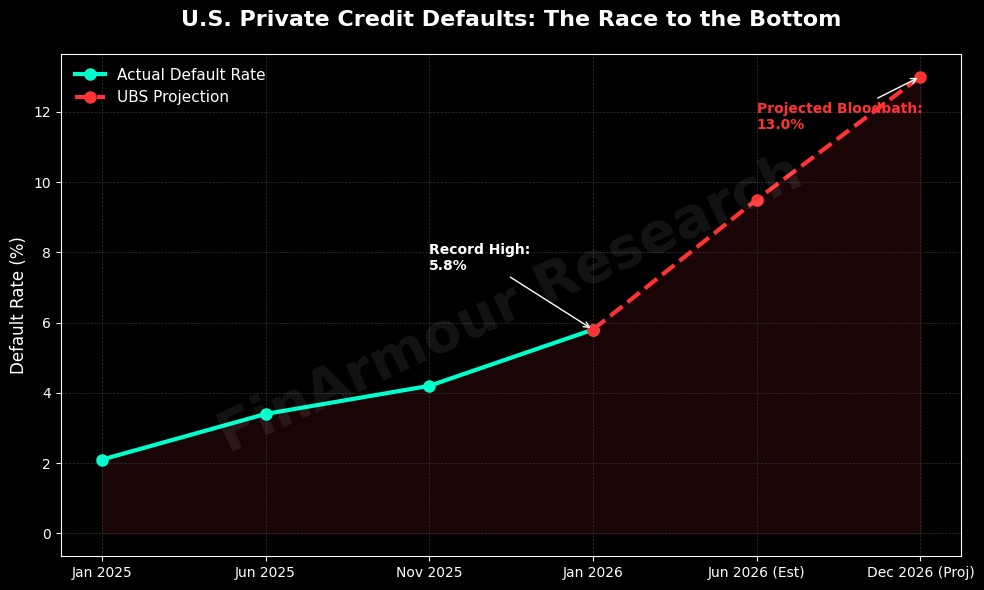
When these software companies and over-leveraged corporate borrowers inevitably default, the off-chain private credit funds will take a massive hit. The problem? Those exact funds are now being digitized, tokenized, and relentlessly borrowed against within an entirely unregulated shadow banking system. What we are witnessing is a digital recreation of the Chinese LGFV (Local Government Financing Vehicle) disaster—using off-balance-sheet vehicles to mask insolvency until the bubble finally bursts.
The "Air Gap" and the Oracle Problem
The fundamental flaw in the entire RWA narrative comes down to friction: the clash between deterministic code and probabilistic reality. DeFi platforms operate on blockchain time. They are instant, algorithmic, and entirely ruthless. Physical assets, on the other hand, settle on analog time.
Pricing these real-world assets requires humans, manual appraisals, and quarterly NAV updates. Yet, on-chain oracles like Chainlink are attempting to feed this inherently "stale" data into smart contracts as if it were real-time pricing. This creates what I call a "Physical-to-Digital Air Gap." When a corporate loan defaults off-chain, its on-chain token doesn't immediately reflect that reality. It remains a "zombie asset," trading at a false premium until the oracle finally catches up. By the time the data syncs, the smart contracts trigger a synchronized, violent wave of cascading liquidations. And remember—there are no circuit breakers here.
Leveraged Looping: Unbounded Shadow Debt
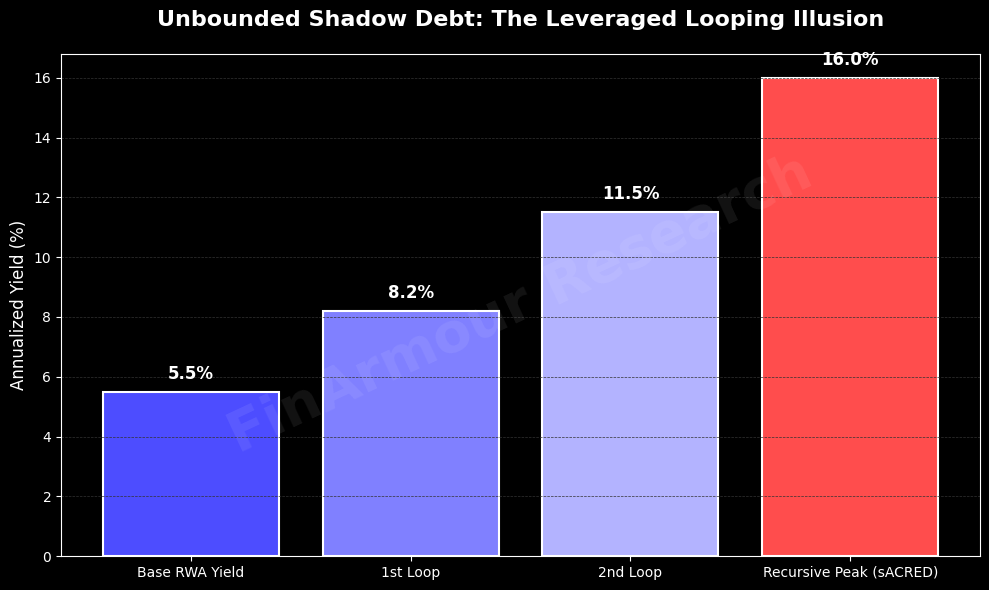
How do institutions maintain this illusion of infinite liquidity? Through a programmatic cycle known as "leveraged looping." They deposit tokenized private credit to borrow stablecoins, only to instantaneously route those exact funds right back into purchasing more of the same yield-bearing assets. It is the on-chain, hyperscaled equivalent of a traditional repo trade, but on steroids.
Take Apollo Global Management’s tokenized fund (ACRED) and its smart wrapper sACRED. They are active players in this space, allowing institutions to artificially amplify yields up to 16% through recursive collateralization. Call it what it is: pure, unbounded off-balance-sheet leverage. The math simply doesn’t add up.
The Warning Shot: The November 2025 deUSD Collapse
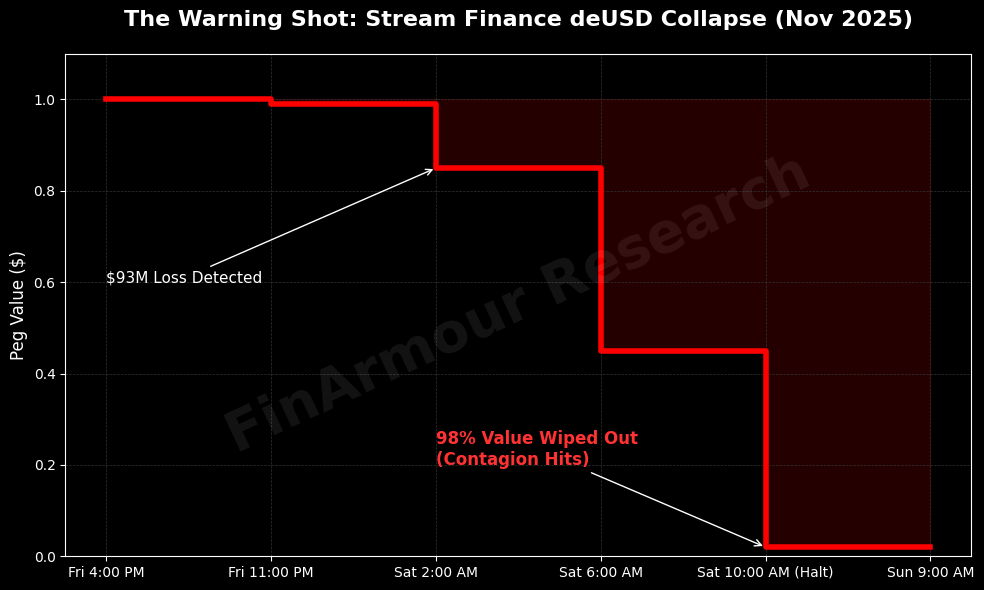
For anyone who thinks this is just academic theorizing, look at the corpse of Stream Finance. In November 2025, the deUSD stablecoin imploded in a matter of hours. The protocol relied heavily on a "tokenized hedge fund" model that managed to lose $93 million in a single weekend trading anomaly.
Because of the absolute composability of DeFi, those toxic tokens had already been rehypothecated across seven different blockchain networks. When Stream abruptly halted withdrawals, Elixir Network’s deUSD lost 98% of its value instantly. Let’s be clear: this wasn't a clever crypto hack or a smart contract exploit. It was a traditional credit default that poisoned the digital well. That $380 million contagion serves as the definitive post-mortem for the RWA dream.
The SRT Doom Loop: Banks Funding Their Own Demise
Meanwhile, European and U.S. commercial banks are playing a dangerous game to dodge Basel III capital requirements using Significant Risk Transfers (SRTs). The banks are offloading the highest-risk, junior tranches of their loan books to non-bank financial intermediaries and private credit platforms.
Then, in a stroke of unfathomable greed, these same traditional banks turn around and provide the actual leverage to those private funds so they can buy the junk in the first place. They are literally funding the offloading of their own risk. It is a textbook financial doom loop. When the tokenized collateral inevitably implodes, the synthetic risk the banks thought they successfully dumped will violently boomerang straight back onto their own balance sheets as defaulted prime brokerage loans.
They thought they offloaded the risk. They were dead wrong.
The Tokenized Treasury Timebomb
But here is where it gets genuinely terrifying. Wall Street titans like BlackRock and Franklin Templeton have poured billions into tokenized Money Market Funds and U.S. Treasury products like BUIDL and BENJI. These instruments are treated as the supposedly safe, bedrock collateral underpinning the entire ecosystem.
When the over-leveraged tech funds trigger that cascading liquidation event I mentioned earlier, the automated smart contracts won't pause to negotiate a workout. They will instantly liquidate everything—including those tokenized Treasuries. To honor that massive, sudden wave of digital redemptions, managers will be forced to execute a multi-billion-dollar fire sale of physical Treasuries in the analog market. Suddenly dumping sovereign debt will instantly drain traditional market liquidity and violently widen bid-ask spreads. Traditional hedge funds holding similar assets will face margin calls they never saw coming. The equity markets will bleed.
Washington is Asleep at the Wheel
And where are the regulators in all this? Handing out free passes. The 2025 GENIUS Act was specifically supposed to force 1:1 reserve backing and stop stablecoins from operating like shadow banks. Instead, banking lobbyists engineered a gaping loophole.
The law stops the primary issuers from paying yield, sure. But it utilizes a flimsy rebuttable presumption at the OCC to let their affiliates and white-label partners do it anyway. It is regulatory arbitrage at its absolute finest. They are preserving the economic substance of unmitigated leverage while quietly checking the technical compliance boxes. Washington is completely asleep at the wheel.
The Algorithm Will Simply Sell
Make no mistake: the trillion-dollar RWA market isn't a bridge to a better, more efficient financial system. It is a meticulously engineered debt trap designed to privatize gains during the bull run and socialize the catastrophic losses when the music stops.
When corporate default rates hit critical mass, there will be no central bank intervention fast enough, and no human forbearance. The algorithm will simply sell. And when it does, it will pull fiat capital out of the traditional system so fast it will snap the neck of the global equity markets.
The timer is ticking. Wall Street engineered the detonator.
Comments
Log in or sign up to join the conversation.