


The first quarter saw many unexpected developments, the most obvious being the U.S. move to engage with Iran, which led to the closure of the Strait of Hormuz. This sent WTI oil prices soaring to over $100 per barrel. It was an unexpected twist that pushed equity prices lower at quarter-end.
By the end of March, the Mott Capital Thematic Growth strategy finished down 10.88%, inclusive of dividends and net of fees. Meanwhile, the S&P 500 total return index declined 4.33%, including dividends. It was a quarter of poor performance for us.

Performance Through 3/31/2026.
Q1 Performance: Earnings Hits in Health Care
The biggest hit to our quarterly performance came in February, when earnings from Boston Scientific (BSX), UnitedHealth (UNH), and Grail caused their stocks to fall sharply. These disappointments led to a much deeper and sharper decline in our portfolios than in the overall S&P 500. At the same time, the shift into health care and the reduction in our exposure to software and technology did not help as intended.
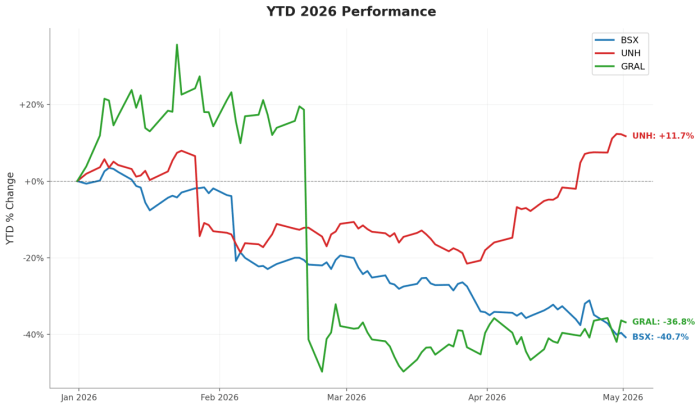
YTD 2026 performance — Boston Scientific, UnitedHealth, Grail.
Portfolio Changes
That said, UnitedHealth has now recovered all the losses it incurred in the first quarter. Meanwhile, Boston Scientific delivered another weak quarter, sending the stock lower and prompting me to exit the position. Given the sizable gains in Amazon (AMZN), I also trimmed our position following its strong move higher. We still maintain a meaningful position in Amazon, but the reduction allowed me to offset some of those gains against the losses in Boston Scientific for tax purposes.
I used the proceeds, along with a portion of our cash position, to initiate a position in Intuit (INTU), the maker of QuickBooks and TurboTax. Intuit’s stock has declined significantly, leaving the valuation at a much more attractive level. Over time, I also believe the company is well positioned to benefit from advancements in AI.
Grail also fell sharply in the first quarter, noting that its top-line data from its cancer screening test failed to meet its endpoint of detecting more cancer in stages 1 and 2. While the study did not meet its endpoint, it still detected more cancer in stage 3, which implies fewer cases progressed to stage 4. The goal of the test is to detect cancer early, when it is more treatable. The company plans to present additional data from the topline readout at an upcoming cancer conference, and with greater clarity, the stock could rebound. I continue to have strong conviction in the stock and its underlying technology.
Additionally, we saw significant weakness among technology-related names such as Shopify (SHOP) and Microsoft (MSFT). While health care stocks were expected to offset some of that weakness, they did not. It was simply one of those quarters where nothing seemed to go our way.
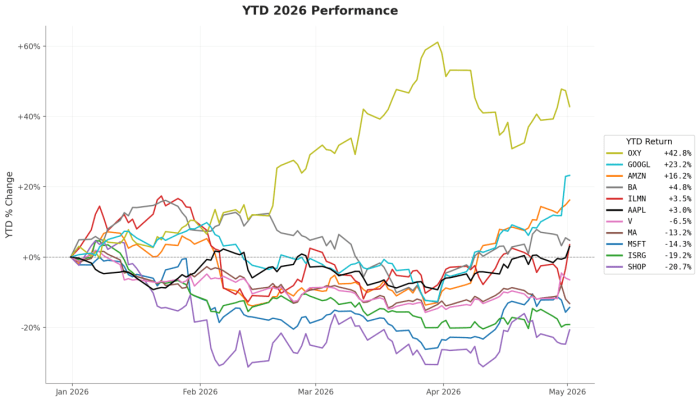
YTD 2026 performance — portfolio holdings (OXY, GOOGL, AMZN, BA, ILMN, AAPL, V, MA, MSFT, ISRG, SHOP).
As the chart above shows, many of the stocks have improved somewhat since March through May 1, but there is still a lot of work to be done, and there will undoubtedly be some reshuffling within the portfolio.
Second Quarter Outlook
While we are now midway through the second quarter, the S&P 500 has reached new highs, but we are again seeing some of the same characteristics observed at the end of 2025, with narrow leadership — primarily concentrated in mega-cap companies.
With oil rising sharply and inflation showing signs of reaccelerating, the key question is whether global central banks will shift from an easing cycle back toward tightening, or whether higher oil prices will ultimately reduce global output and trigger a recession. Under normal circumstances, this would not be a particularly difficult assessment. However, constant war-related headlines and daily market swings have made conditions far more volatile, with larger and more frequent price moves. That said, at some point, oil supply and demand are likely to fall out of balance, and when that happens, prices will move higher. If demand exceeds supply, expectations of a near-term end to the conflict will matter less.
Given the volatility in oil and the rapid rise in Occidental, I decided to lock in some gains and reduce the position to 5% from roughly 8%. In today’s market, gains can be erased quickly, and I was not willing to let that happen again.
The first quarter presented many challenges, both expected and unexpected. It remains unclear how the conflict will evolve, and as a result, oil prices and broader markets are likely to remain highly volatile in the near term.


Comments
Log in or sign up to join the conversation.