
Keeping track of the Fed can be a complicated business. In addition to official releases from the Board of Governors (including policy statements, press releases, meeting minutes, and materials like the twice-quarterly Beige Book), there is also a never-ending parade of appearances in Congress, speeches, and media hits to digest.
One way we stay on top of this mountain of verbiage is natural language processing. For FOMC statements, press conferences, minutes, the Beige Book, and published FOMC speeches, we apply a series of algorithms to compare them to previous commentary over time. This lets us assess how the language scans on a hawk/dove scale. Hawks are central bankers worried about inflation, sanguine or optimistic on growth and unemployment, and generally biased towards raising rates or otherwise tightening policy. Doves are the opposite.
Our algorithms have several different approaches. Two use dictionary-based approaches from papers by Loughran-McDonald and Schmeling & Wagner to look for language that is associated with either hawkishness or dovishness. The Loughran-McDonald algorithm also scores speeches for attitudes on inflation and growth. Another approach is to compare speeches to language from periods when the Fed was hiking rates via a logistic regression, or compare them to periods when the market reacted aggressively to Fed policy (again via a logistic regression). Those two approaches based on rate cycles or market data can also look forward (i.e. regress against the next outcome rather than the current one). In total, we have 8 different methods to score Fed communications, which we can then compare to either similar communications (for instance, comparing a policy statement to other policy statements) or the whole corpus of Fed communications.
Last Monday, July 13, we got a very good example of how these algorithms work. Governor Waller gave a speech (link) that revealed a very hawkish bias. To illustrate that hawkishness, below we show a series of scores for the speech. The higher a score, the more hawkish the speech is perceived to be. As shown, while our rate cycle logistic regression didn't see Waller's comments as very hawkish, our market reaction-based regression did. And dictionary-based regressions were right at the top of the charts.
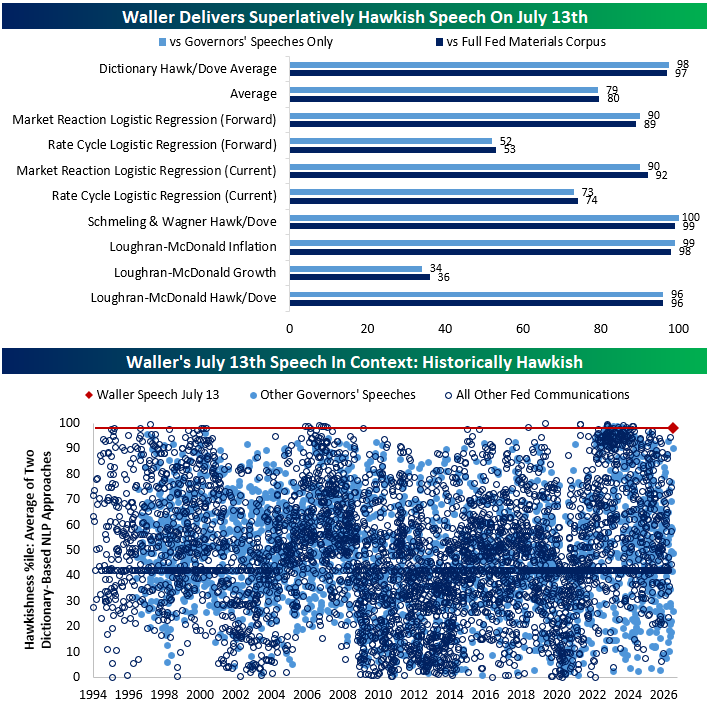
The second chart above illustrates how hawkish the speech was. To create it, we took all Fed communications since 1994 and scored each one, showing the average hawkish/dovish percentile score for our two dictionary-based measures. As shown, there are only a few speeches in Fed history that were more hawkish than Waller's comments two Mondays ago. That's a strong signal that Waller - and given his position as a leading voice that tends to move before the rest of the FOMC - will be ready to raise rates soon, an outcome that felt unthinkable at the start of the year.


Comments
Log in or sign up to join the conversation.