

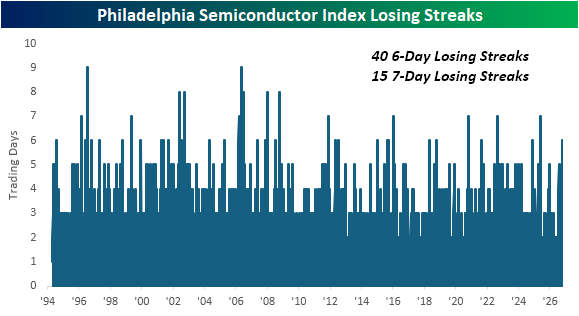
It’s feeling a little like Groundhog Day for semiconductor stocks lately, as the nearly 3% decline in the Philadelphia Semiconductor Index (SOX) has the index on pace for a sixth straight down day, a stretch in which it has fallen more than 10%. Since the SOX’s inception in 1994, this current rut would mark the 40th time that the index had a losing streak of at least six trading days. If you want a silver lining, consider that only 15 of the prior 39 streaks lasted a seventh day, so there’s a greater than 60% chance that the group finishes higher tomorrow. Fingers crossed. The longest losing streak for the SOX was nine trading days, and that happened twice: once in July 1996 and then again in 2006.
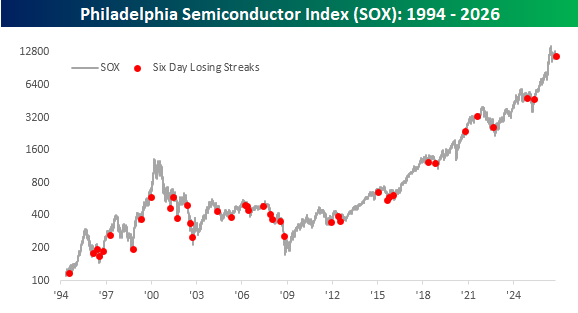
The chart below shows each of the prior six-day losing streaks on a long-term chart of the SOX. The current streak is the first since May 2025, or a little less than a year and a half ago. One aspect of the chart that stands out is how much less frequent streaks of the current length have become. In the 14 years from the SOX’s inception through 2008, there were 25 streaks of at least six down days in a row. In the 18 years since then, there have only been 15. That’s what you would call a maturing market.
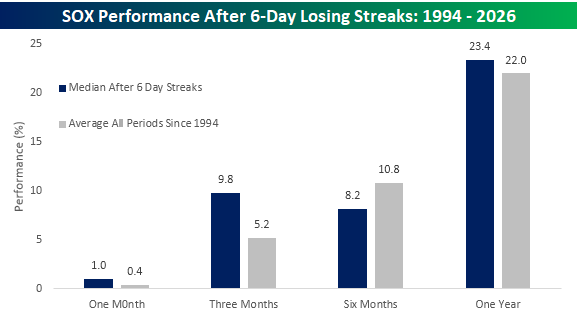
As investors and traders we can try to read into these types of streaks as a sign of impending doom, or an impending bounce back, but the reality is that forward returns after six down days in a row for the SOX are roughly in line with the average for all periods since 1994. As shown in the chart below, median returns following the 39 prior six-day losing streaks were above the long-term average for all periods since 1994 over the following one, three, and 12 months, but below the average for the long-term over the next six months.
The incessant decline of semiconductor stocks over the last several trading days has been a pain to deal with, but markets go up and down, and we didn’t hear many complaints over the last year when it seemed like semis did nothing but go up.

Comments
Log in or sign up to join the conversation.