

Please read my article Risk Capacity Used in Personalized Target Date Accounts is Much More Dangerous Than Risk Tolerance
The problem is that PTDA providers have confused risk capacity with risk tolerance. Capacity can be estimated from recordkeeper data, but tolerance cannot. Capacity is the ability to take risks. Tolerance is the willingness to take risks – it’s emotional. Behavioral scientists tell us that we are risk averse, so we do not want to maximize risk.Capacity is maximum risk.
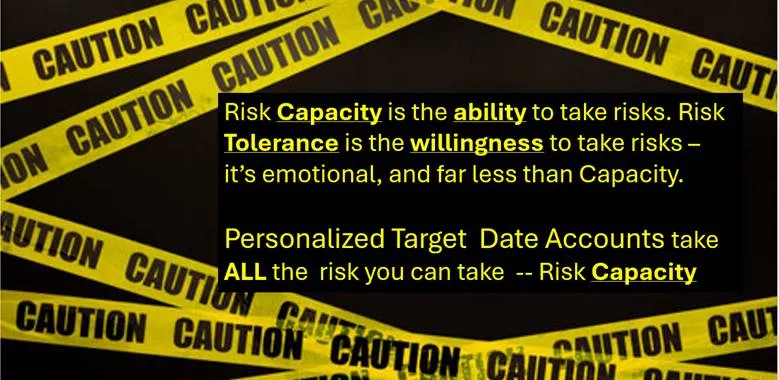
Here’s a brief summary of my article:
PTDA Misstep: PTDA providers confuse risk capacity (financial ability) with risk tolerance (emotional willingness), leading to excessive risk in QDIAs.
Defaulted Participants: Financially naïve defaulted participants don’t engage, making their risk tolerance unknowable and personalization very risky because the only data available is risk capacity.
Data Limitation: Core data points (age, salary, etc.) measure risk capacity, not tolerance. Tolerance is emotional and requires participant engagement, not data.
Solution: A safe “Master PTDA” should be the QDIA, prioritizing protection for defaulted participants. And individual PTDAs should be managed by self-directed (non-defaulted) participants.
More By This Author:
Why Is The U.S. Treasury Yield Curve U-Shaped And Why Did The Treasury Buy Back $10 Billion In Notes?
401(k) Warns Baby Boomers In Target Date Funds To Get Out
Democracy Fails When The Majority Are In The Cart.



Comments
Log in or sign up to join the conversation.