

In an effort to support the economy and stabilize markets, we believe the Fed will go “all in” and cut the fed funds target rate to 0-0.25%, and officially start QE4 on Wednesday, March 18.
Whatever it takes
Wednesday is shaping up to be the Federal Reserve’s “whatever it takes” moment. The economic and financial market situation demands they “go big." To not respond meaningfully would risk a reaction that makes an already intense and somewhat dysfunctional situation significantly worse. We are looking for a 100 bp interest rate cut with an “official” restart of quantitative easing – QE4 – of the order of $50-75 billion per month.
The economic case
Few analysts now doubt that the US is in recession. After a positive start to the year, the fear and disruption caused by Covid-19 has led activity to plunge through March, with the pain spread across multiple sectors. The supply crunch in manufacturing, the panic in the financial sector, and the collapse in airline travel, hotel stays, and leisure activities means we could see a quarterly contraction of the scale reached during the height of the financial crisis. We are penciling in a greater than 7% annualized 2Q20 GDP decline relative to the -4.4% figure experienced in 1Q09 and -8.8% in 4Q08.
There is also a high probability that the US experiences negative headline inflation during the second quarter, and through the second half of the year with the plunge in oil prices already translating into steep declines in the cost of gasoline. Any prospect of a meaningful pick-up in wage growth is now gone with the clear threat that we start to see payrolls slide, as company finances are squeezed by falling demand and tightening credit conditions.
The credit case
It was clearly a turbulent week for markets, as underlined by the fact that at one point we were seeing both risk assets and safe havens, such as Treasuries and gold, sell-off as participants and scrambled for liquidity. The Fed’s willingness to inject US$1.5 trillion at 1-3 month tenors has addressed some of the near-term stress in financial markets, but issues remain.
The NY Fed also changed the way it manages the $60 billion of reserve management purchases away from Treasury bills towards longer tenor issues. The Fed’s decision to aggressively front load them – $37 billion on Friday alone – underlines the strains. Given the uncertain prognosis for Covid-19 and its longer-term economic implications, those stresses are unlikely to disappear.
Last week’s huge liquidity injections underlined the Fed’s willingness to aggressively deal with “temporary distortions,” and this week we expect to see them unleash their full armory. While there may be some push back from certain Fed officials, we believe the FOMC will choose to act decisively with a formal restart of “true” quantitative easing.
The Fed’s double bazooka – 100bp and $75 billion per month QE
The Fed will be wary of disappointing expectations in this time of huge uncertainty, on the basis that it could lead to a tightening of financial conditions that compound the downside risks to growth and inflation. Financial markets are already pricing interest rates at zero by April, and to us there seems little point in waiting. Consequently we favor a 100 bp move in the Fed funds target rate to 0-0.25% with interest on excess reserves cut to zero.
In terms of quantitative easing, QE 1 in 2008/09 was around $30 billion per month of asset purchases while QE3 went up to $85 billion per month from December 2012. We expect the Fed to start QE4 in the range of $50-75 billion, favoring the higher end of that range. Moreover, the Federal Reserve’s balance sheet peaked at $4.5 trillion in early 2015 – equivalent to around 25% of US GDP. Today the balance sheet is around $3.8 trillion or 18% of GDP. The Fed would have to expand its balance sheet by around $1.6 trillion to get us back to a 25% of GDP today, so there is plenty of ammunition.
The purchases will likely focus on Treasuries, but could also include mortgage backed securities, given the recent spike in mortgage rates (around 60 bp in the space of two weeks). Mortgage rates had plunged in the wake of falling bond yields, which triggered a sharp increase in the demand for mortgage refinancing and subsequent issuance of MBS. The recent dislocation in markets means participants are reluctant to absorb the extra MBS – hence the spike in yields now. The mortgage market is a key transmission mechanism for Fed stimulus so asset purchases may be required here.
The size of the Fed's balance sheet - % of GDP
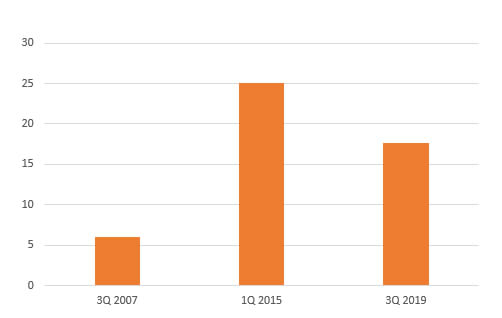
Federal Reserve, ING
The end result
This action in itself is not going to rescue the US economy from recession, but it will help to mitigate the risks from financial tensions that could make the growth and jobs outlook far, far worse. It will also offer breathing room before an anticipated fiscal stimulus, and materialize a potential lending scheme provided by the Treasury. That said, only better news on the prognosis for Covid-19 will return us to “normality." Like most, we hope this will be over by the summer, but the Fed cannot take that for granted, and, consequently, this justifies an aggressive response that can always be reversed.



Comments
Log in or sign up to join the conversation.