


The Fed meets Wednesday, and Fed funds futures and overnight index swaps expect no change in policy. Swaps price about a 42% chance of a hike, but with little new data before the meeting, the next chance for a hike looks like September, with possibly another one or two after that. Looking around the market, though, it is pricing in more action down the road.
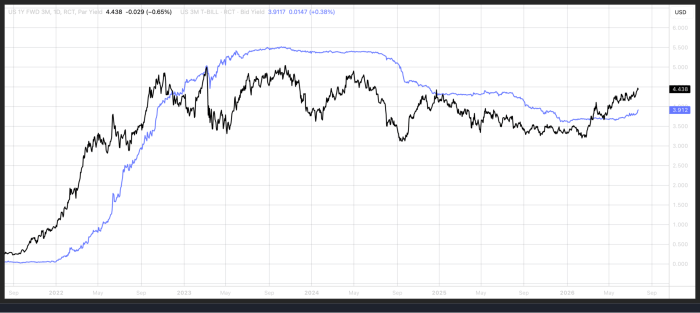
The 3-month Treasury bill has risen about 25 basis points off its year-start low, and its 12-month forward rate is pricing in another 50 basis points above that level. That implies as many as three rate hikes over the next 12 months, with the bill’s rise as the first and the forward carrying the other two.
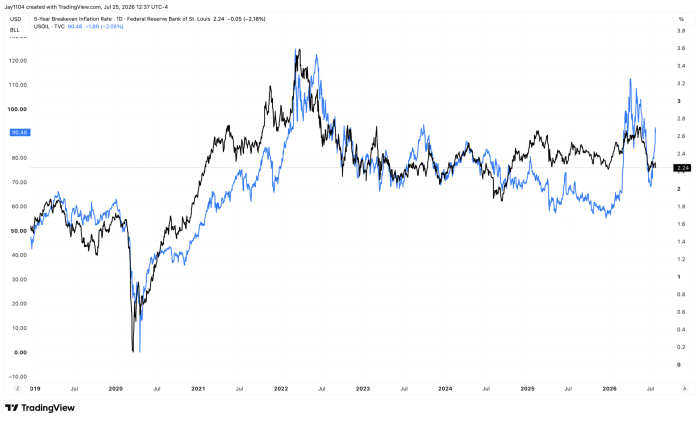
Real yields have risen sharply as well, with the 5-year real rate around 2.16% and the 10-year at 2.40%. The telling part is that the 5-year breakeven, around 2.24%, has not moved up despite oil surging from around $70 a barrel to $89 since the beginning of July. Breakevens rose on the first oil spike, but not this time. That could be because the market is pricing in a Fed that actually responds, tightening financial conditions itself in expectation of the hikes.
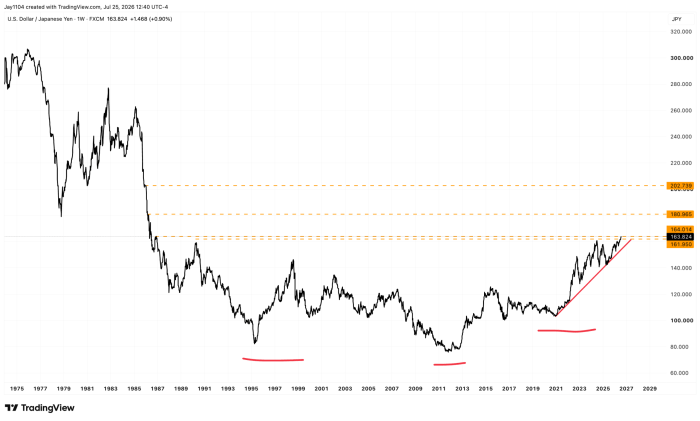
The same thing shows up in the dollar, which has strengthened significantly against the yen, euro, and pound. The euro looks to have formed a bear flag, while the yen has broken out to levels not seen in decades. Beyond the 164 region, there is little resistance until 180 or even 200, and purely on the technicals, an inverse head and shoulders breaking its neckline would point toward 260, though that is a big question.
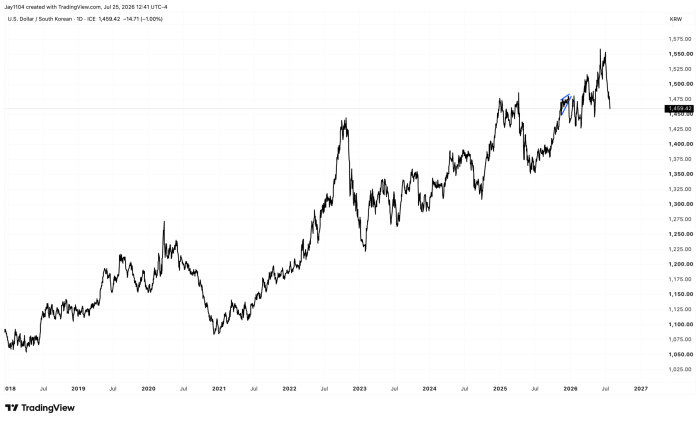
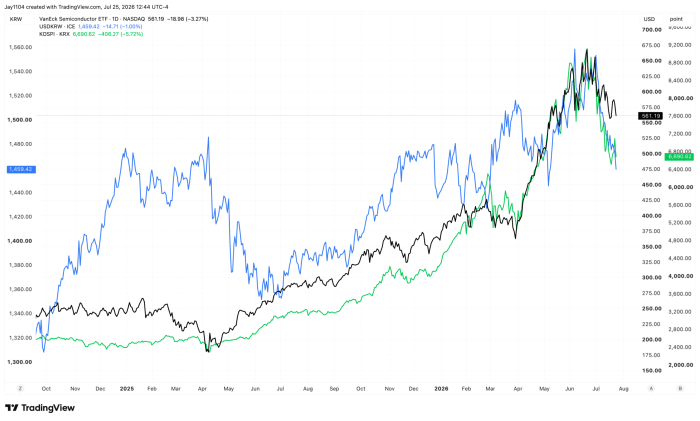
Meanwhile, the market has not a single Bank of Japan hike priced in, while the Bank of Korea already raised rates on July 15 and is expected to reach roughly 3% in August with another hike in November. The won has been strengthening meaningfully as a result. The Fed is likely to be more aggressive than the ECB, the BOE, and the BOJ, but less aggressive than the Bank of Korea.
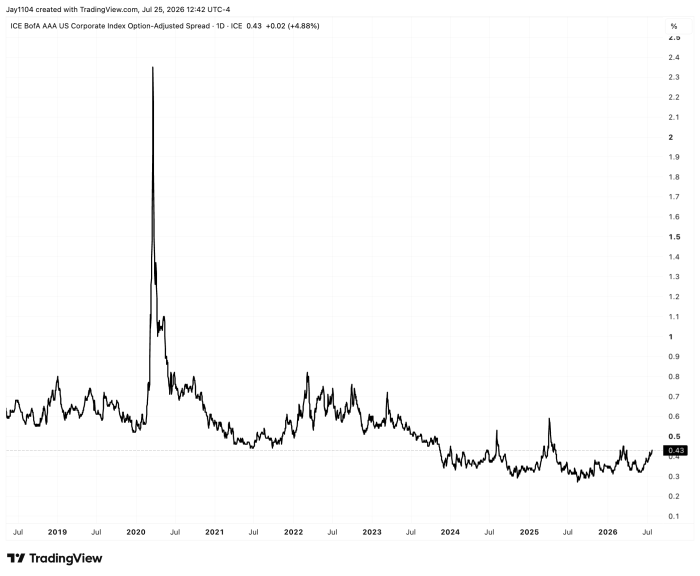
It is starting to show up, very mildly, in credit. The AAA option-adjusted spread has widened back to March levels, and while high-yield spreads haven’t widened yet, I would expect them to if AAA spreads continue to move. HYG and LQD haven’t been performing well either. Nothing major is brewing yet, but widening corporate spreads are another sign of conditions tightening, even if the weekly, lagging NFCI doesn’t show it.
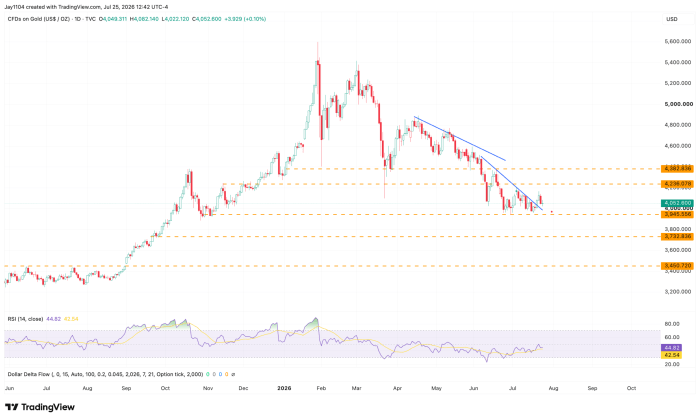
For risk assets, rising real yields, a stronger dollar, and tighter conditions are probably not a good mix. Gold has been coming down fairly hard and hasn’t closed meaningfully above its 20-day moving average, with momentum lower and support not far below. Silver looks similar, and Bitcoin (BTC.X) failed at resistance, so a break lower in its momentum readings could signal a shift as well.
In equities, the Nasdaq 100 closed below a prior intraday low that could mark the neckline of a consolidation pattern, suggesting a further break lower. The SMH is in a downtrend, and its volatility index is no longer rising with price; the deviation suggests a return to the normal regime of vol up, prices down rather than the vol-up, spot-up, gamma-squeeze dynamic. The strengthening won matters here too, since Samsung (SSNLF) and SK Hynix benefit when the won weakens; the SMH and KOSPI have both benefited from a weaker won since the summer of 2025, and if the won was part of a carry trade on the semis, its unwind would be another headwind.
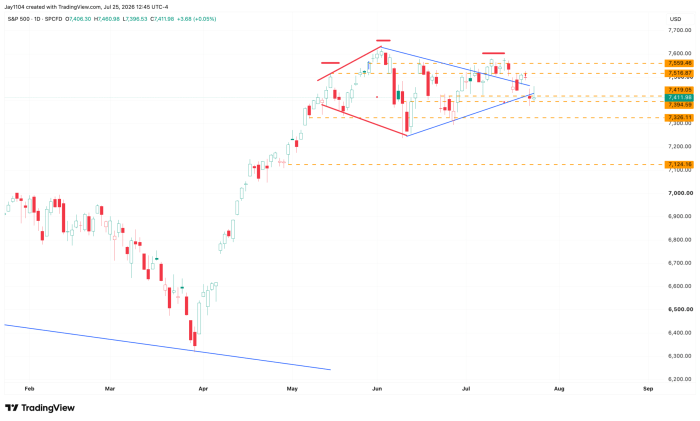
The S&P 500 tried to break out and is coming back down through a diamond pattern, back below its 10-day exponential moving average, though there is still a lot of support just below that would need to break first. If real yields keep moving up, markets can continue to struggle. And if the market keeps pricing in as many as three hikes from a Fed that is giving less forward guidance, a momentum shift may be taking place beneath the surface, where the trades that have been working unwind while beaten-up stocks begin to rebound.


Comments
Log in or sign up to join the conversation.