

In a rambling Speech, Trump signals out Canada. Link here.
At the 2:50 mark Trump mentions “Car plants coming in from Canada who ripped us off at 30 percent of our market.“
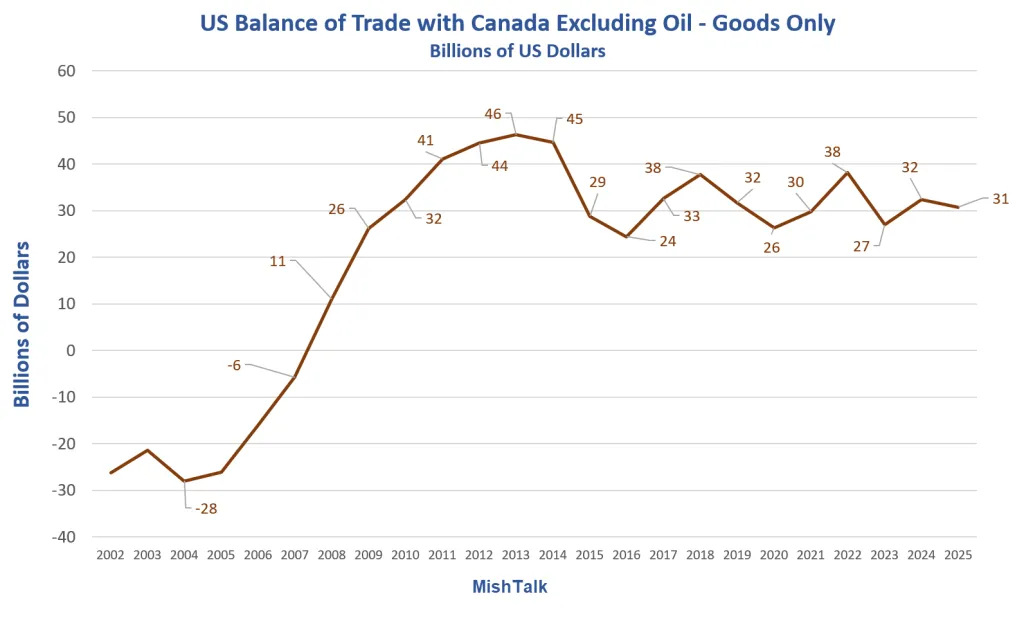
It’s easy to fact check nonsensical claims with actual trade data dating back to 2002.
The lead charts shows that excluding oil, the US has had a trade surplus with Canada for 18 years.
US Trade With Canada Goods Only

Chart Notes
Red Line: Total Balance
Blue Line: Imports from Canada
Green Line: Exports to Canada
Dashed lines are the same, but oil only.
For 2025, the total balance with Canada was – 53 billion. But the oil balance was -84 billion. Excluding oil, the US has a goods trade surplus with Canada of 31 billion.
Q: Why exclude oil?
A: Because the US needs Canadian oil and gets it at bargain prices too!
U.S. Refineries and Canadian Crude Oil
Please consider the Institute for Energy Report on U.S. Refineries and Canadian Crude Oil emphasis by the IER.
U.S. refineries, with a capacity of 18.4 million barrels per day, play a significant role in international trade—importing crude oil from Canada and Mexico while exporting high-value refined goods to regions such as Asia, Africa, Europe, and the Americas. Overall, the industry generates over $688 billion in annual economic activity and supports nearly 3 million jobs.
The last major oil refinery built in the United States was constructed in 1976. Many U.S. refineries were built to process heavier crude grades because, at the time, many believed U.S. oil production was in long-term decline and didn’t foresee the shale oil boom. The assumption was that any increase in crude production would come from heavy oils in the Middle East, Latin America, and Canada. When you combine this with the proximity of Canada and Mexico, crude oil from these countries remains a vital resource for several U.S. refineries, helping to produce liquid fuels and other petroleum products for both domestic use and international export. On top of that, Canadian oil is often priced at a discount, typically 15% or more lower than U.S. crude, due to factors like transportation costs, quality differences, and a more limited buyer pool. This discount plays an essential role in the economics of our domestic oil refineries as their profits are determined by the margin between the cost of crude oil and the revenue generated from selling the refined products.
A proposed 25% tariff on imports from Canada and Mexico would seriously disrupt the supply chain U.S. refineries rely on to produce the fuels and petroleum products Americans use every day. Even with upgrades to existing infrastructure, many refineries simply aren’t built to accommodate such a significant tariff on Canadian crude. Given the long timelines for planning and permitting the necessary changes, plus the fact that refineries depend on refining margins to stay profitable, it would take several years for refineries to adapt to the changes in oil trade flows brought about by these tariffs.
In the meantime, many refineries would struggle financially and many might be forced to shut down.
The greatest impact would be felt in the Midwest, where refineries are uniquely designed for heavier-grade Canadian crude to produce transportation fuels, and these fuels are primarily used for domestic consumption. In the Midwest region (PADD 2), Canadian crude accounts for 100% of crude oil imports, according to the latest data from the U.S. Energy Information Administration.
Refineries in the Midwest are set up to process nearly 70% of the heavy-grade Canadian crude imported into the U.S. Therefore, consumers in states like Michigan, Wisconsin, Indiana, and Ohio would face the greatest impact from the expected higher prices due to these tariffs.
Energy Synopsis
The US gets Canadian oil at a 15 percent discount, and it’s oil that our refineries are built to handle.
The US exports West Texas Intermediate, a higher grade of oil, at a higher price.
Excluding oil, the US has a trade surplus with Canada for 18 years.
Q: What About Services?
A:The US runs a constant services trade surplus with most of the world.
The BEA does not include services in its download and services data lags. Otherwise, I would create more charts.
For 2024, the US had a services surplus with Canada of 33 billion. Thus, excluding oil, the US has goods and services surplus with Canada of 65 billion for 2024.
Rather than buy Canadian oil, for which pipelines and supply chain are already in place, at a 15 percent discount too, Trump would rather get oil from Venezuela.
And Trump claims Canada is ripping us off. Heck, Trump is ripping off Canada and the US, while stealing oil from Venezuela.
Related Posts
February 19, 2026: Trade Deficit Surges in December, Full Year Deficit Hits a New Record
Trump’s claim of reducing the trade deficit by 78 percent dramatically blows up.
February 20, 2026: GDP Slows Dramatically in 2025 Q4 to 1.4 Percent, Big Disappointment
Trump blames the government shutdown and Powell for the slowdown.
February 20, 2026: Supreme Court Strikes Trump’s Reciprocal Tariffs In 6-3 Vote (I Told You So)
February 21, 2026: Trump’s 15% Section 122 Tariff Retry Headed for a Supreme Court Loss Too
There are huge flaws in the Section 122 tariff idea.


Comments
Log in or sign up to join the conversation.