

Zero of Twelve Fiscal Year 2027 Funding Bills Have Passed Congress. Democrats take control January 3.
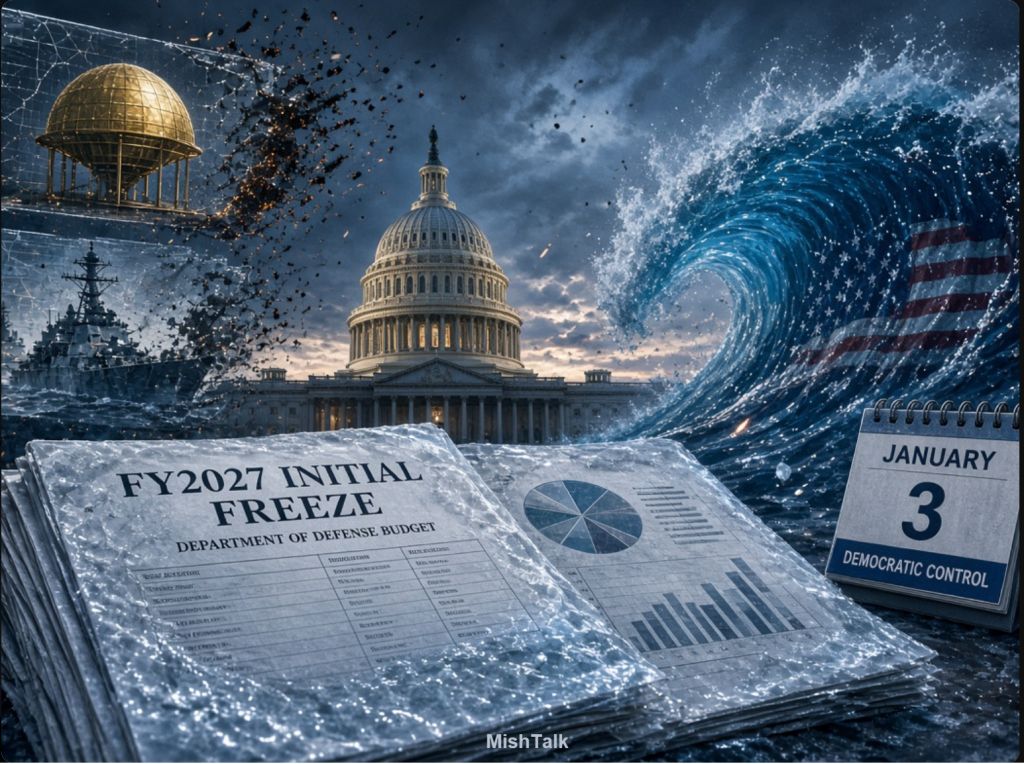
Fiscal Year 2027 Deadline Is December 11. Zero Chance.
Congress still haven’t enacted a single one of the 12 regular appropriations bills for FY2027.
The government is currently running on a continuing resolution (P.L. 119-103) that expires at 11:59 p.m. Eastern on December 11.
What to Expect
A full-year set of bills before the deadline is not happening. But this is the pattern, not the exception.
Since FY1977, Congress has needed at least one continuing resolution in all but three years.
Expect another continuing resolution, probably a short one that kicks the can into the next Congress.
How Often Are Zero of Twelve Spending Bills This Late?
In 21 of the 49 fiscal years since FY1977, Congress enacted zero regular appropriations bills by October 1.
Of those 21, 16 occurred after FY1997 (the last year all bills were finished on time).
In recent decades, starting the year with zero bills enacted has been the norm, not the exception. Since roughly 2011–2012, it has happened in most years.
What’s Different This Time?
In the 2026 midterms (November 3), Democrats won control of both the House and the Senate:
House: Democrats ended up with roughly 259 seats (their largest majority since 1992), Republicans ~173.
Senate: Democrats 56 (including 2 independents who caucus with them), Republicans 44. They flipped 9 seats.
Republicans currently hold both chambers in the lame-duck 119th Congress.
On January 3, 2027, that fully reverses when the 120th Congress convenes. The presidency remains with Trump, so it becomes divided government, but with Democrats holding the legislative branch.
Why this Changes the FY2027 Funding Dynamics
The underlying procedural failure (zero of 12 regular bills enacted this late) is not unusual.
What is different is the incentive structure created by the total switch:
Democrats have little reason to cut a full-year deal now. Waiting until January gives them control of both appropriations committees and much more leverage over spending levels, policy riders, and restrictions.
Senate Appropriations ranking member Patty Murray and others have publicly preferred a short-term CR that pushes the real negotiations into the new Congress.
Republicans are trying to lock in as much as they can (especially on defense) while they still have the majority, but they need Democratic votes in the Senate to do almost anything.
Result: Stronger-than-usual pressure for another short CR rather than finishing any full-year bills before December 11.
How this Compares to Other Years
Lame-duck sessions after midterms often have some of these dynamics when control is about to change, but a full flip of both chambers at once is less common.
The fact that Democrats are about to take full control of Congress in January makes it less likely than usual that the current Republican majorities will finish any of the FY2027 bills on their own terms before the deadline.
Military Spending
Most reporting and lawmakers treat a full-year Defense appropriations bill (or any of the other 11) as very unlikely in the lame duck.
The expected outcome is another short-term CR, possibly running into early 2027.
The White House has already requested various defense “anomalies” (exceptions) for the next CR, including money for Trump’s Golden Dome idea, Trump-class battleships, and other programs.
The separate $350 billion reconciliation package the administration wanted for extra defense spending is widely described as dead or close to it.
Chris Coons (the top Democrat on Senate Defense Appropriations) said the final number will be closer to $1 trillion and will almost certainly be settled next year under the new Democratic majorities.
What Hegseth and the White House Requested
About $1.5 trillion total for FY2027 national defense:
Roughly $1.15 trillion in the regular (discretionary) base budget
Plus $350 billion through a separate reconciliation bill
This was framed as a roughly 42–44% increase over prior-year levels. It was the largest single-year defense request in modern history.
What Congress Has Moved
House Appropriations Committee Defense bill: ~$1.072 trillion
Senate Republicans’ Draft: ~$1.1 trillion
NDAA versions: roughly $1.14–1.15 trillion (authorization only – not funding)
The $350 billion reconciliation package is widely described as dead or extremely unlikely in the lame-duck session.
What’s Likely
Item | Likelihood | Notes |
|---|---|---|
Full $1.5T request | Very low | Especially the $350B reconciliation piece |
Full-year Defense appropriations before Dec 11 | Very low | Same as the other 11 bills |
Another CR (near current levels) | High | Expected near-term outcome |
Final full-year bill around $1.07–1.1T | Possible, but later | Would be negotiated in 2027 under Democratic control |
Something closer to $1T | Also possible | Some Democrats have signaled they want a lower topline |
Hegseth and the White House asked for $1.5 trillion. The near-term reality is another continuing resolution that largely freezes funding near existing levels.
Any final full-year number will almost certainly be set in 2027 after Democrats take control of both chambers, and it is unlikely to reach the full $1.5 trillion request.
Understanding “Initial“
My headline says “Expect a Fiscal Year 2027 Initial Freeze in Military Spending”
Unfortunately, budget compromises nearly always are more of this for more of that.
Republicans want more military spending and offer more social spending to get it. History says expect more of the same.
However, the combination 56 Democrat Senators and 259-260 Democrat House seats changes the dynamics a bit.
Note that Republicans failed to pass much legislation in the past two because a small minority of Republicans could block legislation.
The next Congress will be vastly different. Senate and House leaders cannot be held hostage by a few votes.
However, Trump has a veto. To get things Democrats want, they will need to either compromise or wait until 2028.
That compromise dynamic is not yet clear. But Democrats can force the issue on many bills. Trump will own the political consequences if he vetoes popular measures.
Either way, items such as Golden Dome and the proposed Trump-class warships look more likely to land on the ash heap of unfunded ideas.
Otherwise it’s wait-and-see, but the balance of leverage has clearly shifted.
Related Posts
November 25, 2026: PCE Inflation Spotlights the Huge Problem the Fed Made for Itself
The Fed is undoubtedly behind the curve in rate hikes.
November 26, 2026: How Much Did AI Spending Contribute to Third-Quarter 2026 GDP?
The charts below show the AI impact for every quarter starting 2025 Q1.
November 26, 2026: Trump Doubles Down on Tariff Stupidity, Leans Nothing from Election
My base case was Trump would act foolishly after the election, already proven.



Comments
Log in or sign up to join the conversation.