


The charts below show the AI impact for every quarter starting 2025 Q1.
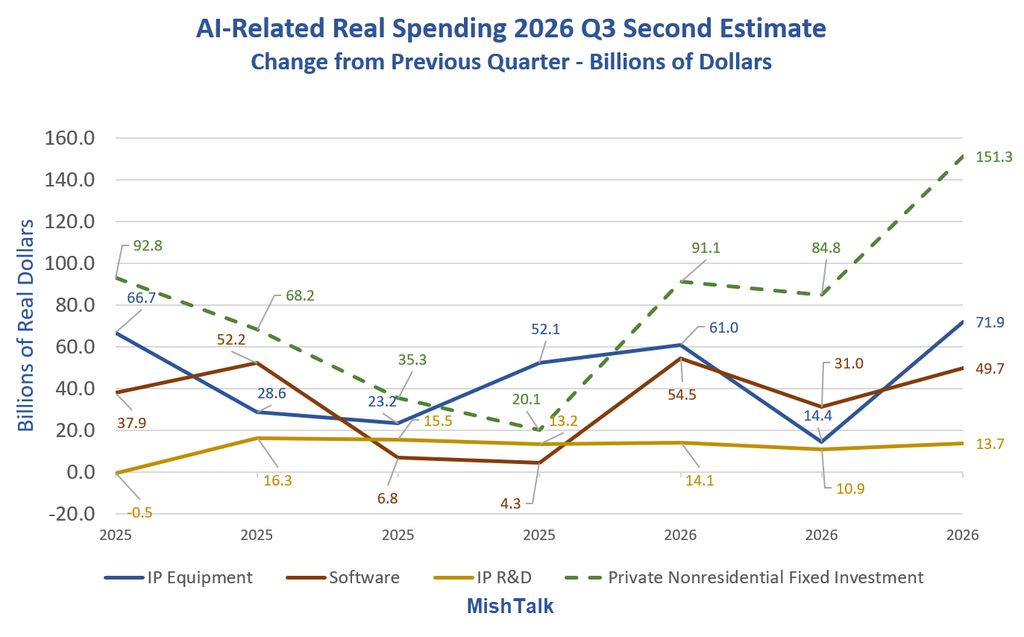
Private Nonresidential Fixed Investment 2026 Q3 Second Estimate, IP Equipment, Software, R&D
The BEA reports Real Gross Domestic Product (GDP) increased at an annual rate of 4.3 percent in the third quarter of 2026 (July, August, and September)
AI-Related Spending Change in Billions
IP Equipment: 71.9 billion
Software: 49.7 billion
IP R&D: 13.7 billion
Real Private Fixed Investment
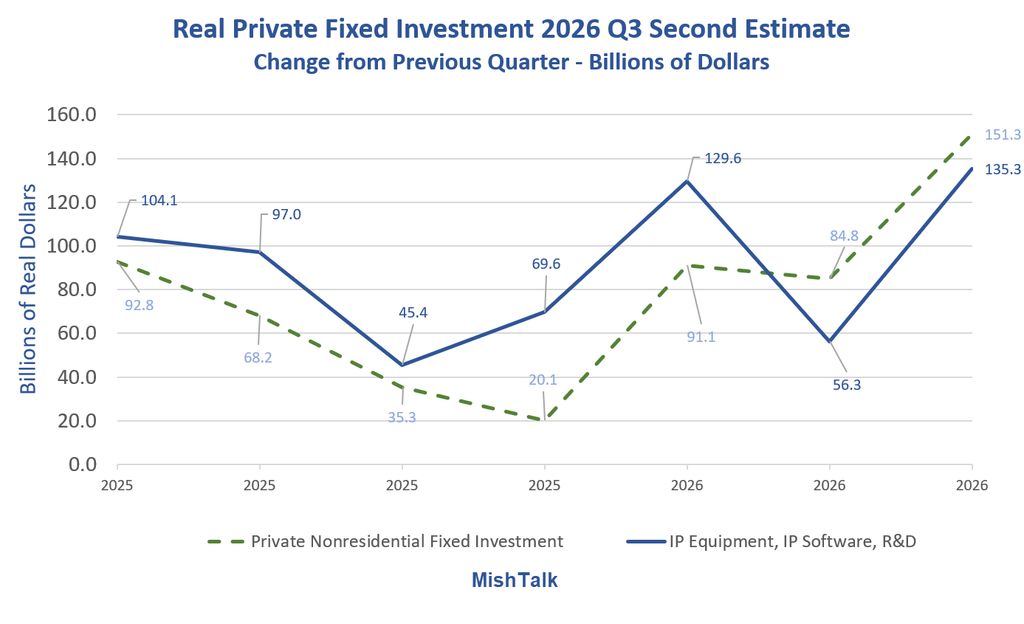
Private Fixed Investment 2026 Q3 Second Estimate
Real Private Fixed Investment Spending Change in Billions
Private Nonresidential Fixed Investment: 151.3 billion
Sum of IP Equipment, IP Software, R&D: 135.3 billion
AI Percent of Real Private Fixed Investment
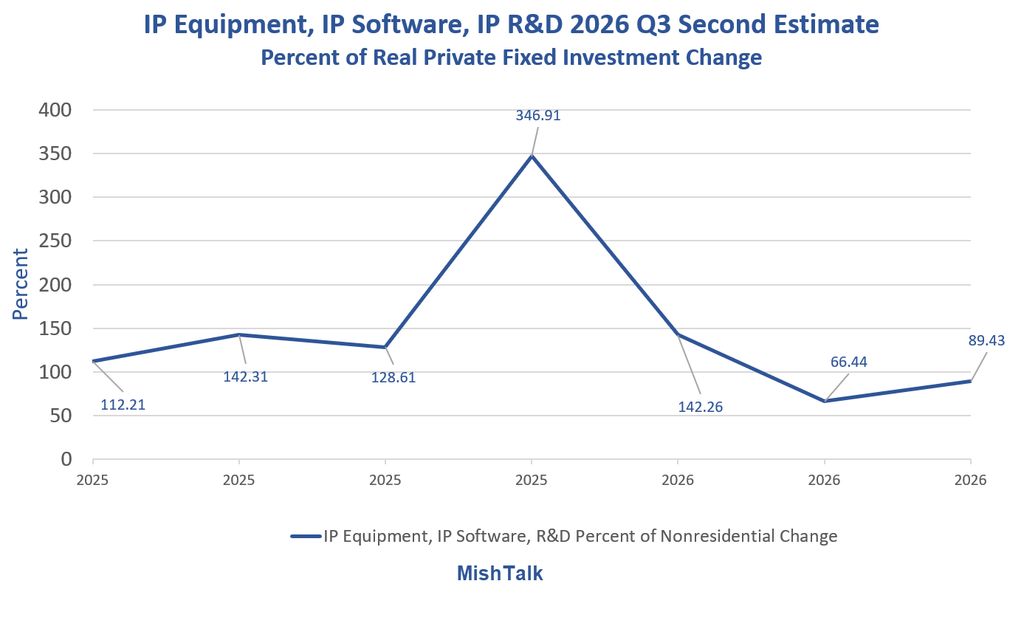
AI-Related Percent of Change in Real Private Fixed Investment
2025 Q1: 112.21 percent
2025 Q2: 142.31 percent
2025 Q3: 128.61 percent
2025 Q4: 346.91 percent
2026 Q1: 142.26 percent
2026 Q2: 64.44 percent
2026 Q3: 89.43 percent
AI contributes the lion’s share of the change in real private fixed investment, currently 89.43 percent.
From the above percentages and the BEA published contributions to GDP we can calculate the AI percentage point contribution to GDP.
The AI percentage point contribution to GDP = AI-Related Percent of the change in Real Private Fixed Investment * the BEA published Private Nonresidential Contribution (yellow bars below).
AI Percentage Point Contribution to GDP
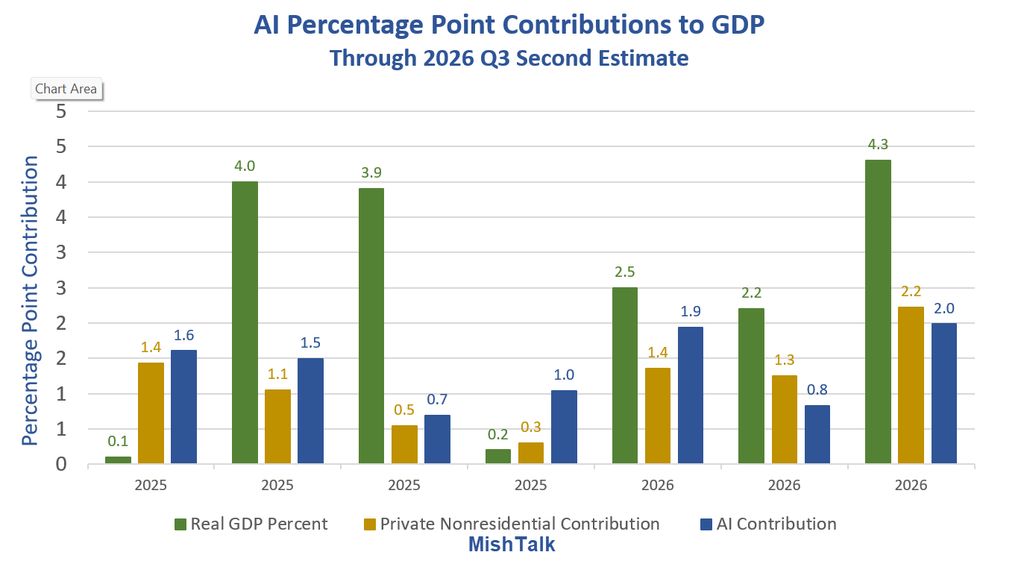
For 2026 Q3, the BEA says GDP rose 4.3 percent.
The private nonresidental contribution to GDP was 2.2 percentage points of which 89.43 percent (2.0 percentage point) was AI related.
Thus, AI contributed 2.0 percentage points to that overall 4.3 percent.
But that’s not the best way of looking at things. GDP includes CIPI (Change in Private Inventories) that net to zero over time.
Real Final Sales subtracts CIPI and is the best bottom line GDP number. The following chart shows AI contribution to GDP and Real Final Sales.
AI Percent of Real GDP and Real Final Sales
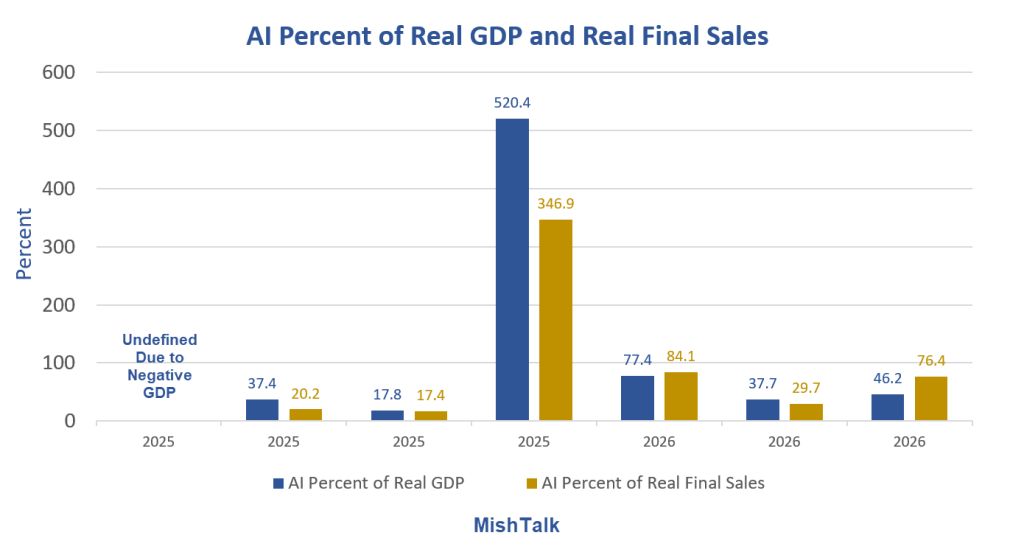
AI Contribution to Real GDP and Real Final Sales
2025 Q1: Undefined
2025 Q2: 37.4% and 20.2%
2025 Q3: 17.8% and 17.4%
2025 Q4: 520.4% and 346.9%
2026 Q1: 77.4% and 84.1%
2026 Q2: 37.7% and 29.7%
2026 Q3: 46.2% and 76.4%
Negative numbers make 2025 Q1 comparisons undefined.
Small numbers make 2025 Q4 contributions look ridiculous. So let’s discuss 2026.
AI-related expenses accounted for approximately 54 percent of GDP and 63 percent of real final sales so far in 2026.
Two Key Questions
How sustainable is the AI growth?
How much of the AI expenditure is malinvestment that will be written off?
We know the answer to the first question. It’s not. The answer to the second question is problematic.
Logically, I view GDP as overstated by the amount of malinvestment. But we don’t know the amount yet.
And no one ever subtracts malinvestment when the writeoffs do happen. Instead, malinvestment and writeoffs will eventually subtract from future growth.
Bombing the Desert
As with private malinvestment, government spending, no matter how useless or counterproductive adds to GDP.
Trump wants hundreds of billions of dollars more in “defense” spending to make up for the wasted missiles.
It would make more sense to spend money on nearly anything than what we are doing in the Mideast.
Over the past two decades we have blown trillions of dollars and all we have to show for it is more enemies and higher inflation.
It’s no wonder the Fed is struggling with inflation and consumers are miserable.
Related Posts
November 24, 2026: Jenson Huang Is Back as CEO. So What? It Cannot Possibly Matter.
The Fed is in a rate hike cycle. Late stage rate hike cycles are never good for markets, especially risk assets. Is this time supposed to be different?
November 25, 2026: Real GDP Growth Revised Up to 4.3 Percent in the Third Quarter
Private domestic sales suggest economic overheating.
November 25, 2026: PCE Inflation Spotlights the Huge Problem the Fed Made for Itself
The Fed is undoubtedly behind the curve in rate hikes.


Comments
Log in or sign up to join the conversation.