

Private domestic sales suggest economic overheating.
GDP, Real Final Sales, and GDI 2026 Q3 Second Estimate
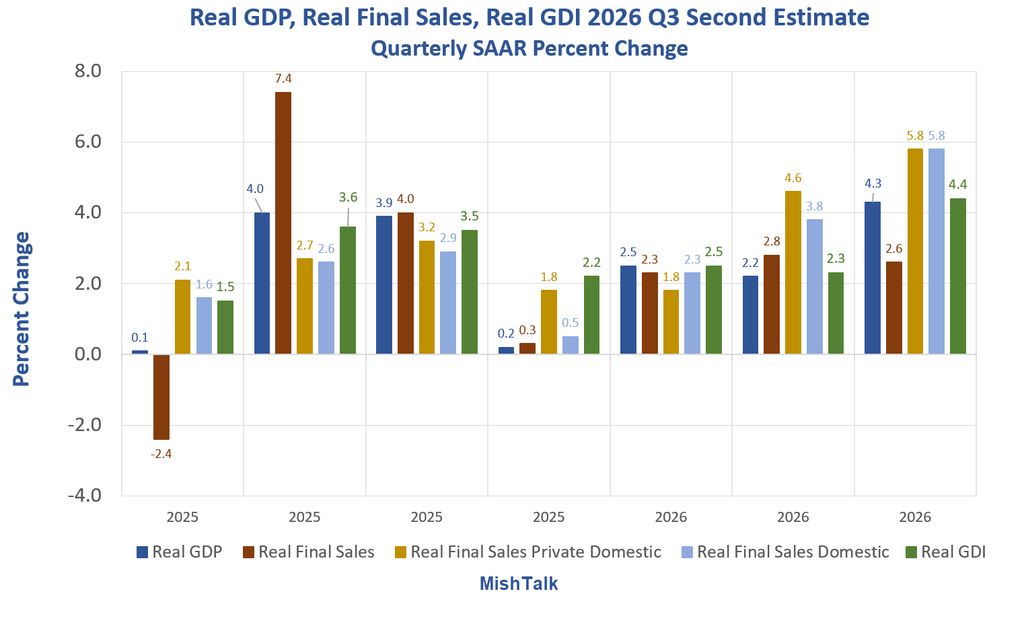
The BEA reports Real Gross Domestic Product (GDP) increased at an annual rate of 4.3 percent in the third quarter of 2026 (July, August, and September), according to the second estimate released today by the U.S. Bureau of Economic Analysis (BEA). In the second quarter, real GDP increased 2.2 percent.
Real Third-Quarter GDP and GDI vs Advance Estimate
Real GDP 4.3% up from 3.4%
Real Final Sales: 2.6% up from 1.7%
Real Final Private Domestic Sales: 5.8% up from 4.9%
Real Final Domestic Sales: 5.8% up from 5.0%
Real GDI: 4.4% vs NA
Real Gross Domestic Income (GDI) is not available in the advance (first) release of the quarter.
Contributions to GDP
Percentage Point Contributions to 2026 Q3 GDP, Second Estimate
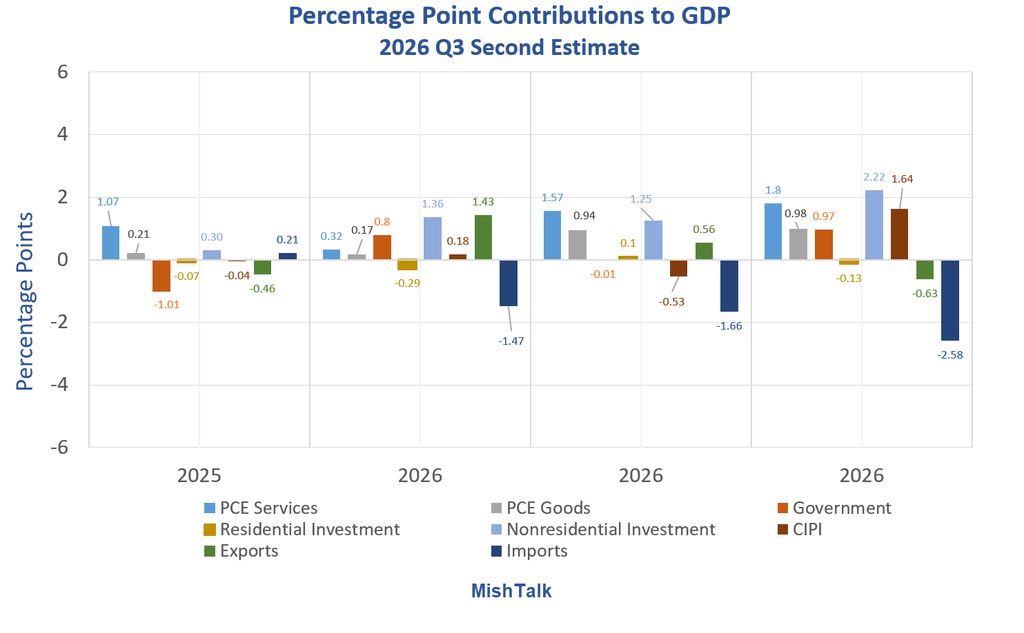
Percentage Point Contributions to GDP
PCE Services: 1.80 PP
PCE Goods: 0.98 PP
Government: 0.97 PP
Residential Investment: -0.13 PP
Nonresidential Investment: 2.22 PP
CIPI: 1.64 PP
Exports: -0.63 PP
Imports -2.58 PP
The biggest change
was Nonresidential Investment: 2.22 PP up from 1.78 PP. That accounted for half of the 0.9 PP rise from the advance estimate.
Change in Private Inventories and Real Final Sales
The difference between real GDP and Real Final Sales is Change In Private Inventories (CIPI) that nets to zero over time.
Thus, an essentially meaningless number added 1.64 percentage points to GDP.
Real final sales is the true bottom line estimate of the economy. It’s 2.6 percent.
Yet, Real Private Final Domestic Sales, a number the Fed watches, are a whopping 5.8 percent.
Government Spending
Government spending (election-timed?) added 0.97 percentage points to GDP.
Hooray?
Imports and Exports
Imports don’t subtract from GDP. They have no impact on GDP at all. The D in GDP explains why.
The BEA subtracts imports because its initial assumption is that all sales are domestic.
Otherwise, the BEA would be trying to figure out things like “What percentage of this hammer from Home Depot is domestic?”
Net exports are -2.58 (imports) plus -0.63 (exports), which totals -3.21 percent.
Tariffs, as expected in this corner, did nothing to fix trade imbalances. Indeed, the latest trade reports show the deficit is the widest in history, ignoring the wild swings around the start of Trump’s reciprocal tariffs.
Real GDP, Real Personal Income, Real GDI
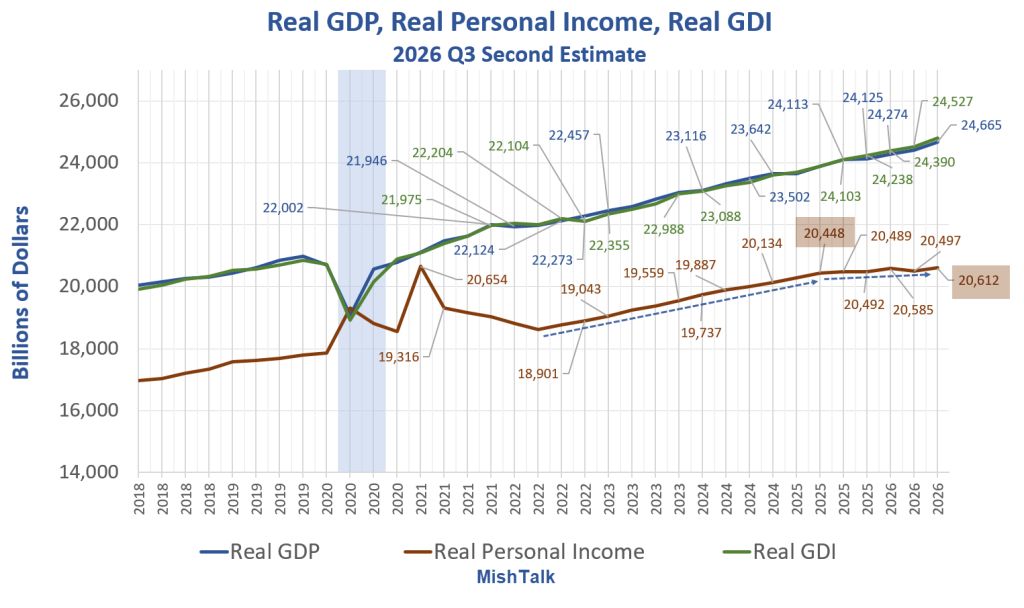
Real personal income is only up a total of 0.80 percent since 2025 Q2.
How is that distributed? I think you know the answer. And it’s why a majority of people do not buy Trump’s preposterous claim of “greatest economy ever.”
Reflections on the Economy
Based on private domestic sales, the economy is overheating.
The surge in imports is related to AI, which is also overheating. I will do a breakdown of the AI impact on GDP shortly.
Meanwhile, please reflect on this: CIPI (1.64 PP) plus government spending (0.97 PP) added 2.61 percentage points to GDP. The BEA reported Real Final Sales as 2.6 percent.
Thus, a meaningless inventory adjustment plus government spending accounted for 100 percent of reported Real Final Sales. And RFS is the bottom line estimate for the economy.
This report is nowhere near as good as what the headline number looks like at first glance.
Related Posts
October 28, 2026: The September Advance Trade Balance in Goods Is Negative 134.9 Billion
Biggest Trade Deficit In History
Excluding the enormous trade distortions caused by Trump’s tariffs, we have the largest trade deficit in history.
Click for more details and charts.
November 25, 2026: PCE Inflation Spotlights the Huge Problem the Fed Made for Itself
The Fed is undoubtedly behind the curve in rate hikes.



Comments
Log in or sign up to join the conversation.