

Warsh cites resilient economy and insufficient inflation progress.
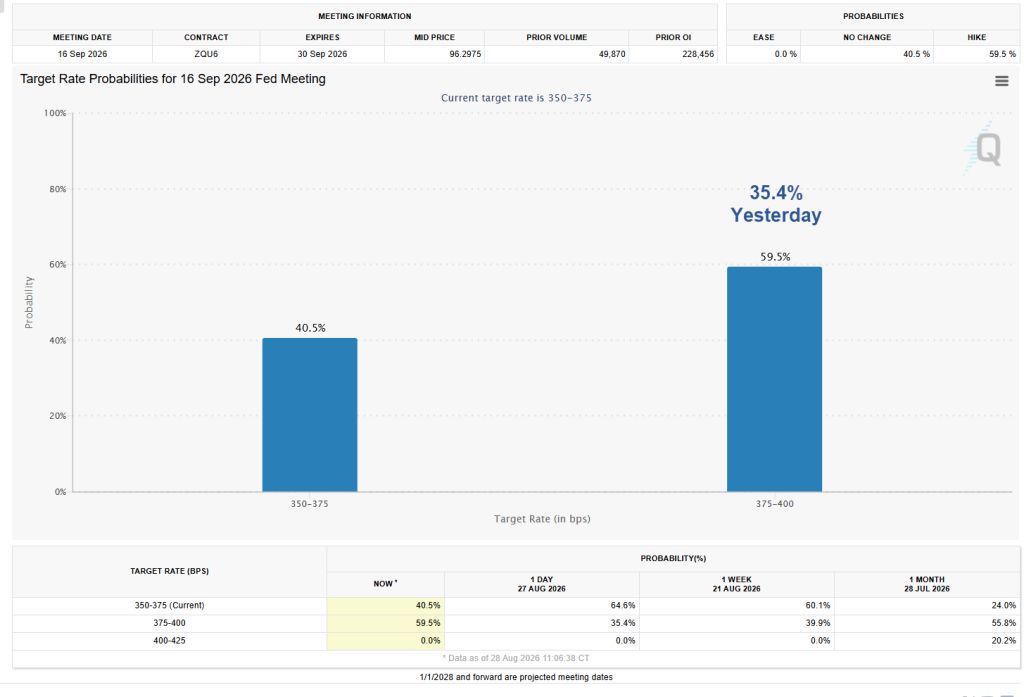
The odds of a September rate hike jumped to 59.5 percent from 35.5 percent yesterday on Fed Chair Kevin Warsh’s comments at Jackson Hole.
Not Done Fighting Inflation
The Wall Street Journal reports Warsh Says the Fed May Not Be Done Fighting Inflation.
“We must be confident that underlying inflation is moving to our objective, clearly and at sufficient speed. Otherwise, we have work to do,” he said in his first speech as Fed chairman, a highly anticipated debut at the Kansas City Fed’s annual symposium in Wyoming.
He described an economy showing few signs of restraint from the Fed’s current rate of around 3.6%. “Credit and loan markets are showing few signs of policy restraint,” he said. Despite some signs of strain in housing and agriculture, “on balance, I would be hard-pressed to describe broad financial conditions as restrictive.”
This summer’s readings “were better than expected,” Warsh said, but “they do not tell me that underlying trends have meaningfully improved.” He highlighted the breadth of price increases: About half the items in the Fed’s preferred inflation basket are rising faster than 3%.
Warsh set aside one of the better arguments for patience when he dismissed moderate growth in wages, which in the Fed’s conventional models is a sign inflation should be better behaved over time. Wage growth “has not proven a reliable indicator of future inflation for a very long time,” Warsh said.
Still, Warsh provided a more detailed reading of the economy than he has at earlier public engagements. “Today I am impressed by the overall performance of the economy, which appears to have strengthened,” he said, citing how well it has held up to shocks. He pointed to credit spreads near the low end of their historical range and business investment growing at its fastest pace since 2021.
Inflation Readings Not Better than Expected
The Personal Consumption Expenditures (PCE) price index was was not better than expected.
The BEA reported 0.2 percent but the consensus estimate was 0.1 percent.
This is despite the BEA reporting a 2.7 percent decline in gasoline that consumers did not see at the pump.
PCE Inflation on the Hot Side
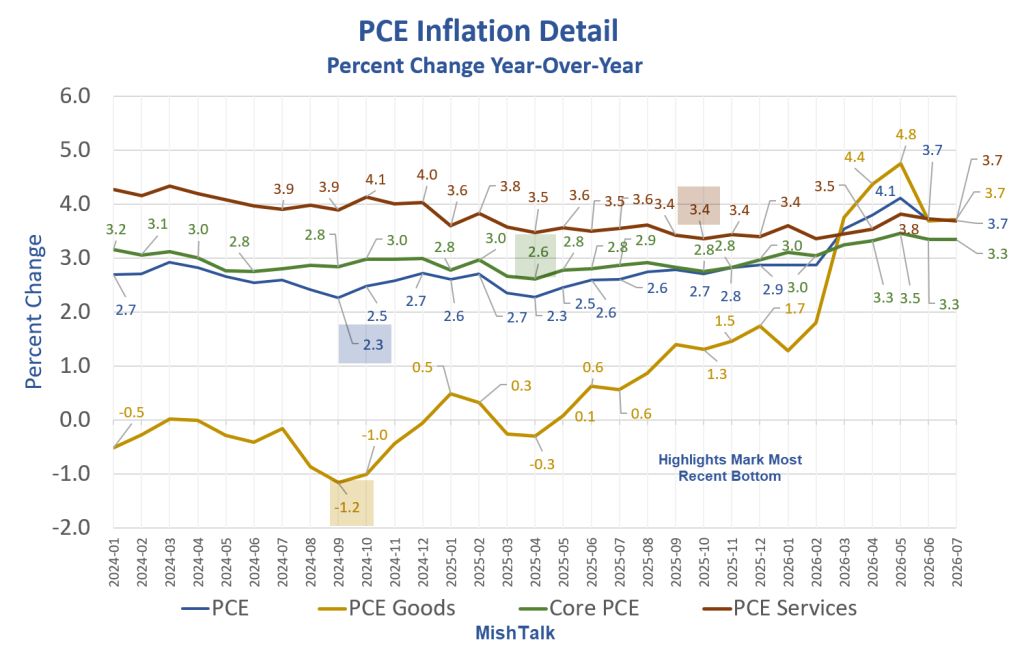
On August 26, 2026, I commented PCE Inflation on the Hot Side, Lack of Progress in Pictures
Let’s discuss the Fed’s preferred measure of inflation and gasoline.
The “hot side” in the title is vs expectations. The Econoday consensus was 0.1 percent month-over-month and 2.6 percent year-over-year.
Actual data was higher.
PCE Above Fed’s Target
If you are a Trump or Fed apologist you are watching core CPI at a still high 2.5 percent and making excuses.
However, the PCE is the Fed’s preferred measure of inflation.
Year-over-Year PCE inflation has been over the Fed’s 2.0 percent target for 65 straight months since March 2021.
The Fed Will Get the Blame
No matter what happens now, the Fed is going to get the blame.
If the Fed hikes (as it should have long ago), and the stock market or economy tanks, the Fed will get the blame.
If the Fed does nothing, the bubble will keep brewing but will eventually pop. The Fed will get the blame for that too.
Resilient Economy or AI Bubble?
“I would be hard-pressed to describe broad financial conditions as restrictive,” said Warsh.
Indeed!
An obvious AI bubble is brewing, and the Fed ignored that.
It ignored the huge surge in credit fueling AI. And the Fed ignores off-balance sheet accounting that hides this debt and inflates earnings.
If the Fed does nothing, the bubble will keep brewing but will eventually pop. The Fed will get the blame for that too.
Related Posts
August 23, 2026: Diesel 21 Cents from Record High. What if Canada Shut Off Oil to the US?
Carney has a huge card, two if he chooses to play them.
August 26, 2026: Americans Now Pay 75 Percent More for Aluminum than the Rest of the World
You can’t increase exports if you are the highest cost manufacturer.
Tariffs increase costs. Both the US and Canada are doing this.
It is absurd to be in this spot, but here we are.
Comments
Log in or sign up to join the conversation.