

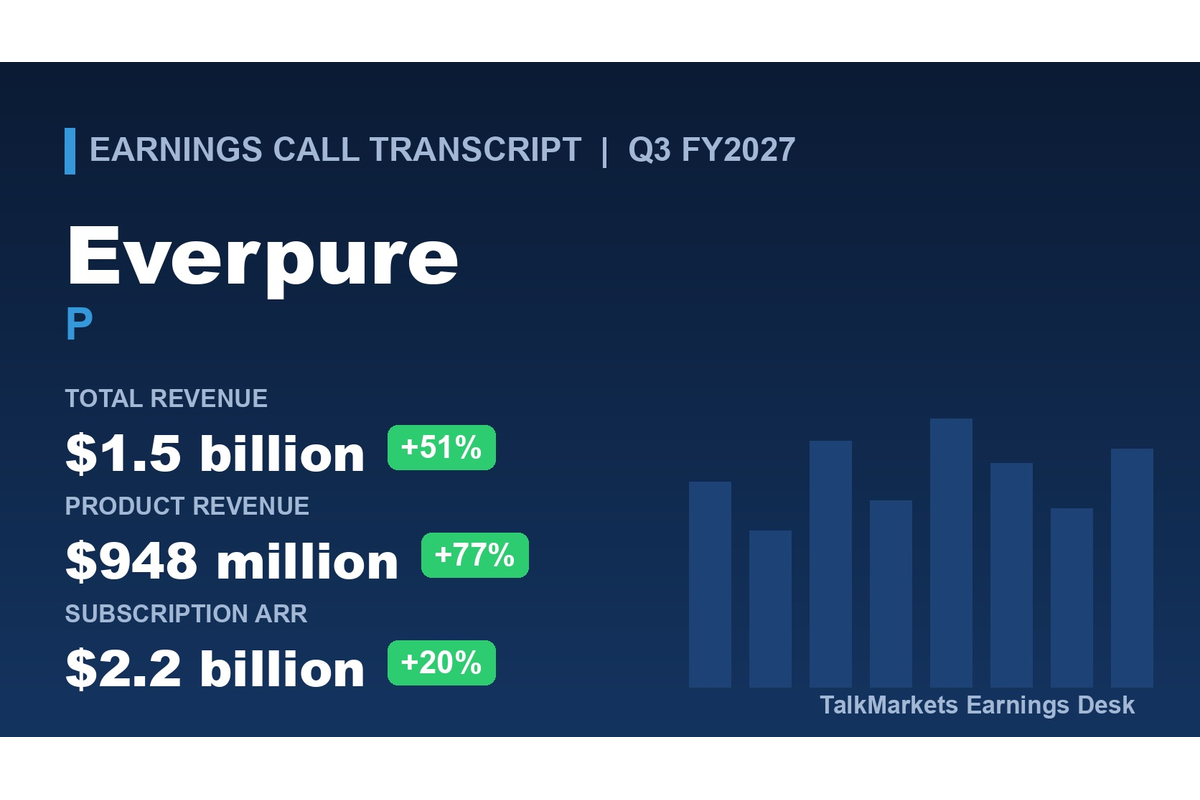
Everpure's Q3 fiscal 2027 revenue rose 51% to $1.5 billion, product revenue jumped 77% to $948 million and subscription ARR grew 20% to $2.2 billion, with GAAP operating income of $150 million.
Ticker: P
Everpure (P) reported results on 18 November 2026 for its third quarter of fiscal year 2027, which ended 1 November 2026. The data storage and management company, which joined the S&P 500 index in September 2026, said it delivered record revenue and operating income in the quarter.
The key numbers (third quarter fiscal 2027, $ thousands)
Metric | This year | Last year | Change |
|---|---|---|---|
Total revenue | $1,459,791 | $964,453 | +51% |
Product revenue | $947,826 | $534,760 | +77% |
Subscription services revenue | $511,965 | $429,693 | +19% |
Income from operations | $150,057 | $53,918 | |
Net income | $100,395 | $54,806 | |
Diluted EPS | $0.29 | $0.16 |
GAAP gross margin was 68.0% and non-GAAP gross margin was 69.2%. GAAP operating margin was 10.3%, while non-GAAP operating income was $345 million, a non-GAAP operating margin of 23.6%.
Recurring revenue and backlog
Subscription annual recurring revenue (ARR): $2.2 billion, up 20% year over year.
Remaining performance obligations (RPO): $4.2 billion, up 44% year over year.
Cash and buybacks
Operating cash flow was $443 million and free cash flow was $265 million. Everpure ended the quarter with $1.1 billion in cash, cash equivalents and marketable securities. It returned approximately $67 million to stockholders through share repurchases of 0.5 million shares.
During the quarter Everpure also secured a design win with a second top-five hyperscaler, validating its DirectFlash technology.
Chairman and CEO Charles Giancarlo said the results reinforce Everpure's role as a trusted partner for critical data infrastructure, with growth across both core and new, high-growth markets. CFO Tarek Robbiati said revenue and operating income exceeded the high end of the company's guidance.
First three quarters
For the first three quarters of fiscal 2027, total revenue was $3,698,585 thousand, compared with $2,603,940 thousand a year earlier, and net income was $198,622 thousand, against $87,929 thousand.
Source: SEC Form 8-K Exhibit 99.1
Full call transcript
Operator:
Good day and welcome to the Everpure third quarter fiscal 2027 financial results conference call. Today's conference is being recorded. All lines will be muted during the presentation portion of the call with an opportunity for questions and answers at the end. If you would like to ask a question, please press star one on your telephone keypad. At this time, I'd like to turn the call over to Paul Zion, Vice President of Investor Relations. Please go ahead
Vice President of Investor Relations:
Thank you. Good afternoon everyone and welcome to Everpure third quarter fiscal year 2027 earnings conference call on the call. We have Charlie Giancarlo chief executive officer Tarek Robbiati chief financial officer and Rob Lee chief technology and growth officer following Charlie's and Tarek's prepared remarks. We will take questions. Our press release was issued after close of market and is posted on our website where this call is being simultaneously webcast. The slides that accompany this webcast can be downloaded that investor.everpuredata.com on this call today.
We will make forward-looking statements which are subject to various risks and uncertainties. These include statements regarding our financial outlook and operations our strategy technology and its advantages our current and new product offerings our ability to procure a sufficient supply of Components and manage our supply chain our hyperscale opportunity and competitive industry and economic trends. Any forward-looking statements that we make are based on facts and assumptions as of today and we undertake no obligation to update them.
Our actual results may differ materially from the results forecasted and reported results should not be considered an indication of future performance A discussion of some of the risks and uncertainties relating to our businesses contained in our filings with the SEC And we refer you to these public filings during this call all financial metrics and associated growth rates are non-GAAP measures other than revenue remaining performance obligations or RPO and cash and investments Reconciliations to the most directly comparable GAAP measures are provided in our earnings press release and slides.
This call is being broadcast live on the Everpure investor relations website. And is being recorded for playback purposes and archive of the webcast will be available on the IR website and is the property of Everpure. Our fourth quarter fiscal year 2027 quiet period begins at the close of business Friday January 15, 2027. With that I'll turn it over to Charlie.
Charlie Giancarlo (Chief Executive Officer):
Thank you, Paul. Good afternoon everyone and welcome to Everpure's Q3 fiscal 2027 earnings call Q3 was another strong quarter for Everpure reflecting our role as the most trusted partner customers can rely on for their most critical data infrastructure. We exceeded our guidance range on both the top and bottom lines Revenue growth of 51% year-on-year continued our three-quarter track record of over 35% growth performance Operating profits surged 76% year-on-year to 345 million resulting in a record 24% operating margin.
We had solid revenue growth and sales momentum across geographies products and customer segments Last quarter in our Q2 earnings call and later in our financial analyst meeting. We outlined our expansion into a number of new businesses.
We qualified these areas as one core including our system product sales and our Evergreen//One subscription sales as well as core AI Representing our sales of core products which plug directly into GPU based systems two hyperscale solutions inclusive of our specialized solutions for hyperscalers and qualifying tech titans three scale AI representing sales of our flashblade exit product and four modern data software including port works Everpure cloud Everpure protect and data intelligence as Carricka explained we will report on the new revenue streams in aggregate at the end of each fiscal year to highlight the progress.
We are making in expanding our core business. Our strength in Q3 was driven by both core revenue as well as our new business revenue. It is important to underscore that the vast majority of our dollar revenue growth in Q3 came from our core business. While revenue percentage growth in new business grew faster than the company average as expected. We saw strong growth in this quarter in our core sales. Which includes a strong showing in products directly connected to GPU environments?
We are beginning to see a significant upturn in the number of enterprises now adding GPU environments on-prem a Stand-out wind discordor was data bento a financial market data provider that shows flashblade s to replace its open-source infrastructure Data bento distributes high-volume market data with micro second precision and is establishing an enterprise foundation for future AI workloads FlashBlade s is proving to be the go-to workhorse in enterprise AI factory build-outs combining performance ease of use Reliability and upgrade flexibility in one integrated package in Q3.
We further improve flashblade AI system performance by delivering pure KVA Meaning key value accelerator. Which pre-stages inference context directly into GPU memory to deliver up to 20 times faster time to first token for large language models TCV forEvergreen//One continues its strong trajectory with nine straight quarters of double-digit growth reaching 57% year-over-year in Q3 One of the world's largest insurance companies expanded its relationship with Everpure this quarter Replacing a legacy competitor in its production and disaster recovery environments to complete a single worldwide standard on Evergreen//One.
The insurer chose Everpure for its proven reliability and service and now manages its entire storage fleet from one place and a leading financial technology provider also chose Everpure Evergreen//One over a competing bid to extend its existing platform to additional US data centers Evergreen//One gives this institution a scalable foundation or continued growth as part of its multi-year infrastructure modernization program Evergreen//One continues to earn industry validation during the quarter Gartner named Everpure a leader in their magic quadrant for infrastructure platform consumption services
for the second year in a row Positioning us highest in execution and furthest in vision turning now to our three new growth areas Hyperscale solutions scale AI and modern data software delivered a strong quarter Hyperscale solutions led this growth with sales increasing substantially during the quarter and continued expansion expected next quarter and into next year fully consistent with our expectations and timing of deployments. We continue to make solid progress in discussions across the hyperscale and tech titan landscape.
As these customers scrutinized performance power consumption reliability and maximizing their overall value are hyperscale solutions provide distinct advantages the software driven architecture of our direct flash technology replaces inefficient legacy storage with dense QLC flash delivering greater performance and reliability with less power in Hyperscale is neo clouds and even in the enterprise. We see data getting hotter by this.
We mean that storage purchases are shifting towards ever faster and lower latency storage systems Everpure is in a perfect position to take advantage of this trend by having the most performance systems in the market in every category of data storage. In scale AI FlashBlade exit continues to expand its market reach during the quarter exit ranked first on every checkpointing and KV cash metric Submitted to ML perf storage V 3.0 an industry standard AI storage benchmark with linear performance scaling.
We continue to advance sales pursuits across multiple segments of customers from AI technology providers to GPU accelerated Quantitative trading to neo clouds of all scales. Our modern data software offerings reflect fundamental architectural shifts in applications one the necessity to unlock data from applications to the shift to container deployed software environments and three cloud and hybrid cloud interoperability AI has broken traditional application centric it. And highlights the need for faster access to higher quality data making data primacy in architectural necessity.
Rather than allowing every application to silo and fragment customers data primacy enables enterprises to establish unified proprietary data models to drive downstream application workflows. For any enterprise deploying operational AI Developing single sources of truth is a prerequisite Everpure data intelligence is this first step to achieving data primacy. It gives customers a clear view of their data estate wherever it lives and builds a contextual graph Design for AI so AI delivers more accurate answers by working only on the most relevant context rich data.
In Q3 we announced Everpure data intelligence file edition Combining purity os intelligence with file metadata to help customers manage govern and understand their data Installed based buyers are responding strongly.
Because it supports better security stronger compliance and a first step on the AI ready journey towards data primacy Data intelligence continues to drive the most customer demand and interest that I have seen in many years Customers intuitively understand the need to catalog Understand and organize their data to better secure it and to deliver more accurate and deterministic results To activate data intelligence through natural language.
We also introduced native model context protocol or mcp integration deployed automatically through our management console AI agents get secure real-time access to governed enterprise context Protecting sensitive data with zero manual integration Portworx further solidified its market leadership this month earning recognition as a leader in the 2026 IDC market scape for container data and infrastructure management software. We are seeing strong customer traction as enterprises move away from legacy virtualization Highlighted by a leading global freight supplier selecting portworx to modernize and provision their vms.
And a global 100 automaker recently completing Its migration of tens of thousands of virtual machines from VMware to kubernetes based virtualization with portworx Just as portworx frees modern containerized applications from cloud and hardware lock-in. Our partnership with Nutanix delivers the same architectural freedom for customers traditional vm estates Customer adoption has ramped quickly and we have now surpassed a hundred joint production deployments Many enterprises are choosing to standardize their new application developments on containers and kubernetes Both in the cloud and on prem.
Our leadership in container storage management with portworx and cloud storage management with Everpure cloud directly supports these initiatives Everpure cloud now supports azure red hat open shift and azure kubernetes service. And improves upon standard cloud storage with enterprise level functionality higher reliability and lower overall costs Demand in Q3 remains solid overall, especially when considering that component costs per terabyte Have risen to levels last seen a decade ago. Our pipeline visibility for the next two quarters is solid.
With these higher prices we are seeing the shape of customer demand shift toward higher performance workloads. And towards greater value, especially in large deals. On the supply side component costs continue to increase through Q3 albeit at a slower pace than in the first half Through strong supply chain and procurement processes and support from our key suppliers Everpure was able to maintain our prices from q2 into and through Q3. At the beginning of this q4.
We were able to reduce our product prices on average for most models. Based on value engineering and data reduction improvements Initiated at the beginning of the year lowering our product costs. As stated previously, we continue to operate our core product sales excluding hyperscale solution sales. At the lower end of our 65 to 70% gross margin range. And we'll do so while these very high semiconductor prices continue.
The higher component market pricing has continued to encourage customers to leverage our Evergreen//One storage subscription offering Sales of Evergreen//One continue to exceed our beginning of year plan and company growth average and enhances our share gain From component costs to broader concerns around the pace of AI infrastructure investment. The macro backdrop continues to change rapidly. But demand for storing more data will continue to increase regardless of the details of the macro. And we continue to be the best choice in the industry.
We expect component costs to stabilize towards the end of the year and to remain high going into next year. We do not share the concerns of some market pundits on how the pace of new data center buildouts will affect our business. Our hyperscale business is resilient in multiple ways. We are only beginning to enter this space and our solution is superior to legacy approaches in cost Performance and operational efficiency.
We will continue to pick up share in our hyperscale solution Regardless of the pace of that build out or the choice or price of storage media over the next several years. Before I turn the call over to Tarek I'd like to complement him and our finance and IT teams on the remarkable achievement of accelerating our closed process Such that Everpure can now announce earnings 17 days after quarter end. The team has developed system and process innovations leading towards the goal of continuous clothes.
Thank you all for advancing Everpure's operational excellence efficiency and agility. With that i'll turn the call over to Tarek to walk through our financial performance and outlook
Tarek Robbiati (Chief Financial Officer):
Thank you Charlie Q3 marked another quarter of outstanding execution for Everpure with strong revenue growth expanding profitability. And broad base momentum across our business Revenue increased 51% year over year while operating profit grew 76. With both metrics exceeding the high end of our guidance ranges. Our operating margin reached 23.6% the highest in company history Demonstrating the expanding operating leverage in our business model.
Our results reflects the strength of our diversified portfolio and the growing opportunities across both our established core and core I business and our emerging new revenue growth vectors. While the vast majority of our growth discordor was driven by our core business. We also made meaningful progress across all three new revenue opportunities hyperscale solutions scale AI and modern data software. We continue to expect these businesses to become increasingly important contributors to our overall growth over time.
As expected hyperscale solutions led the momentum across our new revenue category. We sales increasing substantially during the quarter. We expect continued expansion in q4 and into the next fiscal year Supported by ongoing customer engagement and steady progress in discussions across the hyperscale and tech titan landscape. Turning to the component cost environment NAND and other component costs continue to increase in Q3 Although at a more moderate pace. While we expect commodity cost pressures to continue.
Our architectural advantages and engineering team capability Are enabling us to simplify the bill of materials reducing component costs thanks to our software Customers continue to prioritize mission critical infrastructure investments placing greater emphasis on quality Reliability efficiency and the ability to modernize and upgrade their environments over time. At the same time they are increasingly focused on managing the broader and often more persistence element of total cost of ownership Including labor power cooling floor space and data center infrastructure.
These dynamics reinforce the differentiation of our technology and the value of our evergreen architecture By delivering greater reliability energy efficiency simplifying infrastructure management and reducing total cost of ownership. Our solutions are very well positioned to capture customer spending even in a challenging component cost environment. Looking ahead, we enter q4 with a healthy pipeline strong customer engagement and continued momentum across the organization. The fundamental drivers of our business remain firmly in place. And our Q3 performance further strengthens our confidence in the opportunities ahead.
As a result, we are once again raising our full year revenue growth guidance to reflect our strong execution. And improved outlook for the remainder of the fiscal year. We are also reiterating our fiscal year 28 preliminary outlook as presented at our financial analyst day in september. In Q3 product revenue which excludes Evergreen//One shipments increased 77% year over year to $948 million. As a reminder product revenue now includes royalties generated from our hyperscale solutions business Consistent with our expectations and commentary on prior earning calls.
We are seeing an increase of hyperscale related revenue in the second half of the fiscal year. In line with the anticipated deployment plans of our customers. Turning to our subscription business subscription services revenue in Q3 increased 19% year over year To $512 million representing 35% of total company revenue Annual recurring revenue or ARR grew 20% year over year to more than $2.2 billion Maintaining the consistent growth trajectory we've seen throughout the year.
This performance was driven primarily by continued momentum in Evergreen//One and strong renewal activity during the quarter Remaining performance obligations or rpo Increased 44% year over year to more than $4.1 billion Reflecting the continued strength of our subscription business and the value of our long-term customer relationships. As a reminder rpo represents contracted revenue that has yet to be recognized while ARR reflects the Annualist value of recurring revenue in our business. Because rpo captures the value of multi-year contracts when they are signed.
It can provide visibility into future recurring revenue growth with a contribution to ARR developing over time. It is also important to put our rpo growth into perspective Beginning the second half of fiscal year 26. We saw a meaningful acceleration in rpo growth Driven by the execution of several large customer contracts and strong demand for both evergreen forever and Evergreen//One. As we begin to lap those particularly strong quarters.
We expect year-over-year comparisons to become more challenging which could moderate Reported rpo growth rates even as we continue to see healthy underlying demand and strong customer engagement. Overall we remain encouraged by the momentum across our subscription business. The strength of our customer relationships and the long-term revenue visibility provided by our growing base of contracted commitments. Turning to our storage as a service business.
We continue to see exceptional momentum led by the strength of Evergreen//One To the contract value or TCV sales for our storage as a service portfolio. Which includes Evergreen//One grew 57% year to $188 million in Q3 Reflecting continued customer adoption of consumption based infrastructure solutions. That offer greater flexibility operational efficiency and cost predictability.
Importantly our source as a service business continues to gain scale with TCV accelerating towards an Annualized run rate exceeding one billion dollars in fiscal year 27 Underscoring the strength of customer demand and our confidence in the long-term growth opportunity. Turning to gross margins total gross margin in Q3 was 69.2% Product gross margin was 67.3% an increase of 110 basis points sequentially. As anticipated revenue contributions from our hyperscale solutions business increased during the quarter. With gross margins ranging from 75 to 85%.
The growing contribution from hyperscale deployments Provided an incremental benefit to overall product gross margin as volumes began to ramp in Q3. We continue to take a deliberate and balanced approach to pricing and profitability Beginning in q4 we reduced pricing on average across most of our product models Taking advantage of the benefits of value engineering cost reductions and improved data reductions initiated earlier this year. These efficiencies provide us with greater flexibility to respond to evolving market conditions while continuing to deliver compelling value to our customers.
As a reminder our objective is not to maximize gross margins in the near term. But to leverage our competitive advantages to drive sustainable revenue growth and capture additional market share. We believe this approach positions us to strengthen customer relationships Accelerate competitive displacements and expand our presence in the data center Accordingly we continue to manage product gross margins excluding the contribution from hyperscale solutions towards a lower end of our long-term 65 to 70% range. While elevated semiconductor costs persist balancing competitive pricing with disciplined profitability.
Turning to subscription services gross margin was 72.6 is sequential decline of 230 basis points Primarity reflecting higher bonus accruals and costs of spares. We will continue to closely monitor component costs and market conditions Adjusting our approach as appropriate to support competitive pricing and sustainable margins. Overall we believe this balance strategy is delivering results as evidenced by our strong revenue growth and operating leverage. With operating profit continuing to grow significantly faster than revenue.
Our operating profit of $345 million grew 76% over year Resulting in a record operating margin of 23.6. This performance reflects the significant operating leverage in our business model driven by strong revenue growth disciplined expense management and the benefits of our pricing strategy. Importantly this operating leverage is intentional and reflects our continuous focus on scaling the business efficiently. With total operating expenses now representing less than 50% of revenue.
We believe these results demonstrate the progress we're making towards the long-term financial objectives outlined at our recent financial analyst day Including operating margins exceeding 25% and a rule of 40 score above 60 on an annualized basis. As a reminder, we defined rule of 40 as revenue growth plus non-GAAP operating margin. With respect to our geographic mix of revenues us revenue was $972 million growing 42%. And international revenue was $488 million growing 73% year over year International revenue represented 33% of total revenue in Q3.
Moving on to our balance sheets. Our liquidity remains robust with over $1.1 billion in cash and investments at the end of the quarter Cash row from operations was $443 million in the quarter Capital expenditures were $178 million. For approximately 12% of revenue Reflecting continued investment to support the strong growth of evergreen 1 as well as higher component prices. While these elevated costs are increasing and the dollars required to support our growing subscription business.
Our underlying capital deficiency remains consistent Free cash flow performance was strong as we generated $265 million of free cash flow Resulting in a free cash flow margin of 18.1%. In Q3. We repurchased 542,000 shares returning approximately $67 million to shareholders. We also paid $101 million in withholding taxes on employee awards of setting dilution of approximately 1 million shares. We currently have about $109 million remaining under our existing 400 million dollar Repurchase authorization announcing q4 of fiscal year 26.
Finally our high-down increase sequentially by 269 employees in Q3 bringing our total head count to approximately 7,200 employees. Now turning to guidance. As I previously mentioned our outstanding Q3 performance strong pipeline visibility and continued momentum across both our core business and emerging growth opportunities Gives us the confidence to raise our full year revenue guidance. And to reiterate our fiscal year 28 preliminary outlook Remain encouraged by the breadth of customer demand the accelerating contribution from hyperscale solutions.
And the continued strength of evergreen 1 as we enter the final quarter of the fiscal year. For q4 we anticipate revenue to be in the range of 1 billion farm hundred and five million dollars to 1 billion $515 million representing approximately a 43% year over year increase at the midpoint. We expect operating profit to be in the range of 350 to $360 million Representing approximately a 57% year over year increase at the midpoint.
For fiscal year 27, we now anticipate revenue to be in the range of 5 billion $200 million to 5 billion and $210 million Representing at the midpoint an increase of almost $160 million relative to prior fiscal year 27 guidance. In growth term we expect revenue growth year on year to be at 42% at the midpoint. This is an increase of four points in the growth rate from prior guidance.
We expect operating profit to be in the range of 1.08 to $1.09 billion Representing approximately at the midpoint an increase of $138 million relative to prior fiscal year 27 guidance. In growth terms we expect operating profit growth year on year to be at 72% at the midpoint. This is an increase of 22 points in growth rate from prior guidance.
And this implies a rule of 40 score well above 70 the top end of our long-term financial profile on an annual basis From a free cash flow perspective, we continue to expect annual free cash flow to range between 600 and $800 million. In closing, I would like to reiterate that ever fewer is extremely well positioned to capture substantial growth in a data primacy age. With a well diversified business model and energy efficient solutions Gatorying to different business segments encompassing commercial enterprise and hyperscale customers.
And supporting a multitude of workloads some of which are AI related. This is why Everpure's financial profile is so unique. With that and I'll turn the call back to pole for Q&A Thanks, Terrick
Vice President of Investor Relations:
Before we begin the Q&A session I'll ask you to please limit yourselves to one question consisting of one part. So we can get to as many people as possible. If you have additional questions, we kindly ask that you please rejoin the queue and we'll be happy to take those additional questions as time allows Operator, let's get started
Operator:
Thank you. If you would like to ask a question, please press star followed by the number one on your telephone keypad. If for any reason you would like to remove that question, please press star followed by one again To ask a question again, please press star one. As a reminder, if you are using a speakerphone, please remember to pick up your handset before asking your question. Please limit yourself to one question. We will pause here briefly as questions are registered
Operator:
Your first question comes from the line of Amit Daryanani from Evercore ISI Your line is open. Please go ahead
Amit Daryanani (Evercore ISI):
Thanks a lot and congrats and some really impressive numbers here Charlie, you know, Q3 growth at 51% clearly very impressive and you folks will do well over 40% growth I think but this year and next year right now Can you just talk about where are you seeing the biggest change in customer buying behavior? You know, is it a larger enterprise-wide commitment or is it faster competitive displacement of these AI projects that are moving to production quicker.
Let's just understand, you know, how much of this core growth acceleration will also remain at constant pricing. So anything that helps us appreciate the vectors for growth and durability would be really helpful.
Company Executive:
Thanks Absolutely. Hi Amit, thank you so much for the question so you know at 51% top line, but you know comprised of 77% product growth and 57% Evergreen//One growth. I think you can see we're picking up market share. So that's a very big part of the overall performance of the company I would say in terms of changes in customer buying Criteria I'd first point first of all to the fact that we are as we've been saying all along.
We are seeing increases in what we would call franchise deals where customers are standardizing more and more on tour for all of their different workloads yet again, the number of large customers transacting in the quarter is very high. So that's good. That's good at another level though. Yes, there is a change I would say in the areas of focus for customers.
They're now buying in the areas of critical importance where they absolutely have to buy and we're seeing a shift towards Higher performance higher scale, lower latency workloads. So that has been a shift and I think it reflects the fact that for many customers their budget's been spent through the year. They're really just focusing on those things that are of critical importance at this point. Thank you Amit next question, please
Operator:
Your next question comes from the line of Howard ma from guggenheim Your line is open. Please go ahead
Howard Ma (Guggenheim):
Great. thank you. Good afternoon. And a outstanding performance and financial discipline my question is Everpure seems to be in a unique position in your ability to keep core pricing unchanged in the quarter I'm wondering did this result in an improvement in a year of year unit growth and capacity relative to last quarter and. The price reduction in q4 Just be clear is that on a per unit list price basis or is that on a imputed asp per bit basis.
Yeah, thanks for the question Howard so one of the things we implemented at the beginning of this year Was standardization in our discount policy? So a change now in list prices is a we'll flow directly to the street so that would also means a change in expected Asps as we go forward.
Company Executive:
I think look there's no question that price and volume are connected, you know, standard supply demand Economics and right at the beginning of the year as we started to see core pricing that is semiconductor pricing go up. We implemented value engineering activities to reduce the overall cost of our products and those are now coming into.
You know our ability to be able to produce that for the customer and we're able to extend that then you know as you know we're operating at the lower end of our 65 to 70 range that's a very disciplined approach. And we want to continue to use our skills to be able to pick up Market share in the business. So that has allowed us to lower on average. I would be clear.
It's on average you know our overall pricing into the market that's been communicated you know to our resellers and increasingly to our customers now as we speak so we're going to continue those Value engineering exercises and those of course will flow will continue to aid us even as we all believe over time. So may conductor price has come down. So you know a positive thing for ourselves and for our customers. Thank you. Howard next question, please
Operator:
Your next question comes from the line of wansing mohan from bank of america. Please proceed with your question.
Wamsi Mohan (Bank of America):
yes. Thank you so much and nice results here Charlie just there's obviously a lot of concern around macro and build out of rate and base I'll build out of data centers and I think he said. You know you want to pick up share in hyper scale solution regardless as wondering if you can share some more color on. Why you feel that you will be decoupled from any potential data center delays. And what you're seeing in your backlog and pipeline. Maybe that's giving you the confidence.
And i'm just also curious about your comment about hyper scale neo clubs and enterprise where data is getting harder are you can you help us think sort of like what you are seeing that is driving that conclusion.
Company Executive:
Thank you so much. We have such a small share going into the hyper scale market. and we have a superior solution. It's superior in cost. It's superior in cost of operation. it's superior in performance.
and so rega I mean they even in a down market, they're going to spend a lot more than our current share amounts to and we'll just take share from other solutions because we have the superior product not only that as prices come down again our ability to be able to begin to substitute for hard disk we'll start all over again and that opens up even more opportunity.
So we're insulated Regardless of whether prices go up in which case we're more competitive Against, Ssd's or go down in which case we're more competitive against both ssd's and hard disk. In terms of the. We're seeing the buying patterns trend towards higher performance products. I had mentioned that in Howard's question or sorry in a midst question and higher performance means hotter.
Our team calls it hotter data and what they mean by that is more performance out of the system, which is one of two things either faster delivery of data or it means lower latency access to that data or both together. And that's what we mean by hotter and hotter workloads generally means higher performance systems, which means higher ASPs. Thank you Wamsi next question, please
Operator:
Your next question comes from the line of james fish from piper sanler your line is open. Please go ahead
James Fish (Piper Sandler):
Any guys just limited supply still but pipeline increasing how are you prioritizing customers and understanding that. We're seeing some peak and component costs. But why looking to lower pricing this early on is it becoming more competitive or just trying to be more at parity? Given you guys have historically been a premium price product and kudos for being able to Lower pricing using software. You bring up a very interesting Thought there, which is you know, how can you like lower pricing with limited supply?
Company Executive:
I would say that in general our supply chain now Whereas earlier in the year we were very concerned about allocations and availability of supply to be able to ship we still are seeing higher pricing, but we are less concerned. At this point in time with ability to ship based on allocations. Now who knows if that rear is it's ugly head in the future, but at the moment.
We're feeling more comfortable with our ability to supply so that also allows us then to look to expand of volumes and again, we view this as a market share game. Where a game where well within our long-term range of 65 to 70 Gross margin on the core infrastructure side. And finally and you know, this is not Just something we say for good marketing. These prices are very very high for our customers they're our customers have had a challenging time.
With all of their supply at these we're not talking about 20. We're talking in many cases across the industry not just our industry but compute and everything else Over 100% higher and you know, we're we're in the game with them. You know, we want to make sure they understand that we're doing our share to help them through these difficult times. Thank you Fish next question, please
Operator:
Your next question comes from the line of Simon leopold from ramen james Your line is open. Please go ahead A kind reminder to unmute yourself locally on your device if you are I will proceed to the next question. Please rejoin the queue by selecting star followed by the number one on your telephone keypad Your next question comes from the line of Krish sankar from tdcoen your line is open. Please go ahead
Analyst (TD Cowen):
Hey guys, this is Eddy for Krish congrats on from results and you raised fiscal 27 by revenues by 160 million. But kept the fiscal 28 outlook unchanged and now the growth rate is that four percent points lower I'm wondering if you can give us a cut some color on why where that 160 million came from is it some pull in from fiscal 28 Or are you seeing I including some Low revenue assumption growth rate assumptions because of a price Decrease you guys announced.
I'm just wondering why keep fiscal 28 unchanged at the time when you're increasing fiscal 27.
Company Executive:
Thank you Eddy we anticipated this question. So, you know, you win the big bingo category here. The reason we kept fiscal 2028 the same is because we're not guiding on a fiscal 28 and we're not guiding at this time. So you're correct that an overperformance in Q3 would normally mean. You know, but we don't guide on next year's you know, we gave a look into it. It wasn't a guide.
It was flavor and I would say that our confidence in our growth for next year is just as high as it ever was and this quarter Doesn't change that but we're not guiding on next year. So no one should take anything away from the fact that we did not raise a non guide for fiscal 2028 Just to make it. I don't know did I make that clear enough?
Analyst (TD Cowen):
Yeah, no, absolutely you couldn't have said it any better
Company Executive:
Thank you Eddy next question, please
Operator:
The next question comes from the line of Simon leopold from ramen james your line is open. Please go ahead
Simon Leopold (Raymond James):
Yes, do you hear me guys testing?
Company Executive:
Hello. Yes, yes, we got you do you hear me?
Simon Leopold (Raymond James):
Yeah I promise I wasn't muted. now appreciate you taking the question I wanted to ask about the trajectory of the royalty business in sort of Two parts is did it surprise you on the upside this quarter? And then if you could update us on how your second hyper scale or it's coming a long timing of that Revenue as well as the sales funnel to land new deals.
Company Executive:
Thank you. Yeah, no, I would say because Look the revenue is never quite exact, but it's exactly what we expected for the for the quarter. So you know we get we get pretty long term Agreements well first of all we have long term agreements. But we also have you know the plan for the quarter well in advance and we pretty much ship to that To that amount there's slight timing difference, but for the most part.
It's exactly what we expected and I don't expect to be surprised. In a one quarter ahead in any quarter. That would be that would in fact be a surprise you know in terms of the second hyper scaler.
We do expect to ship next year Probably towards a beginning towards the middle of the year, but I don't have an exact quarter for that yet and Simon, you know on the second hyper scaler when we announced that we said that any Contribution this fiscal year would be de minimis. So, yeah, there are quant contributions from testing and other things, but it's very small. Thank you Simon. Next question, please
Operator:
The next question comes from the line of Eric wood ring from morgan stanley your line is open. Please go ahead
Eric Woodring (Morgan Stanley):
Great. Thank you very much for taking my question guys congrats on the nice quarter. Charlie. We are seeing you know a little bit of weakness and man spot prices and it's primarily coming from consumer markets. But if we were to say Man pricing moved lower at some point in the not so distant the future. You know what gives you comfort that customers would buy more exabytes versus, you know. The risk of customers cutting budgets like we saw back in 2019.
And just since you've already cut product prices. In this in this scenario would lower nan costs flow through to better product gross margins Or would you try to lower prices just to remain competitively priced given you've done this value engineering work that you had that you outlined on the call. Thank you so much
Company Executive:
You bet. Well, this is a little bit of a theoretical discussion, but let's go down that path which is that look we live in a supply demand environment and as prices come down volumes go up and we've seen that and we showed that we showed evidence of that at our Analysts day last a couple months ago and so you know, basically 10 years or more of history of living in a you know a variable Cost market and its effect on customer demand is very very clear.
So yeah, when pricing comes down. You know, what's going on now? We all recognize the fact that higher prices have caused customers to only purchase what they actually need. Well data continues to grow regardless. Which means that the average amount of capacity that customers have spare Is going down. and so you're we're building up to demand is building up waiting for prices to come down. And when prices come down demand will go up. Now that being said.
You know, it will still present a challenge for sure the real question is when do prices actually start to return to 2024 levels prices come down slowly. I expect to see demand come up you know along with that if prices suddenly drop, you know, we're gonna have a different several quarters and that remains to be seen. Thank you, Eric next question, please
Operator:
Your next question comes from the line of peram saying from op and hymer your line is open. Please go ahead
Analyst (Oppenheimer):
Yeah, hi. Thanks for taking my question maybe I want to dive a little bit more into the data management layer. So firstly how early are we in the adoption? And what are some of the critical components from a comprehensive data management layer. That a customer's field you still need to improve either organically or inorganically.
Company Executive:
Thanks. Yeah, no data management is becoming increasingly important at the conversations with, chief data officer Organizations are becoming very very rich and they're concerned about it for several reasons one is security and I and I think we're seeing you know increased concerns around security of critical infrastructure being able to recover from major critical infrastructure outages, from you know from a minimum viable enterprise standpoint is starting to become uppermost in the minds of many, customers now.
So you have the security arrangements and by the way Having known good copies immutable copies of fundamental data, and of the Of the applications that that data runs on is of critical importance and we play a major role there secondly, Corporations are finding that to be able to use AI better. It is both more accurate and less expensive.
If they have their data house in order or put on the flip side of their data house is it not in order meaning if they don't understand where they're, you know, they're Critical sources of truth are or if they don't have them established this is causing them to not be able to take advantage as much of AI And causing them higher overall costs in their it budgets.
So these conversations about how to improve their data hygiene are becoming, you know, a very strong indicator of customer interest in our data management solutions Problem, yep, let me just see if robin anything about that No, I think you I think you summarized it.
Well, in parame I would just say that we're you know early on in this journey as Charlie mentioned the two Biggest themes that we see from the install days in terms of interest early interest is run governance data security and in this concept of air readiness and that's where you know one touch with which is now a rebranded Everpure data intelligence Really brings together a couple of the critical capabilities that enterprises need to get started which frankly starts with just figuring out where data sits, right?
So data discovery helping an enterprise figure out, where there are various, silos of data sit what's in them better understanding, the nature of the data so it can be understood and Connected to the proper governance and security policies and then as Charlie mentioned connected in more efficient ways into AI and agent existence Okay, thank you Parham next question, please
Operator:
Your next question comes from the line of joseph cordoso from jp morgan Your line is open. Please go ahead
Joseph Cardoso (JP Morgan):
I thanks for the questions and also will echo the congrats here. maybe just wanted to touch on the product gross margins, you know Maybe to two parter. Sorry, but how much of the sequential improvement in product gross margins came from hyperscaler mix versus Improvements in the core and that's given the four q price cuts. How should we think about the core and aggregate product gross margins into four q and into 27?
Just I guess the crux of the question here is there further downside on the core within that range? You kind of have been highlighting now and then from an aggregate perspective should we think about Product gross margins as being a fool or in three q and improvement there as hyperscale mixes up All right.
Company Executive:
Well, thank you for the question undoubtedly the sum of the uplift in product gross margin sequentially between q2 27 and Q3 27 Was due to the contribution of new revenue including hyperscalers, but we want Disclose the quantum of the improvement because as we said during our analyst meeting in september. We will report at the end of each fiscal year including fiscal year 27.
The contribution of new revenue to total revenues and we intend to stick to that plan so now in terms of pricing, we feel very good about the Value engineering benefits that we get and reducing our cost of revenue underpinning, product revenue and that is why we were able to reduce prices on average across the portfolio.
So you can expect moving forward that we stick to our Long-term guidance range of 65 to 70 for product revenue gross margin excluding contribution from new revenue, and we intend to, drive, that moving forward I wouldn't venture to say that Q3 is a trough. It's probably too early to say so as they're still movement in underlying commodity costs. But, we feel very comfortable with where we are today on product gross margins overall. Thank you, Joe. Next question, please
Operator:
Your next question comes from the line of Matt calitri from needham your line is open. Please go ahead
Analyst (Needham):
Hey guys Matt calitri over at needham. Thank you for taking our question you mentioned the continued strength you're you're seeing with evergreen particularly as.
You know companies are battling some of these higher component prices that we spoke about and great to see the continued double digit growth I think you said that's nine straight quarters but that like storage has a service tcv Number did come down quite a bit sequentially is there anything we should be thinking about like puts and takes around the 3q or the or the 2q number that that led to sort of that sequential drop I
Company Executive:
You know, i'm very pleased with the performance of our Evergreen//One business. It's it's well on track to achieve a annualized run rate of tcv in the billion-dollar mark I want to also point you to what's going on in our cashflow statement and. It would be worth taking a minute to look at that together. If you look at our cashflow from operations, it's been probably the most solid performance ever for the company. Where we delivered $443 million of operating, cashflow.
But when you look at the capex the capex has increased quite substantially to about $178 million and that is entirely Evergreen//One and so Or the vast majority of it, I should say rather is Evergreen//One and so Evergreen//One is there to achieve its goal of the one billion dollar tcv. We're very pleased with this performance and we continue to see also strength in rpo Want to remind you all that our rpo has grown 44.
Well north of 4.2 billion and also our arr continue to grow very very solidly at 20 North of 2.2 billion. So all good day. Thank you Matt next question, please
Operator:
Your next question comes from the line of Asia merchant from city your line is open. Please go ahead
Asiya Merchant (Citi):
Great. Thanks for taking my question Charlie in your prepared comments. You talked about an upturn of GPUs being deployed on pram at the enterprise Just how should we think about that when you guys could have your analyst day? You talked about rotary I know you're sort of talking about reiterating that but you know when we think about your tam that you guys gave at the analyst Aid across your different sub sectors.
Like how should we think about that upturn and GPUs Affecting sort of the growth rates that you guys had kind of talked about in terms of your service addressable market.
Company Executive:
Thank you. Yeah, thanks for the question Asia. So what we're saying obviously we were partway into the quarter some of these observations. We had going into the analyst day. So I would say it's consistent with our comments on analyst day. But that being said, let me explain it a bit more.
What we're seeing especially since the beginning of this year was that the open weight models in particular, but frankly all the models Dramatically improved in terms of their results in a number of different areas, but especially in the area of software coding and based on that what we've started to see Is and i'm not speaking about the companies that have always been doing high performance computing that is they've been buying GPU based systems for years.
I'm talking about standard enterprises Regular finance organizations, you know, so again outside of the high speed trading environments, you know regular you know insurance companies etc a wide variety of organizations that are starting to buy these ai factories. For the purpose of running their own open weight models. Why are they doing that? Because two reasons one is they're starting to see that these open weight models are actually being able to provide good results.
And they're doing so at a fraction of the cost of using the cloud for these for these workloads. And so now the ROI The world's been waiting for this. That the ROI Work for companies to buy their own GPU environments and run their own models Is starting to come to the forefront and you're when standard companies that have not been doing high performance computing are looking for infrastructure to build out around that. We're a natural go-to partner because of our reliability.
You know the ease of use the very Standardized and consistent performance that we bring you know, and we're seeing a lot of success in this area. It's really just getting started by expect this to grow substantially over the next year. Let's see.
Rob Lee (Chief Technology and Growth Officer):
This is Rob if I could just add to that you know the effect that Charlie was talking about in the prepared remarks of greater GPU deployment I think is just one of many that we did contemplate in the keiger expectations that we laid out at the financial analyst day specific to expectations of the core market and the core AI market. And how we see that growing for the next several years.
At the end of the day if you step back from it, whether it's enterprises deploying open weight models on their own Or just simply having greater access to AI driven technologies. As Charlie said in the prepared remarks today, we see data getting hotter we see that as a secular trend. And that that alone is going to drive a greater value to the data and market growth.
And that Data getting hotter those higher performance demands could come in several forms Charlie outlined one specific to deployment of open weight models. If I simplify it, you know, just think of it this way. You know if an application or an agent and now make use effectively of twice as much data to make a better decision enterprises are gonna go do that thing. And if that agent now needs twice as much data as it did before.
On aggregate in whole that system now has twice the performance demand. And as so as you can see the performance demands of these systems, we expect to continue to increase and as Charlie mentioned we believe we're ideally positioned to go meet that
Company Executive:
Thank you Asia. We have time for one more question. So the next question will be the last question
Operator:
Your final question comes in the line of david vote From ubs your line is open. Please go ahead
Analyst (UBS):
Great. Thanks guys for squeezing me in at the end Maybe Charlie and tara can you help us understand sort of the pricing strategy a little bit more detail? I know you talked about it in some detail. But I think you said pricing was flatish or basically the same pricing in q2 versus Q3. You know, what kind of informed your view.
In terms of how to think about q4 pricing was it just the value engineering that you've been working on all year Was it a combination of the nan pricing softness that we're starting to see in the marketplace Is it customer feedback or receptivity to like the higher price points leading to a little bit of demand elasticity? Just want to get a more holistic view of how you thought about.
What the pricing strategy should look like going forward against what you know has been effectively, you know, decade i prices for terabytes going forward
Company Executive:
Yeah, so thanks for the for the question, dude. First of all, you know, we're pricing i want to be very clear that we are pricing to be competitive. So we do a deep analysis on each and every product All of our competitors win lost races etc to come up with pricing and we now review pricing on a monthly basis so we price to be competitive, but then of course we're we're in business. We have an overall target.
For gross mar we don't really have a target for gross margin. But we want to stay in the 65 to 70 range. Our pricing has some effect on that, you know right now, you know to the extent that we are capable. We are Focused on staying at the lower end of that range now typically when prices go down we can easily get to the higher end of the range Right now we're because of cost being high wanting to share that with our customers.
We're operating at the low end of the range. So that's a general view of our of the way we think about pricing Of course, you're if we could be more competitive by having you know for the same set of capability a lower cost product. Which can either. In your choice with higher margin or better competitiveness and therefore higher volume we're going to do that. And so when we saw component prices go up at the beginning of the year.
We immediately engaged in what's called value engineering simply put Focusing a lot of our engineering organization on looking to see what they could do to lower. The component count the amount of memory the amount of capacity that a system the amount of compute.
That a system requires to provide the same performance level which we did we were able to on a large fraction of our products Be able to put changes in place so lower their costs and that allows us to be more competitive in the market. And therefore we reduce prices Again to sort of maintain that lower end of the 65 to 70% gross margin and to extend lower prices to our customers Hope that helps. Thank you, david.
before we conclude, I think tardly Charlie has a final comment.
Charlie Giancarlo (Chief Executive Officer):
Yeah, thank you Paul I do want to thank our customers our employees partners investors and suppliers. Our continued success is made possible by your trust and commitment to us I would also like to wish everyone on the call who celebrates A holiday this holiday a wonderful Thanksgiving.
Operator:
Thank you very much. That concludes the Everpure third quarter fiscal 2027 financial results conference call. Thank you for your participation. You may now disconnect
Comments
Log in or sign up to join the conversation.